Coronavirus Diaries No. 2

Twitter: “IOC considers postponing 2020 Tokyo Olympics.” Fox News: “Aid talks at standstill as McConnell, Dems argue over sticking points in stalled spending bill.” New York Times: “Partisan divide threatens deal on rescue bill.” Oregonian: “Veteran with coronavirus dies a Lebanon nursing home, bringing Oregon death toll to 5.”]

The Wedding

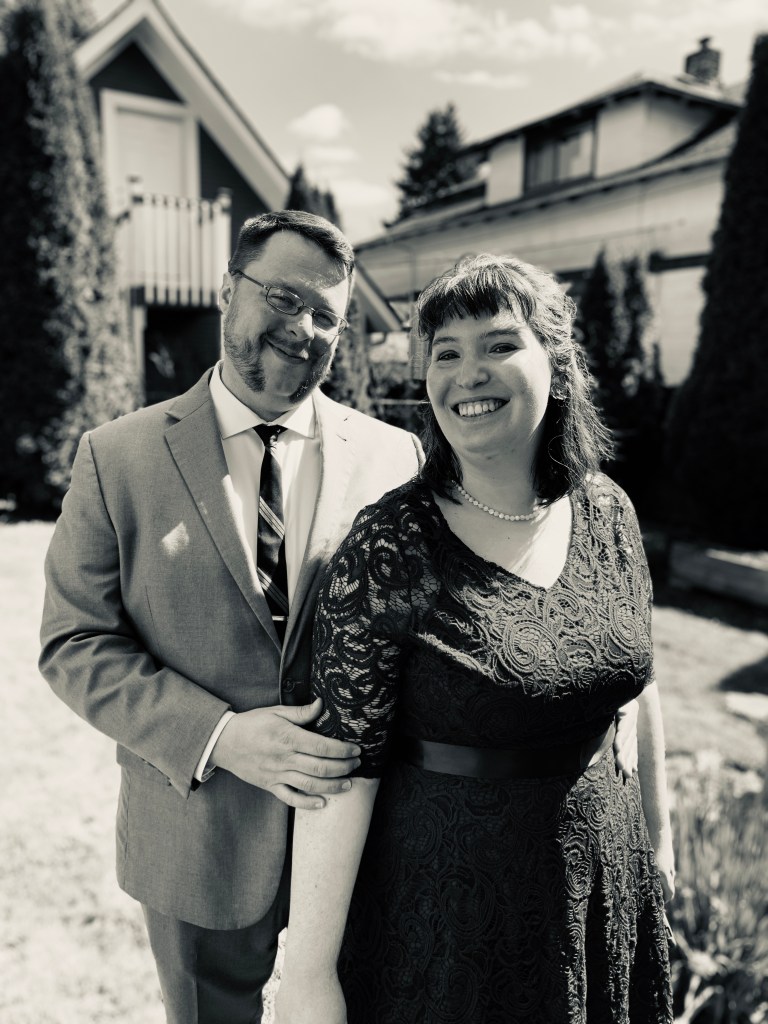
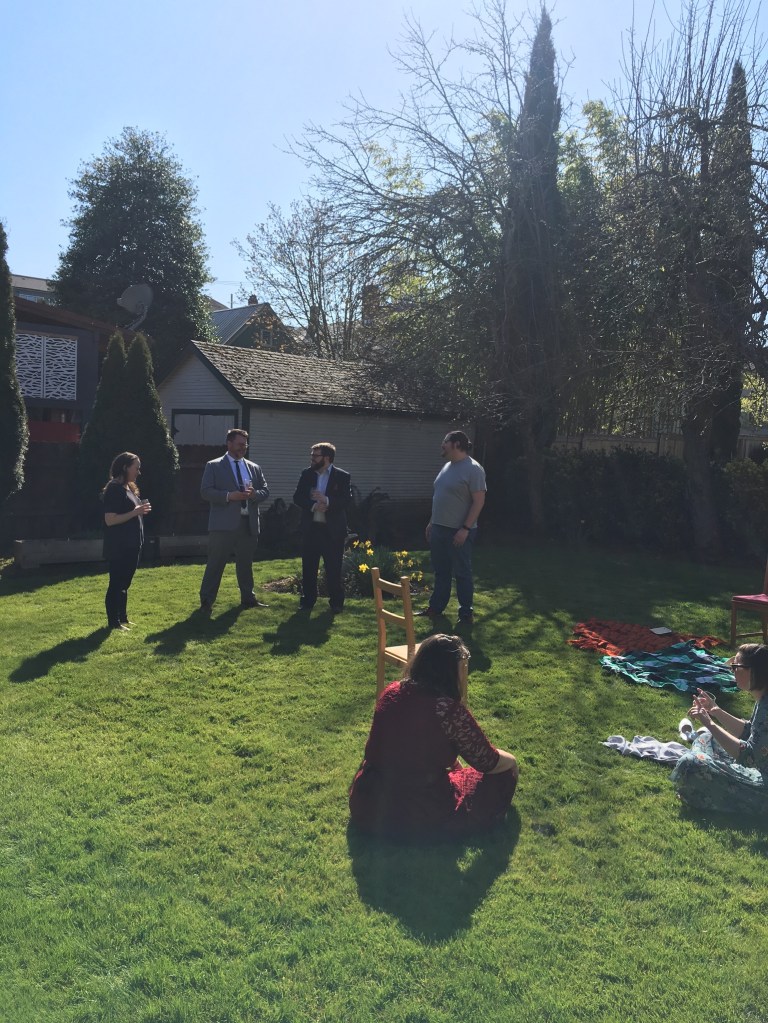
Yesterday, two of my best friends got married to each other. Congratulations, Nick and Celia! It was a totally lovely wedding: seven people present, in plain fresh air on a totally gorgeous day, as beautiful a day as you could dream of in Oregon in March. The grass was grass-green, the sky was sky-blue, and the cherry blossoms were white as wedding dresses.

I love ritual and ceremony. They allow us—“us” being a flexible unit that scales as large as the group observing the ritual or ceremony—to express ourselves through theme-and-variation. Theme-and-variation is one of the basest building blocks of artistic creation, and it exists in every art form. Weddings are a ceremony that have certain very popular elements: a couple, an officiant, vows, rings, a kiss, a party. Every couple decides what to incorporate into their ceremony and what form they take.

For this couple, perfect simplicity: a 10-minute ceremony, photos taken on a cell phone, a handmade cake, a dress ordered online. Each element chosen carefully, but lightly, with no comparison to anything outside its own rightness. Vows written sincerely, spoken in clear strong voice. One witness to laugh, one witness to cry. May you have such authorship and freedom from interference for all of your time together.

Postscript

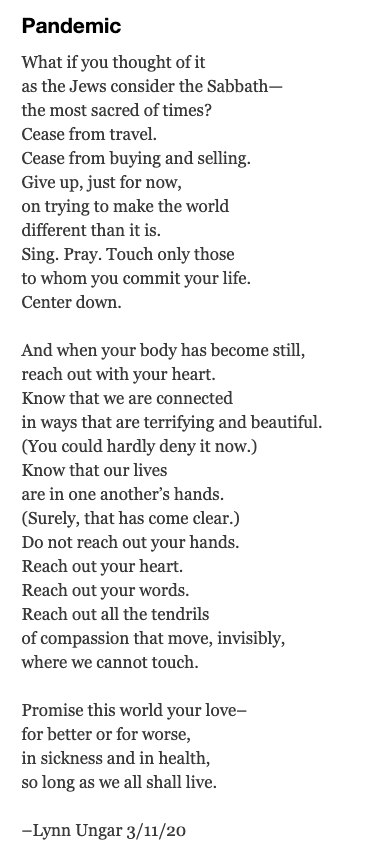
I love the poet’s ability to say things so much more clearly and stylishly than I can. Here’s a poem from Lynn Ungar that captures a lot of what I was trying to say in the last one of these, but much better:

How are you doing? What is keeping your spirits up? If you’ve read this far, please leave a comment.

Coronavirus Diaries No. 1

I have been working from home for the last week and cutting down on socializing (due to an unrelated cold and asthma flare up) for a couple weeks. I have a million ideas of how to use my time, but the unstructured openness of the day makes it hard to focus on any one thing. Working from home feels like neither working nor being home

I’m trying to manage my worry. Entire industries are collapsing, and there is a tsunami of unemployment claims coming. The west coast might be ahead of the country on these measures, but viruses don’t respect state borders and every state that delays responding is going to be hit harder by it in 2-3 weeks. I think it’s possible that we will witness Great Depression-level destruction of the economy.

Oregon has been a half step behind California and Washington in covid cases and public health response, but this week is when the anticipation has become visible. Restaurants and bars have shut down (a big deal here—between coffee, beer, and cocktails it feels like 2/3 of the Portland economy involves pouring liquids). I live on a busy street that usually has two hours of rush hour traffic in the evenings, and it’s been empty.  I have a job, for now, but arts organizations are very vulnerable to recession. My office has felt tense since it became clear that we would need to cancel almost half of our concert season.

I’m doing my best to keep functioning. I make breakfast in the morning. In the absence of free office coffee, I bought beans for the first time in several months and brought my beloved tiny, one-and-a-quarter-mug French press out of storage. In the middle of the day, when I’m feeling bored and antsy after being in my computer chair for too long, I use a jump rope I bought on an impulse. I play video games, I read, I write, I play music. Yesterday I got a tremendous gift from a friend who let me take a long soaking bath in his oversize tub.

I’m not trying to say that everything is so cozy! or wow, isn’t this quarantine kind of like a staycation! I am deeply unsettled right now. When the part of my brain that wants to find the bright side of everything starts to speak up, I have to remind it that we haven’t seen the worst yet, we are still living through the very beginning of this story. What I’m thinking about is how we are navigating a perfect natural experiment in the practice of self-care cut off from the commercial appropriation of the idea.

The writer Tara Brach has a concept she calls “the trance of unworthiness”—a default state of busyness, distraction, dissatisfaction, disassociation, and self-loathing* that defines much of our time, if we let it. Although time goes by quickly without intention, it’s the opposite of a creative flow state. It’s the emotional induced by a society oriented towards trade and; we yield to jobs and technologies that take our time and attention, we work hard for rewards that do not make us feel better or contribute to our growth, and we blame ourselves and the people around us for the eternal discomforts that go along with being alive.

*what are their antonyms? Steadiness, focus, satisfaction, being present, and self-love—­what a great list of virtues to cultivate!

It is not worth the cost that many people are going to pay, but in this brief moment, it seems like the trance is not working. Every daily action, from going to the grocery store to texting your parents to going to work is invested with meaning, danger, and a true understanding of its value to our lives.

Self-care has become a cliché because it has been so successfully coopted by advertising. At the root of the concept is political and economic resistance, though. If the world around you is trying to destroy or oppress you, every act of care that you give to yourself is an act of resistance. It turns out that that’s a big “if” though—big enough to drive an advertising campaign through. Our culture teaches us its most important lesson from a very young age: spending money makes you happy. It establishes a lifelong relationship of cause and effect: when I’m feeling bad, I spend money, then I feel better. Once that lesson and relationship are established, all every company from soap to soda-pop has to do is pull that lever.

But look at where we are! It feels like the world is trying to destroy us. We are being called upon to do something difficult and counter-cultural: stay home, stop spending money, stop socializing in person, be with yourself. We have suspended one of the most powerful parts of our economy: paying other people to distract us from ourselves and make us feel better.

When we develop an understanding of how we can meet our own needs, that relationship to the self is so strong that no commercial interest can exploit it. Feeling good in our own bodies, feeling fulfilled by our work, feeling connected to our relationships, these are all so particular to our individual selves that no product can perfectly fill that need. The satisfaction and strength that we feel when we fill our own needs have so much integrity that we can’t be lured into dissatisfaction.

I think that we are at the beginning of a very difficult few months or years. There is a lot of death coming. We will need to adapt to the need for extended distancing until effective vaccines or medical treatments come into use. There is a possibility that our political institutions are too broken to meet this moment, and if that is the case we may be in for an extended economic depression. Finding ways to meet our own needs and the needs of our close kin and friend communities is going to be a survival skill.

I want to hear about what needs you are discovering and what ways you are discovering to fill them. I’m OK, and I hope that you are OK too.
sharon van etten

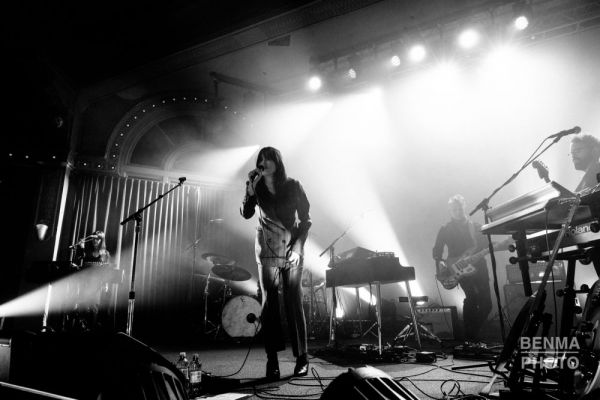
Last night I went to see Sharon Van Etten at the Crystal. Seeing music there is a little dicey because the proportions of the room make me uncomfortable, and as much as I want to enjoy myself, a full 1/3 of my brain is tied up tamping down my claustrophobia.

I went with somebody with an extra ticket, and I wasn’t very familiar with her music beyond some cramming on my drive home from work. There’s something nice about coming fresh to someone in concert. I may have not had the sweet anticipation of her super-fans, the ones who had been waiting five years for new music and were losing their minds, but I think that is balanced by an openness to the new material.

She came out in a gray trouser suit, double breasted and with pinstripes that echoed wartime fashion to me. During the first song, the thin material shook with nerves for just a second. Her voice was swooping, somewhere in the neighborhood of Florence Welch and Stevie Nicks. At first, she hid behind long black bangs, mumbling and moaning into the microphone, stomping chunky black heels and feeling the beat by slapping her legs. Over the course of the set, she loosened up. During “Seventeen,” a track on her new album–so many great songs about that age: “Edge of Seventeen”, “Anthems for a Seventeen Year Old Girl” “Dancing Queen”, “It Was a Very Good Year”–there is this climactic line, I know what you’re gonna be, where all of the sudden she dropped into a new gear of energy and rage and betrayal and power and screamed, and the crowd screamed back because the song speaks to the part of us that is hurt that we all thought we would be different, and we really weren’t, or at least not in the way our seventeen year-old selves thought we would be, those idiots.

(My seventeen year old self would have hated me forever for calling him an idiot, and he’s not wrong, one day one of us will finally kill the other.)

How cool are bands? People that get together to play music. That’s what I was thinking. I was close enough to the stage to see their faces, to see when patches were switched, when folks tuned in breaks, furtive hand signals to the sound guy. It seemed like they were having a great time.

No. 8 – Overlook

Overlook

The emotions of childhood are like the great floods that create canyons and ravines; future flows of water and ice will shape the geography, but it’s major features have been set.

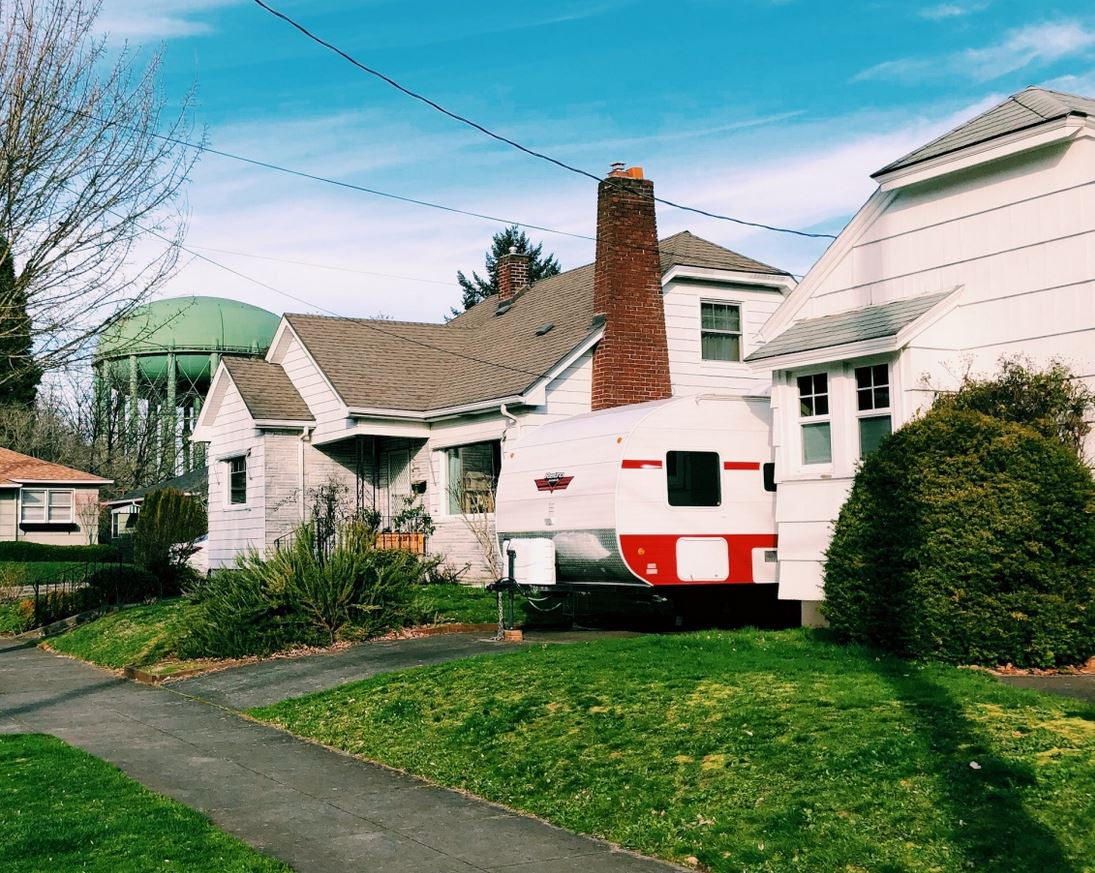
Please check out my newest photo set on VSCO. Photos taken in the Overlook neighborhood of NE/North Portland.

Dumpling

Gentle reader, I find myself once again ill.

After dealing with pneumonia this winter, to feel so weakened by a simple cold feels like an insult. 

My grandmother was a great lover of talking about her illnesses. I found it very boring, so I’ll shut up now.

So, I guess I should be careful about shutting the door on a day before it’s finished. After yesterday’s perfunctory update, my sister chatted me which turned into an hour-and-a-half conversation about motivation, personal growth, what it means to finish things and finish things well, and explore some of the personal revelation/resolution territory that I’ve been in for the past week. We discussed Carol Dweck’s Mindset, which has been my jam over the last six months. It was strange to see her come at some of the same problems that I worried about as a student. I don’t think I’m that much further along in untangling my own human contradictions than she is, but it was interesting to hear her articulate ideas that I’ve had before but now think of as dead ends. For example, I no longer think about my own “motivation” or “laziness,” and tend to see my good and bad habits and desired and undesired behaviors as a product of feedback that feels good or other conditions. That’s really wordy: basically, I’ve stopped beating myself up about being lazy when there is another obvious explanation, like fear or lack of feedback, or lack of self-confidence. 

One of my goals for the new year was to work on the relationship I have with my brother and sister, and I am so happy that we are all talking right now.

I slept in and was a little late getting in to work in the morning. Our work phone has been down for three weeks—it’s so embarrassing that there seems to be no person in the whole organization with the combination of competence and authority to get a simple thing resolved—and I was so demoralized to be at work. It’s been a rough winter after a rough summer, and I have so little confidence in my workplace right now I’m starting to make myself crazy with how much I want a new job. As I was setting up the room for the day, I called my mom. I started to talk about where my head has been with trying to give myself room to dream of new possibilities (I know that’s all very vague, but I’m not yet ready to write even semipublicly about it yet). It ended up being a very raw and open conversation about some of the things that had happened to me as a teenager that made me a much more fearful person than the fearless child I had been. I got very emotional when she said to me that she thought that I deserved to go after what I wanted, to chase after dreams.

I got very excited about Portland’s first Dumpling Week. I’m still waiting to see if it’s going to be affordable, the only reason I could try Burger Week burgers is that prices were set at $5. One of the commenters on the Facebook announcement remarked on the fact that there were no restaurants east of 82nd on the list. [For out of towners, the area of Portland east of 82nd Avenue is where most of the recent Asian immigration has moved to.] At first, I resisted that critique, because its clearly an effort to support a fine dining scene, and it just doesn’t bother me that restaurants in a certain cost range, fanciness, and food aesthetic were selected to participate. At the same time, I thought about how the cruelty of this kind of appropriation is that the white majority sees a subcultural product/object/tradition/design, copies its most superficial aspects in a game of cultural telephone, then siphons away the profits from that subculture. But then I was thinking that a) the idea that any one culture could own a food form like the dumpling is ludicrous. b) the dumplings are just not the same. I understand wanting to identify with the romanticized family restaurant that’s making grandma’s dumplings and nobody cares and the big bad white haute cuisine restaurant across the river makes the same thing and everybody goes apeshit. But that’s not reality. The reality is that those restaurants have completely different ways of communicating about food, sourcing ingredients, presentation, restaurant design, and pretending like all that stuff isn’t important or meaningful is silly. Nevertheless, I’ve been thinking about it all day and don’t feel like I have an “answer.”

Speaking of race and culture, I was hit with two very interesting pieces that dealt with race and classical music in a way that made my soul hurt a little bit. The first was an essay on Wagner and anti-Semitism. I’ve never liked Wagner, there’s plenty of other composers to listen to, I find most of his aesthetic very creepy, and there’s something about his arrogance at claiming that all people must love his music that makes me resist it. Anyway, the choice that the essay tries to force is: either you believe that abstract music, just sound, has the ability to convey a spiritual message, in which case Wagner’s music itself, even that without words, is anti-semitic and abhorrent. Or, as much as we talk about why we love the music, music is incapable of carrying that kind of message and to speak of it as though it is is deceptive/cultish. Read it, if any of that sounds interesting. The second was a Jezebel post about a black woman that had a racist interaction with an older white patron at the Met during a production of Aida. The interaction, whatever. Racist, and shameful that she got no support from the ushers, but racist individuals can be rude anywhere. The part that broke my heart was that she is so completely right about the racist casting conventions of major opera houses. They are decades behind film and TV, neither of which are particularly good at imagination and casting or representation. The other thing that upset me is that if that happened to me, I would never go back.

Work was fine. I lost steam throughout the day, and by the end of the day I was completely burnt out from feeling sick. I got home and downloaded a bunch of new music to listen to, but mostly just dozed. Hopefully tomorrow isn’t too bad.