Twitter: “IOC considers postponing 2020 Tokyo Olympics.” Fox News: “Aid talks at standstill as McConnell, Dems argue over sticking points in stalled spending bill.” New York Times: “Partisan divide threatens deal on rescue bill.” Oregonian: “Veteran with coronavirus dies a Lebanon nursing home, bringing Oregon death toll to 5.”]
The Wedding
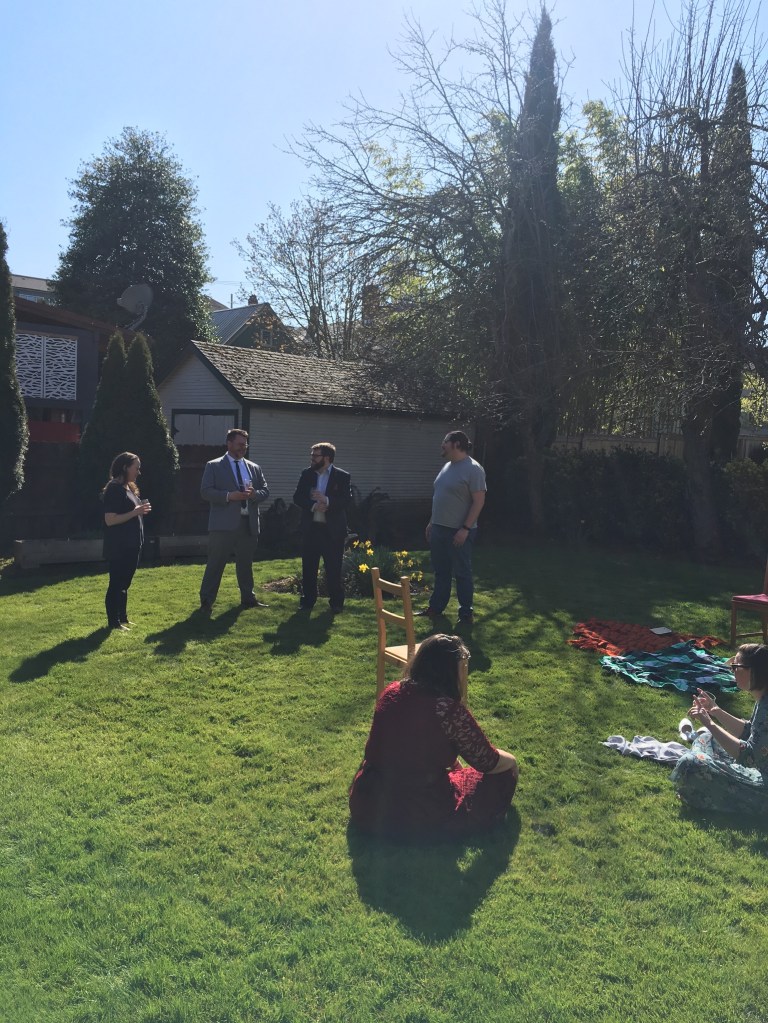
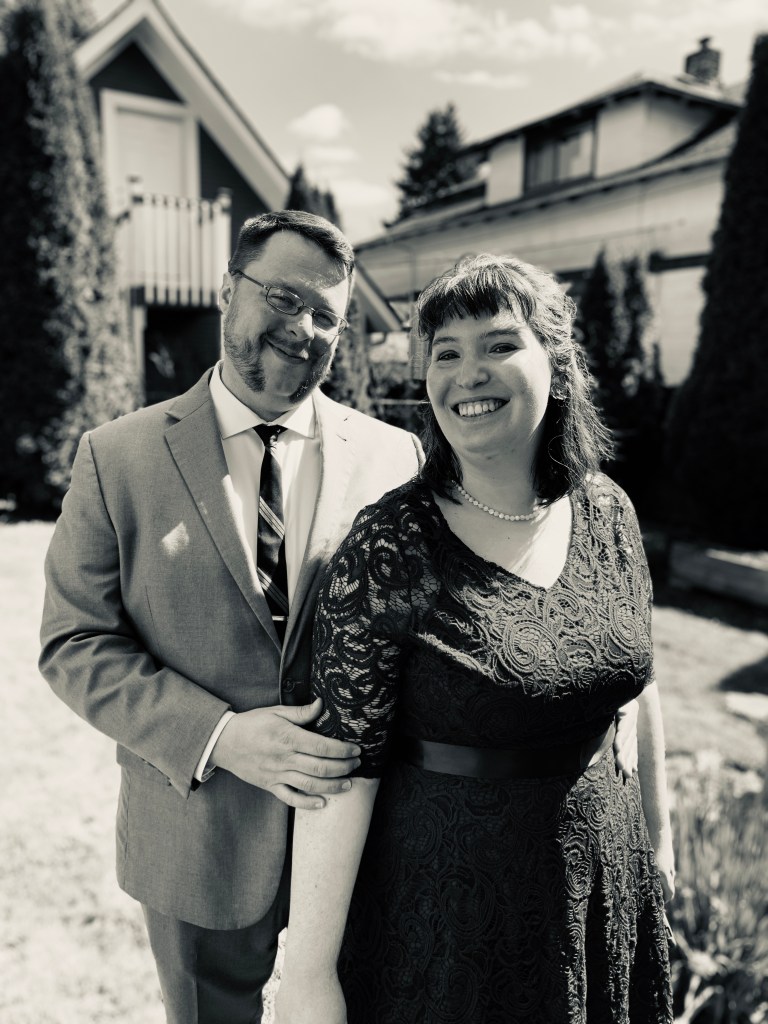
Yesterday, two of my best friends got married to each other. Congratulations, Nick and Celia! It was a totally lovely wedding: seven people present, in plain fresh air on a totally gorgeous day, as beautiful a day as you could dream of in Oregon in March. The grass was grass-green, the sky was sky-blue, and the cherry blossoms were white as wedding dresses.
I love ritual and ceremony. They allow us—“us” being a flexible unit that scales as large as the group observing the ritual or ceremony—to express ourselves through theme-and-variation. Theme-and-variation is one of the basest building blocks of artistic creation, and it exists in every art form. Weddings are a ceremony that have certain very popular elements: a couple, an officiant, vows, rings, a kiss, a party. Every couple decides what to incorporate into their ceremony and what form they take.
For this couple, perfect simplicity: a 10-minute ceremony, photos taken on a cell phone, a handmade cake, a dress ordered online. Each element chosen carefully, but lightly, with no comparison to anything outside its own rightness. Vows written sincerely, spoken in clear strong voice. One witness to laugh, one witness to cry. May you have such authorship and freedom from interference for all of your time together.
Postscript
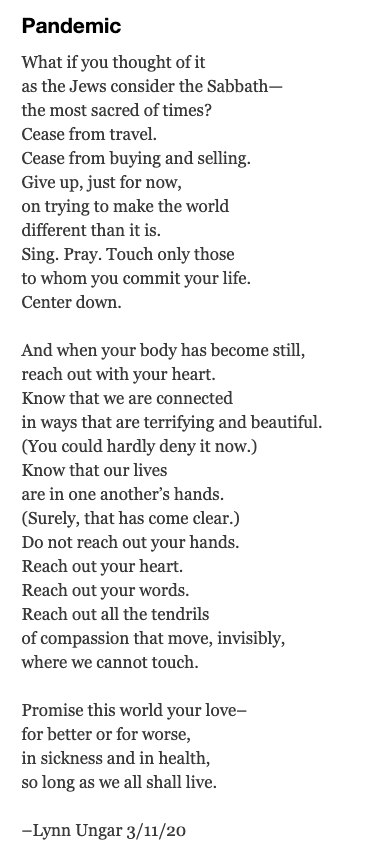
I love the poet’s ability to say things so much more clearly and stylishly than I can. Here’s a poem from Lynn Ungar that captures a lot of what I was trying to say in the last one of these, but much better:
How are you doing? What is keeping your spirits up? If you’ve read this far, please leave a comment.
I have been working from home for the last week and cutting down on socializing (due to an unrelated cold and asthma flare up) for a couple weeks. I have a million ideas of how to use my time, but the unstructured openness of the day makes it hard to focus on any one thing. Working from home feels like neither working nor being home
I’m trying to manage my worry. Entire industries are collapsing, and there is a tsunami of unemployment claims coming. The west coast might be ahead of the country on these measures, but viruses don’t respect state borders and every state that delays responding is going to be hit harder by it in 2-3 weeks. I think it’s possible that we will witness Great Depression-level destruction of the economy.
Oregon has been a half step behind California and Washington in covid cases and public health response, but this week is when the anticipation has become visible. Restaurants and bars have shut down (a big deal here—between coffee, beer, and cocktails it feels like 2/3 of the Portland economy involves pouring liquids). I live on a busy street that usually has two hours of rush hour traffic in the evenings, and it’s been empty. I have a job, for now, but arts organizations are very vulnerable to recession. My office has felt tense since it became clear that we would need to cancel almost half of our concert season.
I’m doing my best to keep functioning. I make breakfast in the morning. In the absence of free office coffee, I bought beans for the first time in several months and brought my beloved tiny, one-and-a-quarter-mug French press out of storage. In the middle of the day, when I’m feeling bored and antsy after being in my computer chair for too long, I use a jump rope I bought on an impulse. I play video games, I read, I write, I play music. Yesterday I got a tremendous gift from a friend who let me take a long soaking bath in his oversize tub.
I’m not trying to say that everything is so cozy! or wow, isn’t this quarantine kind of like a staycation! I am deeply unsettled right now. When the part of my brain that wants to find the bright side of everything starts to speak up, I have to remind it that we haven’t seen the worst yet, we are still living through the very beginning of this story. What I’m thinking about is how we are navigating a perfect natural experiment in the practice of self-care cut off from the commercial appropriation of the idea.
The writer Tara Brach has a concept she calls “the trance of unworthiness”—a default state of busyness, distraction, dissatisfaction, disassociation, and self-loathing* that defines much of our time, if we let it. Although time goes by quickly without intention, it’s the opposite of a creative flow state. It’s the emotional induced by a society oriented towards trade and; we yield to jobs and technologies that take our time and attention, we work hard for rewards that do not make us feel better or contribute to our growth, and we blame ourselves and the people around us for the eternal discomforts that go along with being alive.
*what are their antonyms? Steadiness, focus, satisfaction, being present, and self-love—what a great list of virtues to cultivate!
It is not worth the cost that many people are going to pay, but in this brief moment, it seems like the trance is not working. Every daily action, from going to the grocery store to texting your parents to going to work is invested with meaning, danger, and a true understanding of its value to our lives.
Self-care has become a cliché because it has been so successfully coopted by advertising. At the root of the concept is political and economic resistance, though. If the world around you is trying to destroy or oppress you, every act of care that you give to yourself is an act of resistance. It turns out that that’s a big “if” though—big enough to drive an advertising campaign through. Our culture teaches us its most important lesson from a very young age: spending money makes you happy. It establishes a lifelong relationship of cause and effect: when I’m feeling bad, I spend money, then I feel better. Once that lesson and relationship are established, all every company from soap to soda-pop has to do is pull that lever.
But look at where we are! It feels like the world is trying to destroy us. We are being called upon to do something difficult and counter-cultural: stay home, stop spending money, stop socializing in person, be with yourself. We have suspended one of the most powerful parts of our economy: paying other people to distract us from ourselves and make us feel better.
When we develop an understanding of how we can meet our own needs, that relationship to the self is so strong that no commercial interest can exploit it. Feeling good in our own bodies, feeling fulfilled by our work, feeling connected to our relationships, these are all so particular to our individual selves that no product can perfectly fill that need. The satisfaction and strength that we feel when we fill our own needs have so much integrity that we can’t be lured into dissatisfaction.
I think that we are at the beginning of a very difficult few months or years. There is a lot of death coming. We will need to adapt to the need for extended distancing until effective vaccines or medical treatments come into use. There is a possibility that our political institutions are too broken to meet this moment, and if that is the case we may be in for an extended economic depression. Finding ways to meet our own needs and the needs of our close kin and friend communities is going to be a survival skill.
I want to hear about what needs you are discovering and what ways you are discovering to fill them. I’m OK, and I hope that you are OK too.
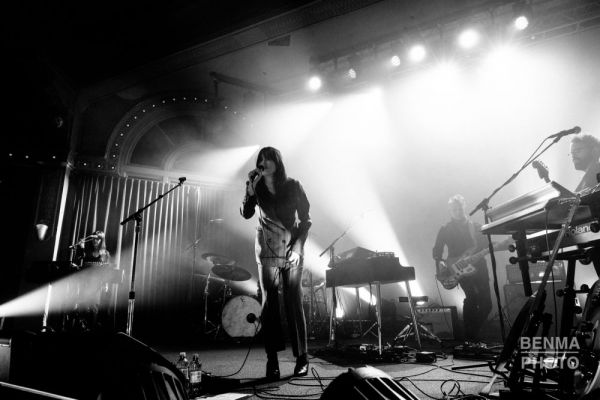
Last night I went to see Sharon Van Etten at the Crystal. Seeing music there is a little dicey because the proportions of the room make me uncomfortable, and as much as I want to enjoy myself, a full 1/3 of my brain is tied up tamping down my claustrophobia.
I went with somebody with an extra ticket, and I wasn’t very familiar with her music beyond some cramming on my drive home from work. There’s something nice about coming fresh to someone in concert. I may have not had the sweet anticipation of her super-fans, the ones who had been waiting five years for new music and were losing their minds, but I think that is balanced by an openness to the new material.
She came out in a gray trouser suit, double breasted and with pinstripes that echoed wartime fashion to me. During the first song, the thin material shook with nerves for just a second. Her voice was swooping, somewhere in the neighborhood of Florence Welch and Stevie Nicks. At first, she hid behind long black bangs, mumbling and moaning into the microphone, stomping chunky black heels and feeling the beat by slapping her legs. Over the course of the set, she loosened up. During “Seventeen,” a track on her new album–so many great songs about that age: “Edge of Seventeen”, “Anthems for a Seventeen Year Old Girl” “Dancing Queen”, “It Was a Very Good Year”–there is this climactic line, I know what you’re gonna be, where all of the sudden she dropped into a new gear of energy and rage and betrayal and power and screamed, and the crowd screamed back because the song speaks to the part of us that is hurt that we all thought we would be different, and we really weren’t, or at least not in the way our seventeen year-old selves thought we would be, those idiots.
(My seventeen year old self would have hated me forever for calling him an idiot, and he’s not wrong, one day one of us will finally kill the other.)
How cool are bands? People that get together to play music. That’s what I was thinking. I was close enough to the stage to see their faces, to see when patches were switched, when folks tuned in breaks, furtive hand signals to the sound guy. It seemed like they were having a great time.
The emotions of childhood are like the great floods that create canyons and ravines; future flows of water and ice will shape the geography, but it’s major features have been set.
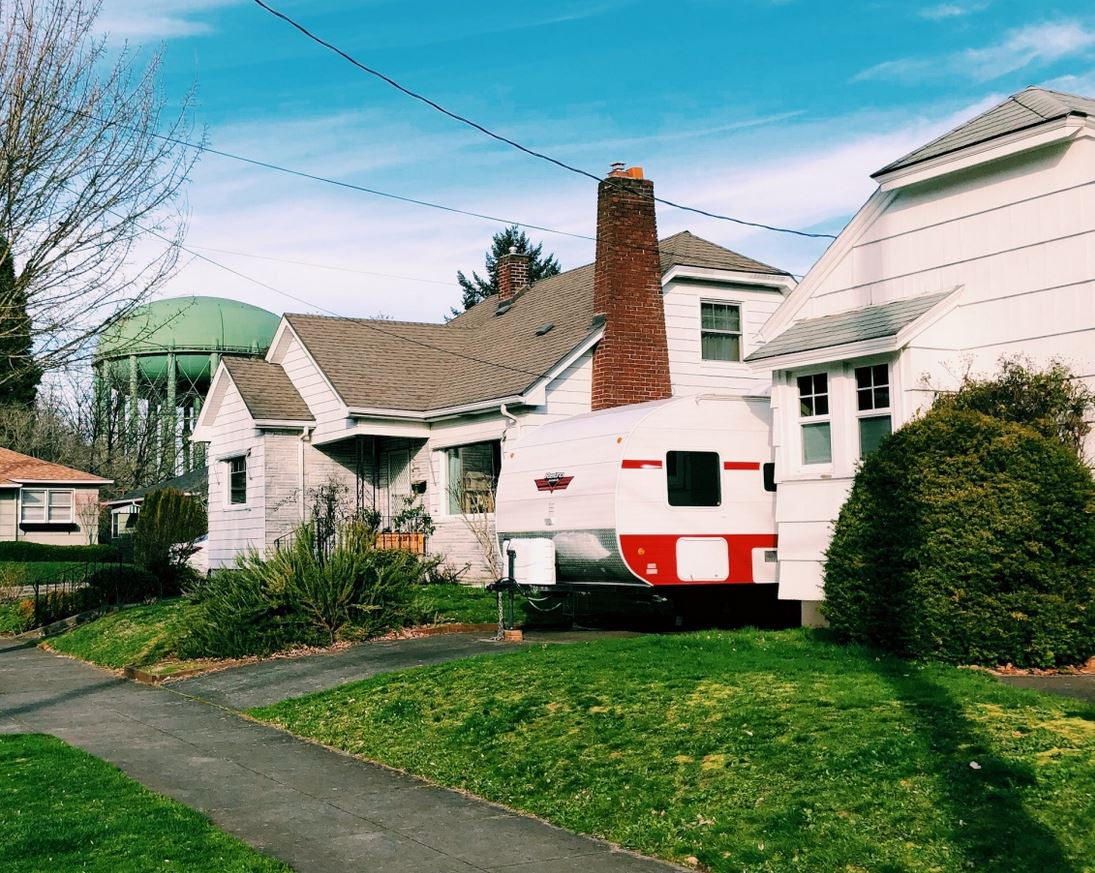
Please check out my newest photo set on VSCO. Photos taken in the Overlook neighborhood of NE/North Portland.
This one is going to be from a place of frustration. I learned today that I didn’t get a job that I really wanted. I thought it would be a good fit, and I was looking forward to that new-thing, this-is-going-to-change-everything feeling. “You only like the beginnings of things,” as Faye Miller tells Don Draper.
So I’m a little busted up about that. Yesterday was a bizarre Waiting For Godot experience while I was waiting to hear, and I think subconsciously I knew that even if I got the job it wasn’t going to be the easy, fairy tale version of that story anyway, and so I feel more tired and empty about it than sad.
All that being said, I’ve had some amazing experiences in the last few days that I haven’t had the time to process or reflect on, so this post is going to be a little raw, a little messy, and a little stream-of-consciousness.
A Stranger Walks Into Town
A few days ago I got a text that my aunt was coming into town for a job interview. This was the first I had heard that she would be in town, and the first I heard that she might be moving into town. We had a very nice two day visit, in which I got to show off my new city and the things I’ve discovered in it, and she got a chance to get used to me, the “a and not-a;” both the same and different person that left California and knows things and knows things that she doesn’t know sometimes. We had two fantastic meals together, best meals in a long time for both of us.
I have been avoiding being a Salt & Strawperson for years, but ever since going with Jesus Christ and his friends a few weeks ago, I’ve been dying to have people in town to visit with. I love their Strawberry/Balsalmic/Cracked Pepper ice cream so much, and its going to be a temptation forever for me to just get the same flavor every time (for example, this time I got an Almond Ganache that was delicious, but I’d rather have had the Strawberry). My aunt was overloaded with consumer choice, and the takes-everything-too-seriously focus on radical quality that is Portland’s stock in trade, but I was pretty amused too. After walking around 23rd, Washington Park, and stopping over at Powell’s, we went to Pok Pok.
A five minute wait for Pok Pok! Oh, truly the stars were aligned for us. It was delicious as always (I used my aunt being from out of town and married to a guy that hates fish to order the fish sauce wings). Their basil drinking vinegar was super delicious too. I’d never sat in the upstairs area, and it makes me wonder just how nuts people thought Ricker must have been when he remodeled the house that’s under there. We had a delicious dish of spicy fiddlehead ferns that I thought was so cool, both from a produce perspective and conceptually, as northwest fusion food.
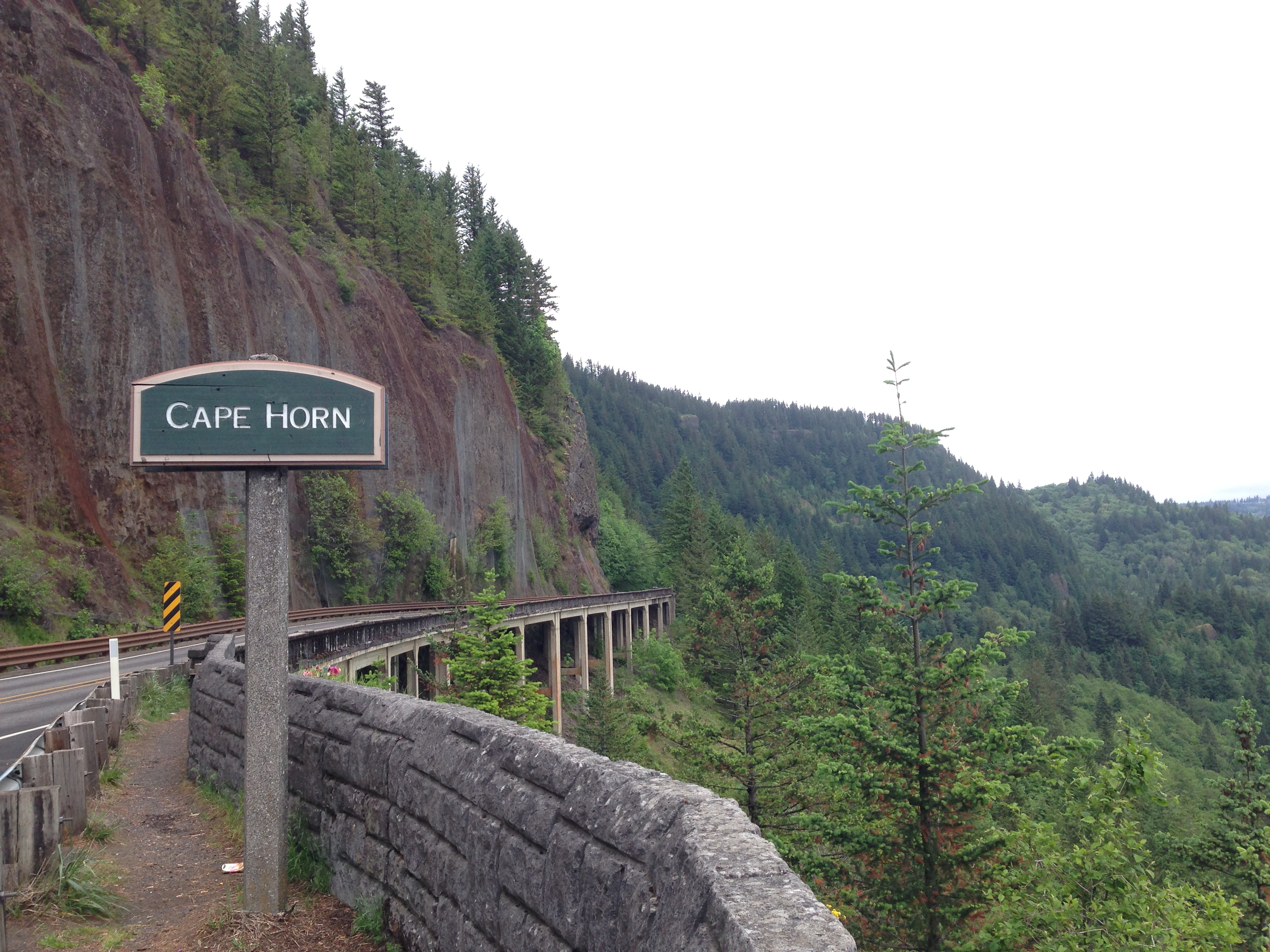
Cape Horn-Skye
The headphone jack on my phone is busted, and the road noise in the blue club van is nothing compared to the asthmatic vacuum whine of the engine. Given the choice between peaceful solitude and the unyielding chatter of talk radio and podcasts, I choose the chatter every time. The steady flow of ideas, arguments, and the New takes me away from the stupid waste of my day, from my cheap uniform, from my body completely.
The road to the school I’m visiting is filled with the windy switchbacking roads that remind me of the highway between Santa Paula and Ojai. There, as here in Washington, newcomers pull off as locals whiz by at breakneck speeds. Every turn was a surprise, as the road is enclosed inside the tall cathedral spaces under the pines.
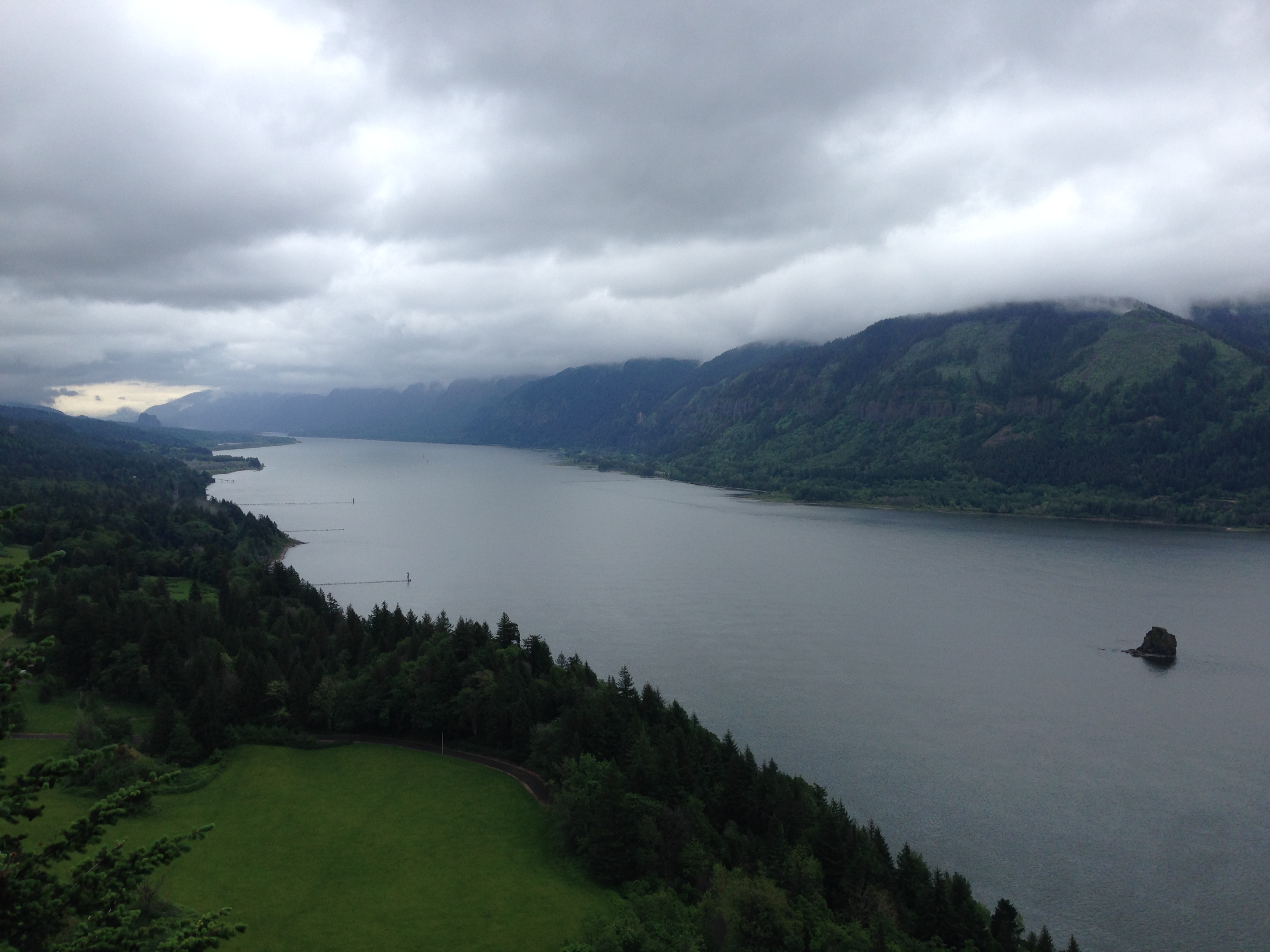
I drive around one corner of the road and find a view so beautiful that I have to pull over in my rattletrap van to take it in, just for a second. I feel a little foolish, pulling off in my blue exclamation point of a van (LENTS FEED AND SEED, reads the peeling sponsor logo on the side), but I figure that anybody that notices is probably proud that their backyard can create such a reaction. The bruised and brooding sky is all gray light, light gray highlights and dark gray shadows play in the gray clouds and are mirrored on the surface of the gray water. It reminds me of a church, or else it reminds me of Ingmar Bergman reminding me of a church. There are old, stylish concrete pylons holding up the highway above the dramatic drop into the Gorge, and the cliff face is held back from sweeping away the road by rusted chain-link nets.
The school I was visiting was Canyon Creek Middle School, connected directly to the beautifully named Cape Horn-Skye school (in Skamania County, no less, another great name). I was curious later about the name of the school, because of the hyphenation (both for the spelling of “Skye” rather than “sky,” and also because it was pretty unusual to me that a name would be hyphenated with a place name). When I looked it up later, I found out that Cape Horn-Skye is the last incarnation of the two Skye Schools, which pioneers organized and built on the leading edge of the American frontier.
Chef’s Table
I’ve been fascinated by the Netflix documentary series Chef’s Table, from the filmmaking team that created Jiro Dreams of Sushi. We live in an incredible age of documentary film. I’m just spitballing, but I imagine that part of the reason it is so good is that:
We are at the end of an incredible growth period as documentarians have borrowed styles and techniques from feature films, and in some ways leaped past them.
There’s an understanding on the part of the subjects that there is a potential for something great to come from the project, meaning that the right team can get very open and vulnerable (and, to be sure, media-savvy) subjects to cooperate.
Digital video equipment has become better and smaller and faster and cheaper, meaning that there is a possibility of getting footage from smaller places, like a kitchen during dinner service.
I’m fascinated by the way that each restaurant, each service, each menu, is conceptual art. Like anything else, most of them do fall into types: fast food, casual Mexican, upscale American bistro. But each restauranteur or chef makes choices about how the kitchen works as a team, about what the relationship to the food is, to how the relationship is with the customer. I love hearing chefs talk about the choices they make.
It makes me think about classical music (I don’t usually, I gave my ears a break after graduating college and ever since it’s something that I know I’ll come back to listening but I don’t think its the kind of music that I want to make). What if each orchestra made unique decisions about the relationship between the conductor and the players, or the orchestra, the venue? What if musical institutions made their brand on reinventing and exploding standards, like Massimo Bottura, or an opportunity to educate towards a better future, like chef Dan Barber?
The other thought I had was about the kitchen brigades of the featured chefs. For (not very hard to understand) reasons, I’ve been thinking a lot about work, excellence, and shared purpose. One side effect of the radical second person perspective of these documentaries, in which nobody but the featured chef and one or two others—critics, associates, or family members—is allowed to speak, is that the supporting cooks and chefs that make up the kitchen become silent acolytes, bowing at each station, intoning the mantra of “Yes, chef” (or in Dan Barber’s kitchen, more creepy, a slower and full throated “Yes”). Even the radical closeups of food and hands means that the people attached to those hands blur into the shadowy background. I kind of get it. Restaurant work has always struck me as the worst kind of repetitive (maybe not the creative side of it, but for sure the cleaning and prepping side of it), but I understand finding yourself in a place where excellence is chased beyond all human proportion and every day is a real opportunity to figure out something new, and never wanting to leave. I was once talking with a friend, a tremendous musician and all around good guy, who had just started at an organic farm. This friend was commuting by bicycle just to get to a transit station where he could get a ride to work, for fairly low pay. He was explaining that one of the couple that owns and runs the farm made lunch every single day and all of the workers ate together, and how that one thing makes him want to stay forever. “It’s the most humane workplace I’ve ever been in,” he told me.
A Stranger Walks into Town, Part II
On our second evening, we went for a late dinner at ClarkLewis, my favorite restaurant in the city. We were one of the last tables seated, and my aunt was Into It. The menu sent her into overload, as she wanted to ask about every ingredient of every dish, appetizer and cocktail. Fortunately, we were matched with the perfect waiter, a thin, ropy man in his ’50s with a city drawl that unfurled at its own pace. He was full of helpful aphorisms. On the tagliatelle: “Pasta…is pasta. As for me, when I go out, I order lamb.” On the delicious looking Pimms and gin cocktail: “You know these kids keep thinking they’ve reinvented the wheel. I’m fifty-four years old. I’ve already lived through the razzle-dazzle. It’s not rocket science—you start with your base spirits, add a nice mixer, then some bitters and a garnish. I’m sure it’s a nice little sipper. But as for me, I like to try the base spirit, and if I like it, I order a shot.” She had lamb, I had a delicious sturgeon. Both were the best thing I’ve ever tasted. We finished up with dessert at Pix, and I had the best frothy cheesecake confection with basil ice cream. I love aromatic food and drinks, herby and delicious.


 hammer & jack