Veneno

Veneno is a bio-drama miniseries from Spain about La Veneno—a trans hooker who was “discovered” by a TV tabloid show in the mid 1990’s and who became a hypersexualized, circus figure on talk shows. For a younger generation of trans women, she was a representational icon at a time where there was no room for anything but ridicule for them in Spanish society. Veneno dramatizes both La Veneno’s life, and the coming out and transition of a young teen fan that idolizes her and with whom La Veneno publishes a memoir, bringing her back to media attention in the weeks before her untimely and mysterious death.

Marcos Sotkovszki as a young Veneno in Veneno on HBO Max

Veneno takes several strains of queer TV/film aesthetics and turns up the volume and executes them very well. Operatic set pieces, bright and postmodern set designs and surreal storytelling devices from gay auteurs like Russel T. Davies, Pedro Almodóvar, and Ryan Murphy mark emotionally important moments in Veneno’s life. There is a commitment to queer actors playing queer parts and incorporating members of the communities depicted on screen, as in queer shows like Vida and Work in Progress. There’s some exploration of how queerness moves around in families across generations from Transparent, and the beautiful rush and heartbreaking pain that comes with depicting mental illness from close up and on the inside from Eurphoria and I May Destroy You. These are my points of reference, all excellent.

Isabel Torres as La Veneno and Paca la Piraña as herself in Veneno on HBO Max


Veneno is often beautiful—you can see the set design budget stretched when sets are reused one too many times, but everyone looks great—and there are several moments where costuming choices took my breath away, like when we first see teenage Veneno’s outfit to wear to a village festival. The writing is strong too, although there’s only so much I can say about that given that I am watching in a subtitled translation. Some emotional notes are hit a little too often for me, particularly in montages of the young trans writer, Valeria, gazing adoringly at Veneno, but any bum notes are saved by the incredible talent on screen. Highlights in the cast include Marcos Sotkovszki, Jedet, and Isabel Torres, who all play La Veneno at different ages, Paca la Piraña, Veneno’s longest friend and appearing as herself, Lola Rodriguez playing Veneno’s young disciple Valeria, and Lola Dueñas who plays the amoral TV producer that first finds La Veneno.

Lola Rodríguez as Valeria, Isabel Torres as La Veneno, and Paca la Piraña as herself in Veneno on HBO Max


Veneno was a charismatic monster to Spanish TV audiences in the 90’s, and she’s a bit of one now. Her understanding of queerness and sexuality, her love of commoditizing and sharing her body, her hunger to be objectified, these are all uncomfortable traits for queer heroes as we round into 2021. We are not supposed to so nakedly hang our self esteem on how we are desired by men. It has taken a whole apparatus of corporate gay organizations to send the message that being queer is not synonymous with risky sex, sex for money, sexual violence, mental illness and drug addiction, but these were all important parts of La Veneno’s story. At the end of her life, all of her friends that loved her wished that she had a different life. We get a sense of the arc of her whole life, how she hungered for safety and love in every chapter of her life. She didn’t often get it, and we have a chance to give her some of that love in death. She made for great television, and it appears that she still does, and we as viewers have to sit with that knowledge too. 

other voices

hey there mister bisexual

Processed with VSCO with c1 preset

It is bi visibility day. One lovely thing about bisexuals is that—because it’s a tricky identity to wrap your head around—although folks come out as gay and lesbian according to a more or less microwave popcorn distribution centered around late high school and young adulthood, folks seem to steadily come out as bi as they assimilate that self-knowledge into the life and relationships they have.

I identified in high school as bisexual, but in college that didn’t last very long. I got really in my head about whether I was adopting the label because I was afraid to identify as gay, something that felt more taboo in the religious context I was raised in (more on that in a bit). In college I decided that because my attraction leaned heavily towards men, I might as well identify as gay and at the time it brought me a lot of satisfaction.

If the process of creating myself has been imperfect and absurd, coming to terms with my sense of desire has been downright chaotic. Boxes, labels… when we are looking for words to tell us who we are, they can be extremely helpful. Being named can help us feel less alone and make us feel like others who are like us have lived and have had meaningful lives. They are only ever shortcuts to self-understanding, though, and in the best case scenario, where they help you grow, one eventually grows out of them.

Once I put away some of my issues around body shame and being outside of the beauty ideal—a fucked up hierarchy that has so much power invested in it, particularly by gay men—I was able to rediscover my sense of play and exploration in regards to sexuality. It’s painful to think about how grim and serious my mental models for sex were 10 years ago. It was a hunger that could only be satisfied by metaphorically feeding off of, taking away from, someone else and (at best!) letting them feed off of you. Each the only one to see the true face of hunger. It was not a popular offer! Once I was able to trust others a little better and believe more in my own capacity to give pleasure, a whole different attitude that was light and playful and improvisatory and spontaneous and experimental opened up, and with that came better sex.

And an interest in exploring bodies other than cis men.

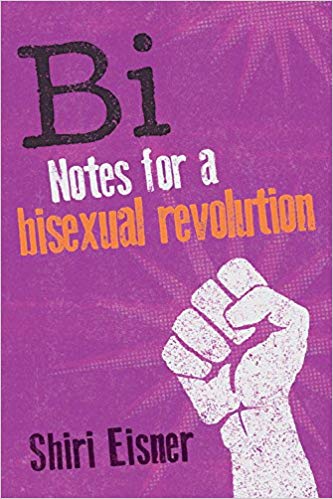
I think that I would have been fine with the (imperfect, contradictory) identity of “gay man who sometimes has sex with women sometimes and is pretty indifferent to the continuing decoupling of sex and gender,” but reading through Shiri Eisner’s Bi: Notes for a Bisexual Revolution. In addition to going through some of the negative stereotypes of bisexuals in media—the vampire/serial killer/sociopathic/hedonist, the bi-until-graduation, I Kissed A Girl And I Liked It—Eisner points out that bisexuals are particularly destabilizing to patriarchal values because every deviation from its rules is a choice. It’s true that there are not very many visible bi male icons, and there is nowhere near the level of definition about what their (our) role is in society, much less than the roles of straight man or gay man.

I’m still figuring out what it means to be bi in practice. I’m happy to be visible, to be counted, to surprise anybody that has known me for a long time and people who form expectations instantly when they meet me alike. If I can open up the idea that the world around you is messier and more complicated than it looks on the surface, that’s a good day’s work done.

Juliet Takes a Breath

Juliet Takes a Breath, Gabby Rivera

To begin, a little disclaimer: If there are readers that see themselves in Juliet and take strength in her journey, I want to honor that. If there are white readers out there that are able to see themselves through an outsider’s eyes through this story, I think that’s a valuable thing too.

As a piece of writing, however, Juliet is very mixed in quality. For all of the time that we spend in Juliet’s head, I never came away with that deep an understanding of what shaped her attitudes towards gender and sexuality in the 19-ish years of her life before the events of the book take place. Despite being based on a set of meaningful real experiences, the observations of Portland, Oregon or the Bronx, of the people that fill out those places and attend the workshops, etc. never go past superficial observations. We find out fairly late in the story that it’s supposed to take place in 2003, yet every character speaks in the language of queer subculture circa 2015, and I’m fairly certain that the undercut that brings catharsis to a character late in the story would have been perceived not as cutting edge queer fashion in 2003 but as a weird attempt to resurrect a Nazi haircut.

Even the plotting has a pageant-like quality where Juliet experiences cliched microaggression after another with a corresponding Socratic dialogue enlightening the reader about the real power dynamics at play. It left me wondering who exactly this novel was for. I don’t think Juliet—in either her 2003 or 2015 incarnations—would believe the journey that we get in this novel. It does not seem like it’s for a “mainstream” white feminist reader, exactly either, although the internal politics of white feminist spaces and relationships end up taking center stage in this story for much longer than brown queer spaces do.

But for all that, the description of finding strength in a queer scene free from the white gaze or the burden of navigating and accommodating whiteness was really effective and even though I had to slog through much of this novel, by the end Juliet had won me over.

I am interested in the new graphic novel adaptation that seems to be in progress. Perhaps the magic that illustrations can do to bring depth to characters through facial expressions and ground scenes in place can smooth out some of the roughness in the writing and allow the story to shine.

Get Used to It

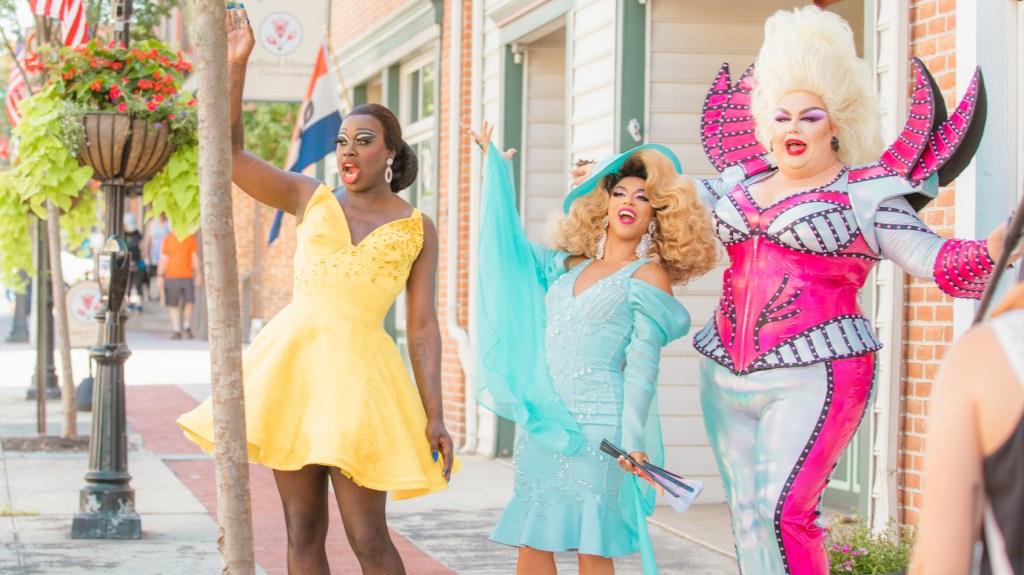
We’re Here [HBO]. Three drag queens not named RuPaul take a Priscilla/Too Wong Foo tour through small towns across America to stage drag shows and use their power to validate and heal local queer scenes.

I loved gay culture, like so many of us did, before I loved my gay self. I loved the sense of humor and the aesthetic and the love for the forgotten and the neglected. I learned to love myself eventually, and only now am I truly understanding what it means to love and to gather close to the most defiant and challenging of us: the sissies and the faggots, the bullied and abused.

There’s so much power in the experience of learning to love yourself. That’s something that Queer Eye taps into so deeply. The danger in Queer Eye is that it muddies the line between who you are and what you buy (although much much less than its original incarnation) and also in the sheer amount of space it occupies in queer representation. Some queer people, especially young people discovering themselves, may not have more access to queer adults than their Netflix account, and I worry that the aspirational devotion the show has towards its stars makes their confidence seem unattainable to younger queers.

I considered ditching We’re Here a few minutes into its first episode. I though its hosts, Shangela, Eureka, and Bob the Drag Queen, were doing a tired and derivative imitation of Queer Eye. I’m so glad that I gave the show a second chance, because once I figured out what it was doing it totally won me over.

The show has more or less a fixed format. Bob, Shangela, and Eureka roll into a small town (ranging from about 10k people to about 50k, from Pennsylvania to New Mexico). They explore downtown shops, locals don’t know what to make of them. They pick three locals to collaborate with to put on a free drag show: one is always a straight, cis guy. Another is a queer person who is trying with all of their might to be themself despite adverse conditions, like a wildflower in a thunderstorm. The third is a little loose, but the thread that connects them is that they are people who have chosen to stay in their home communities despite deep wounds, and who are in need of a little healing through community.

Bob the Drag Queen, Shangela and Eureka O’Hara/HBO’s We’re Here.

There is a little bit of “once in a lifetime experience”/“transformation” language—that’s what turned me off in the beginning—but the show is pretty straightforward about the fact that when the drag queens leave town, regular life will resume. “Your life is not going to change in one week” Shangela bluntly tells a young gay Latino man, José, in a Louisiana town. There’s a scene later in that episode where Shangela sits down with José’s mother so we can get the tearful scene where she tells him that she will always love him because he’s her son. What sets this show apart from the pack is the scene that comes afterward. “Moms always put on their best face for company,” Shangela says quietly. José’s face is guarded and ambivalent. He’s heard the love before. He’s also heard disappointment, disapproval, and scolding. It undercuts the drama of the moment, but it’s a thousand times more real than the staged scenes of reconciliation in Queer Eye, almost fraying in front of you at the edges of the frame.

This show would be so obnoxious and patronizing if it was about the big bad city queens showing small time yokels how it’s really done. What comes through so strongly is that, even though the locals are “crunchy,” according to an unusually shady Shangela in the episode in Twin Falls, Idaho, they have such respect for the people they are working with. The queers that stay in small towns are those who defy a whole host of voices—some loving, some hateful—that say that you are going to have a happier life if you don’t live it here. Queer people are delicate flowers. We flourish in environments where there is enough material abundance for beauty and grace to be valued, where self-expression is permitted, where difference is tolerated. Small town queer people are those flowers hanging on, fiercely, to life. The succulent rooted in sheer face of rock, the thistles growing on the side of the road, the tree that was uprooted by the storm but flowers anyway.

I was transfixed by the beauty of these people, the fierce way that they held on to their sense of themselves. A grandfather and a grandson, bonded so tight by love that there was no room for shame. Two gay men who have a beautiful friendship in which each is totally comfortable in the company of the other. The title carries a double meaning. It’s not just “we are now here” or “we’re here, we’re queer, get used to it,” it’s “look, we have always been here, right here, in your town. We’re your brother or cousin or granddaughter or boss or teacher.” The visiting drag queens are basically church planting. They are giving all of the local queer people a reason to gather together, a way for all of their allies to gather together by bringing this bubble of total queer acceptance and (almost) uncompromising queer aesthetic and letting everybody see each other and experience together what queer joy feels like. The shit that they stir up is the grit around which the pearl forms.

So in that way, it’s not like Queer Eye at all. It’s really the anti-Drag Race. (I think that Drag Race gets a lot of unfair hate. The critiques are totally valid, but they wouldn’t matter as much or sting when the show gets it wrong if there was a whole ecosystem of queer entertainment that was funded and promoted and critiqued and awarded like entertainment directed at straight audiences. That puts way more weight on Drag Race than it can support.) Drag Race is about gatekeeping, it’s about designating something as special, it’s about elevating regional talent into international spotlight. We’re Here is about recognizing that queer talent and beauty and joy is everywhere, and about the power of coming together and nurturing that in the places where you live.

This is for: queers who need a pick me up, people tired of LA/NY stories or having to pretend places like Houston, Chicago, or Atlanta are small towns because they are slightly smaller than those two cities, anyone really missing Pride this summer.

Not for: haters, cynics, the lactose intolerant.

Recommended. 🏳️‍🌈🏳️‍🌈🏳️‍🌈🏳️‍🌈/5

Bi: Notes for a Bisexual Revolution | Shiri Eisner

There is a shelf on the third floor of Central Library in downtown Portland. It contains all of the nonfiction books specifically about bring queer: books about raising your gay teenager, coming out in later life, how to support your partner who is transitioning, and about four books on bisexuality. I have never done anything in my life without reading a book about it first, so I picked out the most relevant of those four books, which was Bi: Notes for a Bisexual Revolution.

It turns out that Bi has everything to do with why there are only four books on that shelf. Shiri Eisner has put together a book that discusses the particular political, economic, and social marginalization experienced by bisexual people—distinguished from the experience of gay, lesbian, and straight people (“monosexuals,” in her terminology). Eisner starts by describing how bisexual can be a radically inclusive term for all sorts of people that experience attraction to more than one gender, then goes through the myths, stereotypes, and stigmas attached to bisexual people. Next, Eisner examines how bisexual identity intersects with sexist and racist axes of oppression, then proposes this vision of a radical bisexuality that inherently destabilizes patriarchy and gender based oppression.

Whew!

There is a lot of material in this book, and because of the jargon-bordering-academic language it uses, the tedious and repetitious disclaimers of privilege, and activist-y eye rolls at global capitalism and the police state, I would say that it’s more of a reference than a book to read front to back. I did appreciate the thoroughness of the work, and I have to admit to a certain bias against radical and activist thinking that sometimes provokes me into greater critical thinking and sometimes makes me churlishly dismissive.

Unfortunately, I was also turned off by some methodological loosey-goosey and an inconsistent analytical lens that made it seem like polemic. For example, a lot of Eisner’s evidence for the argument that bisexuals experience worse health economic etc. outcomes is based on a single set of demographic data. That’s certainly not Eisner’s fault—she argues persuasively that bisexuals are an understudied group of people. But in another part of the book, she points out that because this data set is based on self-reported categories, it dramatically under-represents the group within bisexuals that would have the best outcomes due to other kinds of privilege, namely cis bisexual men.

Whatever gripes I might have with the rigor of some of her evidence, I also have to admit that despite coming in with a lot of skepticism, Eisner ended up convincing me that there is a unique stigma attached to bisexual people, and I came to understand why she considered bisexuals and their relationships as a battlefield of patriarchy and queer liberation.

And yet, I did end up walking away a little disappointed. I was still looking for some idea of what the specific bisexual experience of the world is. My gay identity was built not only from crushes and eyes averted and inconvenient erections and hot shame, but also from books and poetry and movies and narratives and testimony and role models. And a lot of that just isn’t out there for bisexual men—or at least I might have to keep working to find it.