Get Used to It

We’re Here [HBO]. Three drag queens not named RuPaul take a Priscilla/Too Wong Foo tour through small towns across America to stage drag shows and use their power to validate and heal local queer scenes.

I loved gay culture, like so many of us did, before I loved my gay self. I loved the sense of humor and the aesthetic and the love for the forgotten and the neglected. I learned to love myself eventually, and only now am I truly understanding what it means to love and to gather close to the most defiant and challenging of us: the sissies and the faggots, the bullied and abused.

There’s so much power in the experience of learning to love yourself. That’s something that Queer Eye taps into so deeply. The danger in Queer Eye is that it muddies the line between who you are and what you buy (although much much less than its original incarnation) and also in the sheer amount of space it occupies in queer representation. Some queer people, especially young people discovering themselves, may not have more access to queer adults than their Netflix account, and I worry that the aspirational devotion the show has towards its stars makes their confidence seem unattainable to younger queers.

I considered ditching We’re Here a few minutes into its first episode. I though its hosts, Shangela, Eureka, and Bob the Drag Queen, were doing a tired and derivative imitation of Queer Eye. I’m so glad that I gave the show a second chance, because once I figured out what it was doing it totally won me over.

The show has more or less a fixed format. Bob, Shangela, and Eureka roll into a small town (ranging from about 10k people to about 50k, from Pennsylvania to New Mexico). They explore downtown shops, locals don’t know what to make of them. They pick three locals to collaborate with to put on a free drag show: one is always a straight, cis guy. Another is a queer person who is trying with all of their might to be themself despite adverse conditions, like a wildflower in a thunderstorm. The third is a little loose, but the thread that connects them is that they are people who have chosen to stay in their home communities despite deep wounds, and who are in need of a little healing through community.
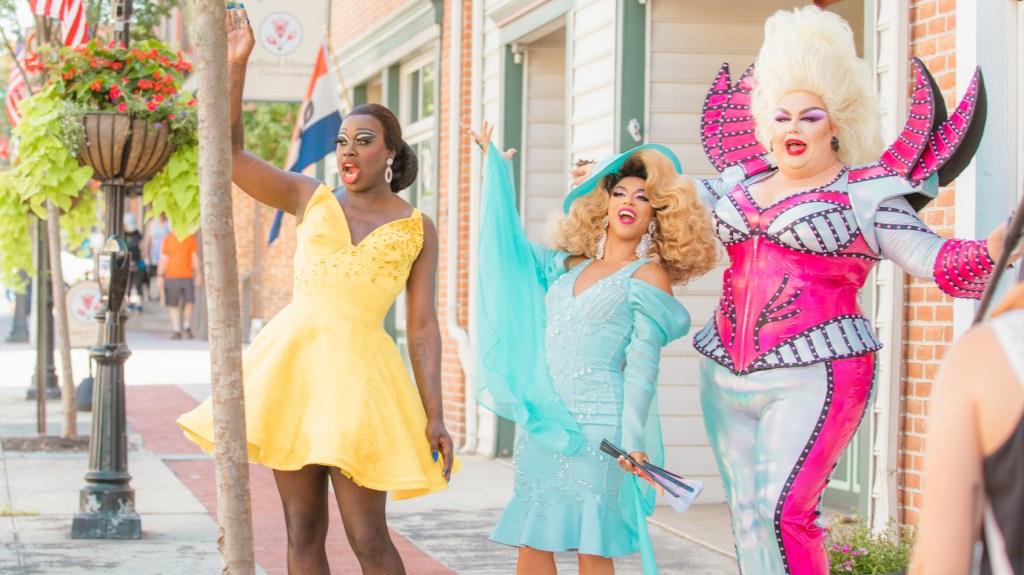
Bob the Drag Queen, Shangela and Eureka O’Hara/HBO’s We’re Here.

There is a little bit of “once in a lifetime experience”/“transformation” language—that’s what turned me off in the beginning—but the show is pretty straightforward about the fact that when the drag queens leave town, regular life will resume. “Your life is not going to change in one week” Shangela bluntly tells a young gay Latino man, José, in a Louisiana town. There’s a scene later in that episode where Shangela sits down with José’s mother so we can get the tearful scene where she tells him that she will always love him because he’s her son. What sets this show apart from the pack is the scene that comes afterward. “Moms always put on their best face for company,” Shangela says quietly. José’s face is guarded and ambivalent. He’s heard the love before. He’s also heard disappointment, disapproval, and scolding. It undercuts the drama of the moment, but it’s a thousand times more real than the staged scenes of reconciliation in Queer Eye, almost fraying in front of you at the edges of the frame.

This show would be so obnoxious and patronizing if it was about the big bad city queens showing small time yokels how it’s really done. What comes through so strongly is that, even though the locals are “crunchy,” according to an unusually shady Shangela in the episode in Twin Falls, Idaho, they have such respect for the people they are working with. The queers that stay in small towns are those who defy a whole host of voices—some loving, some hateful—that say that you are going to have a happier life if you don’t live it here. Queer people are delicate flowers. We flourish in environments where there is enough material abundance for beauty and grace to be valued, where self-expression is permitted, where difference is tolerated. Small town queer people are those flowers hanging on, fiercely, to life. The succulent rooted in sheer face of rock, the thistles growing on the side of the road, the tree that was uprooted by the storm but flowers anyway.

I was transfixed by the beauty of these people, the fierce way that they held on to their sense of themselves. A grandfather and a grandson, bonded so tight by love that there was no room for shame. Two gay men who have a beautiful friendship in which each is totally comfortable in the company of the other. The title carries a double meaning. It’s not just “we are now here” or “we’re here, we’re queer, get used to it,” it’s “look, we have always been here, right here, in your town. We’re your brother or cousin or granddaughter or boss or teacher.” The visiting drag queens are basically church planting. They are giving all of the local queer people a reason to gather together, a way for all of their allies to gather together by bringing this bubble of total queer acceptance and (almost) uncompromising queer aesthetic and letting everybody see each other and experience together what queer joy feels like. The shit that they stir up is the grit around which the pearl forms.

So in that way, it’s not like Queer Eye at all. It’s really the anti-Drag Race. (I think that Drag Race gets a lot of unfair hate. The critiques are totally valid, but they wouldn’t matter as much or sting when the show gets it wrong if there was a whole ecosystem of queer entertainment that was funded and promoted and critiqued and awarded like entertainment directed at straight audiences. That puts way more weight on Drag Race than it can support.) Drag Race is about gatekeeping, it’s about designating something as special, it’s about elevating regional talent into international spotlight. We’re Here is about recognizing that queer talent and beauty and joy is everywhere, and about the power of coming together and nurturing that in the places where you live.

This is for: queers who need a pick me up, people tired of LA/NY stories or having to pretend places like Houston, Chicago, or Atlanta are small towns because they are slightly smaller than those two cities, anyone really missing Pride this summer.

Not for: haters, cynics, the lactose intolerant.

Recommended. 🏳️‍🌈🏳️‍🌈🏳️‍🌈🏳️‍🌈/5

➕ new.amsterdam ➕

New Amsterdam is a mediocre vodka, New Amsterdam is a bad TV show. I can’t stop watching it.

I made a conscious decision in college to stop hate-watching things because I was spending a lot of time with a friend, let’s call him Trip, that only seemed to hate-watch things that he thought was bad and it made me feel like I was only ever choosing to watch things I didn’t like. This is five or seven years later and I feel good about the movies I’ve watched since then.

In Trip’s defense, there were some common themes to the bad movies that he liked to watch. He loved movies where filmmakers were un-self-aware in various ways: uncool movies that unconvincingly treat uncool things as cool, movies where the screenwriter thinks they’re a god and too good for an editor and the actors are always a little confused, movies from other countries trying to introduce a new genre, movies with jarring and inexplicable shifts toward adolescent-boy lecherous tone. He loved what came when a creative team team was in a little over its head, like the faces you make when reaching for a dish on a shelf just out of your reach.

When I hate watch, I look for something different. I love to hate-watch movies and TV shows that are trying to copy something else but don’t seem to understand what made the original good. Sometimes formulas are copied and the copy is pretty good, or better than the original. If it works, I don’t care that it’s a copy. There’s an clunky uncanny valley that I find frustrating when part of the formula is right and part of it is wrong (here’s looking at you, Netflix originals and the entire Greg Berlanti TV universe). And then there are the copies that miss it completely. Complexity is simplified, the specific becomes generic, and characters are flattened like a pancake. Any part of the show that provokes the viewer to consider something differently is repurposed to cut a deeper groove into our preconceptions.

Which is what draws me to New Amsterdam. It’s a really, really bad copy of a copy of ER.

Hospital dramas are TV staples and will never go away because the setting lends itself so well to episodic stories. The stakes are inherently life and death, there are a lot of different things that motivate doctors, medical care touches people from all strata of society, and medicine is always at the center of our political and moral battleground. Patients come in and out, and doctors and nurses make new relationships with them in every episode.

ER premiered in 1994 and made a huge leap forward for hospital shows because of two special advantages. First, Michael Crichton, the series creator, was a doctor who had been a resident and was a perceptive enough observer of emergency rooms to get the emotional tone right. Second, Jurassic Park-era Steven Spielberg was the first executive producer, and it seems that his production choices led to better medical special effects than had ever been on TV. ER invested deeply in its cast, too. Certain characters got most of the attention, however background characters played by regular guest stars got to be real too. Different characters worked day shifts and night shifts. Malik, Jerry and Heleah all managed the intake stations and answered phones differently. Most importantly, ER understood what was dramatic about a TV show and (at least in the early seasons) did not underestimate its audience. We always got glimpses into character’s lives outside the hospital, but that was never the most interesting part of the show. What we knew about the rest of their lives allowed viewers to decode the emotions underneath the surface as characters went about their work.

New Amsterdam gets this hilariously wrong. It’s based on the fairly sober seeming and workmanlike memoir Twelve Patients: Life and Death at Bellevue Hospital  by Eric Mannheimer, but its hard to imagine him recognizing his work in the show. Doctors almost never practice any medicine. Background characters get no lines so even though the show is shot on a giant set with lots of extras, we only ever interact with about six doctors. Instead of exploring any number of inherently dramatic scenarios that happen in hospitals, all the drama is interpersonal and involves two characters conflicting then slowly telling the other four characters what is going on while ignoring the patients in front of them. Maybe the writers knew they were working with a turkey because the main character is (and I’m not joking): taking over the largest public hospital in New York, while mourning the death of his sister at the very same hospital, while his wife is having complications from a pregnancy, and also he has brain cancer.

But the worst thing of all, and the car crash that I can’t turn away from, is that it is the most blatantly cynical or un-self-aware (or both) White Savior story I have ever seen. I am surprised, and also not, that this got made in 2018. The implicit message of the show is that all of the ills of modern medicine: high medical bills, impersonal care, corporatization, lack of mental health care; all could be solved by a white man with unlimited authority. It’s Trump, M.D., and if you think that I’m overstating, the very first act of this incoming medical director is to fire all tenured doctors. [This is after an excruciating scene where the hospital’s janitors are gossiping in Spanish and the medical director responds in Spanish because he’s Down Like That™️ and Not That Kind of White™️]. His plan to turn the hospital around? I don’t know and neither does he because his only instruction to his doctors is to give a shit. This is meant to be inspiring.

It’s racist and cynical, but the reason I can’t look away is that it so deluded about what the challenges of the day are. Climate change, economic collapse, infrastructure deterioration, these are all big problems that are going to require big thinkers. But this show is so nakedly wishing for a simpler time when someone powerful like a doctor at the top of the pyramid could just order the reality he wanted and all the people in the jobs that don’t get lines on this show: the nurses, the janitors, orderlies, billing techs, patients; they all have to fall in line and make that reality. Through that lens, this show may be a part of white America coming to grips with the failure of the Trump presidency. New Amsterdam believes that the system we had in the past was pretty good, as long as you had someone goodhearted running it.

I don’t think it’s coming back.

Prime

Tuesday

I went to bed early on Monday night, and set the alarm for a generous 8 hours, but ended up sleeping in past my alarm. I’ve been taking Nyquil before bed, but it doesn’t make sense to me that it would make me sluggish in the morning. At any rate, I rolled into work well past when I wanted to.

I did some tidying up and busywork, but, as per the last few weeks, my heart hasn’t been in my work recently. There has just been too much.

When I got home, I prepared myself some food, and watched the new episodes of Girls and Looking. Girls had a spotty last season, and the first two episodes of this new one weren’t that great either, but this week’s (Episode 3) was really great. I’m very willpower- and empowerment-minded right now, and I love watching Marnie and Hannah come into their own, even as they are terrible and awkward in their manner. Adam and Jessa are such a natural pair I can’t believe we haven’t seen them play off of each other before.

Looking still doesn’t realize who its interesting characters are, but Patrick was almost funny and charming and we got to see a little bit of the beautiful Raúl Castro. I’m worried that he’s going to hook up with Agustín, which would be a waste, but I’m just glad that he’s not gone forever. Please don’t make him get back with Patrick.

I got the last of my weekend Charliework done, and had one of those blissful moments where my bed was made with fresh bedding and I had just taken a shower and I was in a robe and I had tea and was just lazing. My mom and my sister decided that they wanted to read Moby-Dick this year, so I started the first few chapters. I think I might be the only one that’s started. 

Wednesday

Nyquil fog again. Bought lunch, was trying to only prepare my own food this week.

Nothing special at work.

Got started on Anne Lamott’s Bird by Bird, which is kind of about writing and also about just doing what you are meant to do. I realize that I’m deep in a wheel-spinning cycle of inspiration addiction, and decided to stop reading the book and take a month or so break from big picture writing, and use my time to either make work or read some primary text—take in books, movies, whatever.

I became fascinated with this New Yorker story about Yitang Zhang, a mathematician that solved some old problem. As you can tell, my grasp of the math is scant, but Zhang emerges as a fascinating human character, almost an artist:

A few years ago, Zhang sold his car, because he didn’t really use it. He rents an apartment about four miles from campus and rides to and from his office with students on a school shuttle. He says that he sits on the bus and thinks. Seven days a week, he arrives at his office around eight or nine and stays until six or seven. The longest he has taken off from thinking is two weeks. Sometimes he wakes in the morning thinking of a math problem he had been considering when he fell asleep. Outside his office is a long corridor that he likes to walk up and down. Otherwise, he walks outside.

Zhang worked on this problem with no outside encouragement or support for more then a decade while working as an adjunct. Before that, unable to find a professorship, he worked as a bookkeeper at a Subway franchise. Although it seems he is superintelligent, it is his complete focus that is inspiring. From another interview:

I am a quiet person. I like to concentrate on the math, on what I like. I do not care about the life conditions, like a good house, good cars, good clothing. This is my personality. I don’t have a car right now. I have a townhouse, but it is in California, where my wife lives. In New Hampshire I rent an apartment. The most important thing is to concentrate on math itself.

I don’t have any confidence that I’ll ever find that focus, nor really any desire to. I like good house, good clothing (we share our indifference to cars). But one of the reasons that I’ve always found a kinship to the pure math/pure physics crowd is that, like music, they are things that are outside of words and semantic reasoning—words will always be a metaphor, and it is possible to think in the thing without needing words at all. Sometimes when I can get all the voices in my head quiet, I can get to that place where I’m just thinking and being in music and sound, no words. I don’t feel that same thing about numbers, but if somebody else does, I understand wanting to be in that state as much as possible.

I called my mom, talked for a little bit. Realized that my car is not worth much, so my fantasy of trading it in for something smaller and more energy efficient is not just a fantasy, but a pretty stupid one at that.

I had a long, emotional conversation with my brother. My heart breaks for him right now, because he’s 18 and out of school, and he has some things to figure out right now that are twisting him around. Even the questions he’s asking make me think that he’s on a truer path faster than I was—I was stubborn enough to stick to a contract I thought I had to stick to (a contract that I invented, that nobody asked me to sign, and that never made sense in the first place) for another two or three years before it ran out of gas and I had to try and build myself again from scratch.

Mad Men & The Beatles


Readers who legitimately do not give a shit about Mad Men may still be interested in my comments on the Beatles album Revolver after the embedded YouTube video.
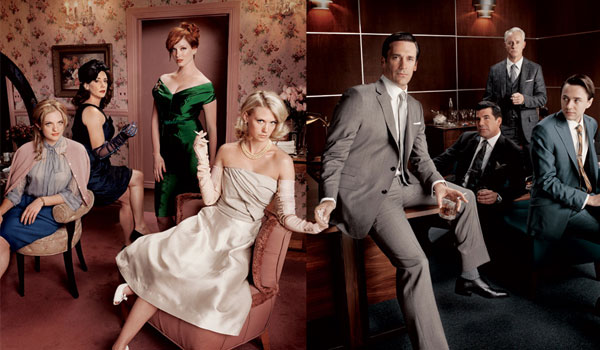
I have no interest whatsoever to blog seasons of television or do recaps or anything that needs to be timely or consistent, but I do want to say that I’m enjoying Mad Men so much this season; it may be my favorite season so far. I’m sure that almost everyone has decided at this point whether they’re into the show or not, so writing or talking about the show can feel a little circlejerky, but the show has changed so much over time that I feel like evangelizing the show all over again.
I feel like Mad Men‘s dramatic juice has always come from this combination of elements (and disregarding, for the moment, other concerns like marketing, costume design, cast etc.):

  1. The charisma and mystery and glamour of the character of Don Draper.
  2. The art and science of advertising, and
  3. The knowledge that the next decade, and the judgment of history, are going to hit this class of people like a bus.

Mad Men’s M.O. has generally been to foreground 1 & 2, while letting 3 work quietly in the background, visible only to the viewers. This formula has shifted over time. For one, Don Draper is just less mysterious. We may still be captivated by the way that he behaves and his responses to situations, but there’s no more puzzle to his history, and we’ve come a long way from watching him navigate between his wife and his piece on the side. For the last couple of seasons, even as the show stays anchored in the workplace, there is less emphasis on the advertising business. In the first season, it seemed like the show was going to establish a product-of-the-week format. This season, there have still been some high profile clients that contribute a C- or D-plot (Howard Johnson’s, Miracle Whip), but there’s less pontificating on the nature of advertising, fewer Draper pitches, fewer observations about what people want.
But where this season has been really shining is with that third element. Change has come to the foreground. Changes in music, in morés, style and class, there hasn’t been an episode this season where our characters haven’t been confronted by the culture moving to another place, or disrupted by a person that’s already there. One of my roommates is watching the show for the first time, and one huge contrast between the first season and the current season is the first season, both in both its style and its narrative, is about deeply controlled people. Their suits are fitted. Their lives, even as they are falling apart behind closed doors, are carefully compartmentalized. The most shocking moment of the pilot is Don Draper, who we’ve come to know in the context of his workplace, open his door and step into his role as father and husband. In comparison, this season is very messy. Characters are divorcing, shacking up; colors are loud, patterns clash; and the braintrust of Sterling Cooper Draper Pryce is increasingly buffeted by changes in mass taste and an increasingly politicized culture.
Some of the fun of this season is watching unexpected reactions to those changes–the same Roger Sterling who performed in blackface has seemingly skipped a generation and become an LSD-dropping nihilist, while the same Pete Campbell who was batted away from pursuing black-targeted accounts has begun to act out with all the propriety of a drunken salaryman at a karaoke bar–but none has been more interesting to watch than Don Draper. Because this is supposed to be the time where the culture catches up to Don Draper. In earlier seasons, Don is shown to be operating ten years ahead of his clients by producing ads that focus on the lives and desires of consumers rather than on products. At times, particularly in his preference for and interactions with strong, independent women, and his apparent dislike for the rules prescribed for men in gray suits, he has seemed like the audience-insertion character. Don’s pitches used to promise the future. But now we’re in the future, and it’s a new world of Beatles and beatniks, of civil rights and antiwar left, a world that Don is increasingly reluctant to embrace.


Last episode featured the Beatles song “Tomorrow Never Knows” in an extremely effective manner. This season has featured many “the 60’s are here” moments, but few have been as powerful as Ringo’s snare knocking on Don Draper’s door to introduce sounds that have become deeply integrated into contemporary pop culture’s DNA. And so I have found myself completely, and admittedly sheepishly, obsessed with Revolver.
It is because of the centrality of the Beatles catalogue to popular music that it has been hard for me to listen to their music as music, or listen to their albums like any other band. It was only a few months ago that I decided to try and listen to the albums through to get a sense of them as albums, instead of units containing some of the hits that I knew. I began with Sgt. Pepper’s, then slowly through  Rubber Soul  and Abbey Road. Somehow, I had not yet gotten to Revolver. I had heard from music people that Revolver was the best Beatles album, but I never appreciated the extent to which it–and Sgt. Pepper’s–are simply in a league of their own*. Rubber Soul is too indebted to their earlier pop rock sound, Abbey Road has a signal to noise ratio that’s too low, and Let It Be is moribund. In these two albums, they managed to do everything they do well right, and produce an astonishing amount of perfect songs on each. My the worst track on Revolver is either “Doctor Robert” or “Taxman,” and both of them are extraordinarily good songs.
*I’m going to break in with a couple of caveats here: One, a general disclaimer that I haven’t heard all of the albums yet. So I’ll admit the possibility that one of the other albums might just be that much better (though somehow I don’t think Magical Mystery Tour will be it). Two, it’s relevant that I really hate most of the early-Beatles, teen idol-y songs. I imagine that there is still some cohort that dislikes all of their albums after they went to India. But for me, almost all of those early albums are going to be disqualified.
Listening through Revolver also provided me with one of those cherished opportunities to check in with my own evolving tastes. I remember having a conversation with my piano teacher’s husband about whether we liked the Beatles by John Lennon or the Beatles by Paul McCartney better. I declared myself a McCartney man. My piano teacher told me to “give that time.” And that’s proven to be completely true. I can see where I was coming from; I played piano, and all of the best Beatles songs to play on the piano are Paul’s ballads (“Let It Be,””Yesterday”)**. Lennon’s songs tended to be more guitar-riff driven and  production-heavy.*** Scanning a tracklist of Revolver reveals that all of the songs that have been rocking my shit are Lennon songs.
**It took me time to discover that the best McCartney songs are the quasi-art songs: “She’s Leaving Home,” “Penny Lane” “The Long and Winding Road” etc. 
***Though, of course, those taxonomies can be deceptive. “Helter Skelter,” for example, is a McCartney song and is about as aggro as the Beatles get, while “Something” was written by George Harrison and is (with the exception of an extra-prominent guitar solo) almost a quintessential Paul song.
And now just a few thoughts on individual tracks:

  • “I’m Only Sleeping” and “Here, There and Everywhere” are weirdly mirror images of each other; the root of the chord progressions in their choruses are extremely similar, 1-2-3-4 (Here, There and Everywhere) and 1-2-3-2 (I’m Only Sleeping), yet I can’t stand HTE, and can’t get enough of IOS. IOS contains maybe my favorite use of sweet oohing harmonies, and the backtracked guitar solo is still just the greatest.
  • For all that the 90’s Britpop genre (Oasis, etc.) is pretty much defined by an indebtedness to the Beatles, “She Said, She Said” is maybe the only song in their catalog that I think could just be a 90’s song, if John Lennon didn’t have one of the most distinctive voices in rock. For that matter, the guitar intro could kick off a Pavement song. The drumming on this track is sublime; the only time that I have been completely impressed with Ringo Starr.
  • “For No One” is almost a perfect song, but the dotted rhythm at the end of “no sign of love behind the tears” is like jamming an icepick into my ears, I hate it that much.
  • “Tomorrow Never Knows” is still the greatest: epic tape loops and distortion; Lennon’s incantation-like delivery; anti-guitar solos; mystical nonsense that smells like profundity; a killer drum and bass ostinato; a maximalist masterpiece.

Mad Men & The Beatles

Readers who legitimately do not give a shit about Mad Men may still be interested in my comments on the Beatles album Revolver after the embedded YouTube video.

I have no interest whatsoever to blog seasons of television or do recaps or anything that needs to be timely or consistent, but I do want to say that I’m enjoying Mad Men so much this season; it may be my favorite season so far. I’m sure that almost everyone has decided at this point whether they’re into the show or not, so writing or talking about the show can feel a little circlejerky, but the show has changed so much over time that I feel like evangelizing the show all over again.

I feel like Mad Men‘s dramatic juice has always come from this combination of elements (and disregarding, for the moment, other concerns like marketing, costume design, cast etc.):

  1. The charisma and mystery and glamour of the character of Don Draper.
  2. The art and science of advertising, and
  3. The knowledge that the next decade, and the judgment of history, are going to hit this class of people like a bus.

Mad Men’s M.O. has generally been to foreground 1 & 2, while letting 3 work quietly in the background, visible only to the viewers. This formula has shifted over time. For one, Don Draper is just less mysterious. We may still be captivated by the way that he behaves and his responses to situations, but there’s no more puzzle to his history, and we’ve come a long way from watching him navigate between his wife and his piece on the side. For the last couple of seasons, even as the show stays anchored in the workplace, there is less emphasis on the advertising business. In the first season, it seemed like the show was going to establish a product-of-the-week format. This season, there have still been some high profile clients that contribute a C- or D-plot (Howard Johnson’s, Miracle Whip), but there’s less pontificating on the nature of advertising, fewer Draper pitches, fewer observations about what people want.

But where this season has been really shining is with that third element. Change has come to the foreground. Changes in music, in morés, style and class, there hasn’t been an episode this season where our characters haven’t been confronted by the culture moving to another place, or disrupted by a person that’s already there. One of my roommates is watching the show for the first time, and one huge contrast between the first season and the current season is the first season, both in both its style and its narrative, is about deeply controlled people. Their suits are fitted. Their lives, even as they are falling apart behind closed doors, are carefully compartmentalized. The most shocking moment of the pilot is Don Draper, who we’ve come to know in the context of his workplace, open his door and step into his role as father and husband. In comparison, this season is very messy. Characters are divorcing, shacking up; colors are loud, patterns clash; and the braintrust of Sterling Cooper Draper Pryce is increasingly buffeted by changes in mass taste and an increasingly politicized culture.

Some of the fun of this season is watching unexpected reactions to those changes–the same Roger Sterling who performed in blackface has seemingly skipped a generation and become an LSD-dropping nihilist, while the same Pete Campbell who was batted away from pursuing black-targeted accounts has begun to act out with all the propriety of a drunken salaryman at a karaoke bar–but none has been more interesting to watch than Don Draper. Because this is supposed to be the time where the culture catches up to Don Draper. In earlier seasons, Don is shown to be operating ten years ahead of his clients by producing ads that focus on the lives and desires of consumers rather than on products. At times, particularly in his preference for and interactions with strong, independent women, and his apparent dislike for the rules prescribed for men in gray suits, he has seemed like the audience-insertion character. Don’s pitches used to promise the future. But now we’re in the future, and it’s a new world of Beatles and beatniks, of civil rights and antiwar left, a world that Don is increasingly reluctant to embrace.

Last episode featured the Beatles song “Tomorrow Never Knows” in an extremely effective manner. This season has featured many “the 60’s are here” moments, but few have been as powerful as Ringo’s snare knocking on Don Draper’s door to introduce sounds that have become deeply integrated into contemporary pop culture’s DNA. And so I have found myself completely, and admittedly sheepishly, obsessed with Revolver.

It is because of the centrality of the Beatles catalogue to popular music that it has been hard for me to listen to their music as music, or listen to their albums like any other band. It was only a few months ago that I decided to try and listen to the albums through to get a sense of them as albums, instead of units containing some of the hits that I knew. I began with Sgt. Pepper’s, then slowly through  Rubber Soul  and Abbey Road. Somehow, I had not yet gotten to Revolver. I had heard from music people that Revolver was the best Beatles album, but I never appreciated the extent to which it–and Sgt. Pepper’s–are simply in a league of their own*. Rubber Soul is too indebted to their earlier pop rock sound, Abbey Road has a signal to noise ratio that’s too low, and Let It Be is moribund. In these two albums, they managed to do everything they do well right, and produce an astonishing amount of perfect songs on each. My the worst track on Revolver is either “Doctor Robert” or “Taxman,” and both of them are extraordinarily good songs.

*I’m going to break in with a couple of caveats here: One, a general disclaimer that I haven’t heard all of the albums yet. So I’ll admit the possibility that one of the other albums might just be that much better (though somehow I don’t think Magical Mystery Tour will be it). Two, it’s relevant that I really hate most of the early-Beatles, teen idol-y songs. I imagine that there is still some cohort that dislikes all of their albums after they went to India. But for me, almost all of those early albums are going to be disqualified.

Listening through Revolver also provided me with one of those cherished opportunities to check in with my own evolving tastes. I remember having a conversation with my piano teacher’s husband about whether we liked the Beatles by John Lennon or the Beatles by Paul McCartney better. I declared myself a McCartney man. My piano teacher told me to “give that time.” And that’s proven to be completely true. I can see where I was coming from; I played piano, and all of the best Beatles songs to play on the piano are Paul’s ballads (“Let It Be,””Yesterday”)**. Lennon’s songs tended to be more guitar-riff driven and  production-heavy.*** Scanning a tracklist of Revolver reveals that all of the songs that have been rocking my shit are Lennon songs.

**It took me time to discover that the best McCartney songs are the quasi-art songs: “She’s Leaving Home,” “Penny Lane” “The Long and Winding Road” etc. 

***Though, of course, those taxonomies can be deceptive. “Helter Skelter,” for example, is a McCartney song and is about as aggro as the Beatles get, while “Something” was written by George Harrison and is (with the exception of an extra-prominent guitar solo) almost a quintessential Paul song.

And now just a few thoughts on individual tracks:

  • “I’m Only Sleeping” and “Here, There and Everywhere” are weirdly mirror images of each other; the root of the chord progressions in their choruses are extremely similar, 1-2-3-4 (Here, There and Everywhere) and 1-2-3-2 (I’m Only Sleeping), yet I can’t stand HTE, and can’t get enough of IOS. IOS contains maybe my favorite use of sweet oohing harmonies, and the backtracked guitar solo is still just the greatest.
  • For all that the 90’s Britpop genre (Oasis, etc.) is pretty much defined by an indebtedness to the Beatles, “She Said, She Said” is maybe the only song in their catalog that I think could just be a 90’s song, if John Lennon didn’t have one of the most distinctive voices in rock. For that matter, the guitar intro could kick off a Pavement song. The drumming on this track is sublime; the only time that I have been completely impressed with Ringo Starr.
  • “For No One” is almost a perfect song, but the dotted rhythm at the end of “no sign of love behind the tears” is like jamming an icepick into my ears, I hate it that much.
  • “Tomorrow Never Knows” is still the greatest: epic tape loops and distortion; Lennon’s incantation-like delivery; anti-guitar solos; mystical nonsense that smells like profundity; a killer drum and bass ostinato; a maximalist masterpiece.