
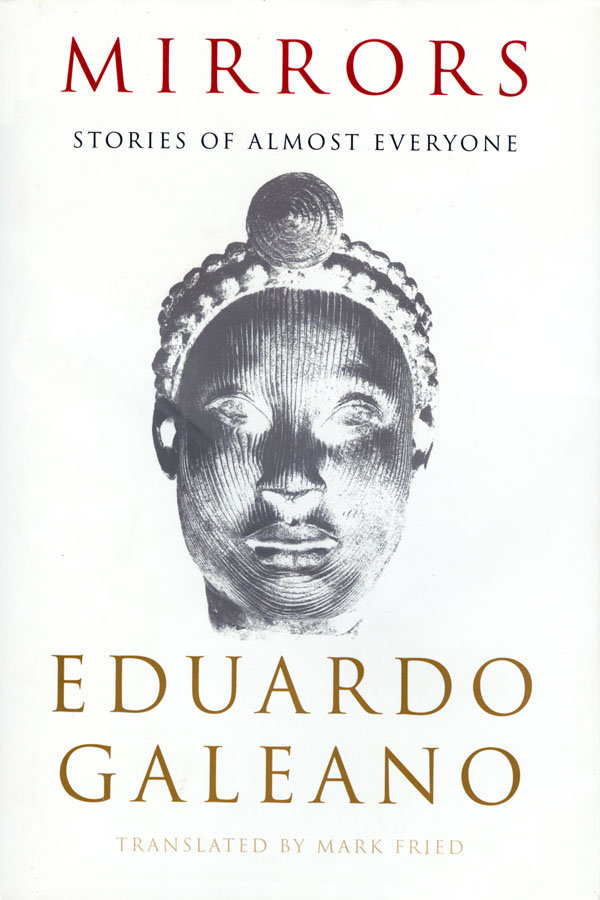
Mirrors: Eduardo Galeano

Eduardo Galeano - Mirrors - cover

  • Mirrors: Stories of Almost Everyone. Eduardo Galeano, translated from Spanish by Mark Fried. 400p, Nation Books, 2010. (Powell’s)

It all began at Christmas two years ago, when my daughter was four-years-old. And it was the first time that she’d ever asked about what did this holiday mean? And so I explained to her that this was celebrating the birth of Jesus. And she wanted to know more about that. We went out and bought a kids’ bible and had these readings at night. She loved him. Wanted to know everything about Jesus.

So we read a lot about his birth and his teaching. And she would ask constantly what that phrase was. And I would explain to her that it was, “Do onto others as you would have them do unto you.” And we would talk about those old words and what that all meant.

And then one day we were driving past a big church and out front was an enormous crucifix.

She said, who’s that?

And I guess I’d never really told that part of the story. So I had to sort of, yeah, oh, that’s Jesus. I forgot to tell you the ending. Well, you know, he ran afoul of the Roman government. This message that he had was so radical and unnerving to the prevailing authorities of the time that they had to kill him. They came to the conclusion that he would have to die. That message was too troublesome.

It was about a month later, after that Christmas, we’d gone through the whole story of what Christmas meant. And it was mid-January, and her preschool celebrates the same holidays as the local schools. So Martin Luther King Day was off. I knocked off work that day and I decided we’d play and I’d take her out to lunch.

We were sitting in there, and right on the table where we happened to plop down, was the art section of the local newspaper. And there, big as life, was a huge drawing by a ten-year-old kid from the local schools of Martin Luther King.

She said, who’s that?

I said, well, as it happens that’s Martin Luther King. And he’s why you’re not in school today. So we’re celebrating his birthday, this is the day we celebrate his life.

She said, so who was he?

I said, he was a preacher.

And she looks up at me and goes, for Jesus?

And I said, yeah, actually he was. But there was another thing that he was really famous for. Which is that he had a message.

And you’re trying to say this to a four-year-old. This is the first time they ever hear anything. So you’re just very careful about how you phrase everything.

So I said, well, yeah, he was a preacher and he had a message.

She said, what was his message?

I said, well, he said that you should treat everybody the same no matter what they look like.

She thought about that for a minute. And she said, well that’s what Jesus said.

And I said, yeah, I guess it is. You know, I never thought of it that way, but yeah. And it is sort of like “Do onto others as you would have them do unto you.”

And she thought for a minute and looked up at me and said, did they kill him, too?

This American Life, episode 188, “Kid Logic”

History doesn’t repeat itself, but it does rhyme.

Mark Twain

I often have profound reading experiences, but I rarely have transformative reading experiences. While a work might challenge and open my sense of what is possible in writing, or present me with a different level of human empathy than I thought myself capable of, or open up worlds beyond my own imagination, it is rare that I read something that completely changes the way I look at the world. I can really only think of two books that held their power.* The first was Randy Shilts’ And The Band Played On. I thought I had some idea of how politics worked in this country. I thought I had some idea what gay identity and culture was like. Reading that book exposed my own naiveté, and since then I have become more cynical about the notion of a government’s responsibility to its people and the capability of the US government to respond to crisis. The second book that has had this effect is Eduardo Galeano’s Mirrors. 

*There are doubtless more, especially from when I was younger and knew less. But these are the two books where reading them felt like an intellectual, spiritual, and aesthetic transformation.

I want to talk about form first. This is a history of the world in 400 pages, in a sequence of one-third of a page to one and a half-page stories. The presentation of material is roughly chronological. Sometimes they are connected by region or theme. Sometimes these are the stories of individuals, sometimes whole cultures. Sometimes politicians, sometimes artists. Sometimes gods. Each of them is perfect, yet I cannot say for sure what they are. I call them stories because that’s what the title of the book calls them, but they could just as easily be called short stories, or prose poems. The language in each of them is beautiful; in the rare story of positivity Galeano’s words can make you feel the ecstasy of human possibility. In the majority of the stories of violence, ignorance, and waste, the beauty of Galeano’s words cut deeply into the soul, as a threnody. Each story works as a dab of color in a pointillist’s painting, or an individual figure in a tapestry. Alone, they are radically subjective (Galeano occasionally quotes or paraphrases words, and even more rarely references dates, but there is no sourcing and the overall effect is like an oral or folk history of the world) and perhaps crude, but together they form a whole that seems large and durable enough to encompass the world.

The other trick that Galeano accomplishes is so unique and so subtle that I feel inadequate in my ability to describe it. To do so properly, I have to take a quick detour through anecdote:

The required freshman year seminar at my college was a year-long “Great Books” -styled class based on Greek and Roman classics. It was a competitive environment (in the best way), as all of the students that were big fish in their small ponds vied to distinguish themselves academically through insight and precocious command of academic language. One of the common conflicts within the class was an inability to settle on a common frame of inquiry. There were kids that were perfectly happy to examine a work like Lucretius’ On The Nature of Things within the frame of ancient Greek cultural assumptions.* There were kids who were more interested in taking the greater scientific knowledge and socially progressive attitudes from our present and using it to undermine the philosophical conclusions of the past. And then there were the savvy kids with enough knowledge of various postmodern perspectives to argue about a given work’s misogynistic or cryptofeminist implications, etc. None of these frames are in any useful sense “correct.” Each brings insights that would be missed or devalued within the frame of the other. And a common source of tangent and fruitless argument was an inability to reconcile these frames with each other.

*A trait I found correlated with the interest in becoming a Classics major, for what that’s worth.

The magic of Galeano’s Mirrors is that it manages to present a history of the world as though one could experience all of these frames simultaneously. These effects are most pronouced at the chronological extremes of the book. Various origin stories and foundational myths are recounted, but Galeano is unsentimental about the way in which these stories have hatred for women and the Other encoded in them. At the other extreme, bloody conflicts of the 20th century are presented as yet another episode of the overflow of triabalism, geographic destiny, and European paranoia. To call the former pedantic and and the latter oversimplified would miss the point, as Galeano’s supreme achievement is to bring these histories together to the point where we can, as per the Twain aphorism, see the rhymes: hatred for women, hatred for the poor, the power of the wealthy, the disposability of the marginal, the difference between an advanced civil culture and an advanced martial culture, the pointless destruction of knowledge, the desecration of the earth.

This is where form and content meet. Galeano’s prose is deeply beautiful and deeply sad at the same time. The register of the stories is such that the combination of childlike simplicity and clear moral authority comes together to produce something that is wise.

I do have one caveat to note. While Mirrors is not an academic book, Galeano blurs the line between fact and metaphor to a degree that I imagine will turn off some readers. There were a couple of times where a story seemed so perfect that I followed up by taking a quick look at Wikipedia and found that the history was more complicated than presented (although just as often the history was presented completely accurately in distilled form). And with any story that touched any of my areas of expertise, I found that Galeano never fudged facts, but clearly shaped them.* Galeano also has particular scorn for the legacies of colonization and the Catholic Church in a way that will certainly turn off some of the potential readers of this book that could perhaps need it most.

*It reminded me of something that I came across once, and wish I could find again, that basically commented on the contradiction that “A butcher will read an article in the paper about the meat industry and find it to be over-simplistic and only half-true yet will accept that same paper as accurate about foreign policy or politics.”

Read this book. It was brutal to read, like drinking from a firehose of sadness and violence. But those rare episodes of true goodness also shine, their light brighter in the true comprehension of darkness.

This Reader's Digest, July 2013

Big reading month for me. Here’s the good, the bad, and the ugly, with some commentary. I get apathetic about rewriting what is easily Googleable, so no plot summaries. Unreservèd recommendations are marked with a star.

*The Little Way of Ruthie Leming Rod Dreher

The Little Way of Ruthie Leming – Rod Dreher

A truly unique project. Dreher’s book rarely strays beyond the borders of the small Louisiana hamlet in which he was raised and his sister lived, but it manages to be at once a small book about the complex relationships between siblings and a large book, a synecdoche of America’s relationship to the rest of the world. Dreher made me stop often to consider the way that the dynamics and attitudes he describes have played out in my own life. It was also consistently frustrating to me, as some of the insights that Dreher captures are so right, and others betray the same lack of flexible thinking and imagination that he sees as missing in his sister and father. Go forth and read this book.

Devices and Desires K.J. Parker

Right on the border between sci-fi and fantasy. If you look at a plot summary and think you might be interested, you’ll probably like it. If it sounds like it’s not for you, you’re probably right.

The War for Late Night Bill Carter

Bill Carter’s 1994 account of the Carson-Leno-Letterman Tonight Show saga, The Late Shift has become one of the canonical pieces of television writing and reportage. I haven’t read it, but I thought I would have more interest in this second book, because I remember the media nuttiness surrounding Conan O’Brien at NBC. Reading the book, I became aware of two things. First, I just care less about everybody involved in this story than I thought. Second, disciplined academic writing has spoiled me for easy narratives, characterizations, and explainations. After yet another TV executive’s negotiating style explained by their hardscrabble Brooklyn roots, I said fuck it and dropped the book.

*We The Animals Justin Torres

We The Animals – Justin Torres

One of the most intriguing debuts I’ve read. I hated this book when I finished it. I thought the ending was so cheap, so out of keeping with the rest of the novel. It was like watching somebody construct something amazing, then seeing them turn on the project and burn it down. Once I calmed down from that initial emotional reaction, I was able to consider that, no, it’s not the same thing as burning it down. The first three-quarters of the book are still great. Torres’ prose (prose poetry?) shows either stylistic precocity or stylistic vapidity. This is one of the few books these days that I wish would have a better constructed plot. The structure of the book is very loose, either a novel, novella, short story cycle, fictional memoir, or vignettes, depending on how you feel about it. I personally think its a fantastically successful short story cycle, and a poor novel. I eagerly await either Torres’ first volume of poetry or his third novel.

You Can Say You Knew Me When K. M. Soehnlein

I was excited to read this book because Soehnlien’s The World of Normal Boys, which I read a couple of years ago, is a true masterwork. While not breaking from the model established by Edmund White’s A Boy’s Own Story, Soehnlein’s specificity of character and setting elevates it above the many realization and coming out stories that are staples of gay lit. You Can Say You Knew Me When, about a self-destructive 30something gay in San Francisco discovering himself and shit, is not nearly as good. It was fine. If you’re like me, and will read any half-decent piece of trash if there are gay people in it, go ahead and pick it up. Otherwise, there’s only about three pieces of real interest. 1. The main character’s encounter with a rough-around-the-edges 19 year-old perfectly captures the appeal of rough trade. 2. The description of pre-90’s tech bubble craziness has come back around and become relevant again in this day of billion dollar aquisitions. 3. The main character’s father is compassionately portrayed, and is interesting and plausible as a person who had a bohemian youth and became more conservative in later life.   

Role Models John Waters

Reading this book is like listening to the filthy gay uncle you never had hold court. So there are bound to be great stories here (my favorite involved a one eyed, alcoholic, lesbian stripper named Zorro) and some sections that put you to sleep.

Gulliver Travels [since renamed Gulliver Takes Manhattan] Justin Luke Zirilli

Absurd book written by a gay club promoter that proves that endless fucking in New York is not, in itself, engaging absent any other point of interest.

*Far From the Tree Andrew Solomon 

Far From The Tree – Andrew Solomon

To me, Andrew Solomon’s project, which you can learn about in compressed form in this TED talk, boils down to this: what does the “normal” parent-child relationship look like when defined as the opposite of its variants? To that end, Solomon looks at situations where children best thrive by developing identity through peer relationships and opposed to familial relationships (deafness, dwarfism, homosexuality); where emotional relationships cannot be reciprocated (autism, multiple disabilities); where meaning of the child to the world shouts down meaning of the child to its parents (prodigies, criminals). The miracle of this book is that Solomon manages to balance on the knife’s edge between detachment and compassion towards his subjects, and has created one of the few recent pieces of writing that I might call wise. His prose has a razor sharpness to his conservatism of meaning and precision of language, and the through-line of his logic is consistent, and strong. He presents factual information straightforwardly, both communicating the best of what we know about these conditions while acknowledging that the science is in its infancy. At the same time, he is respectful of his subjects and their constructed identities, while refraining from adopting their communities’ jargon unless it edifies. This is not an easy read. The prose is dense, and because it is so carefully written it reads slow. And in focusing on this cohort of families, a major secondary theme that runs through the book are the profound bioethical questions that are going to come, with fury and anger and disruption and casualties, to our world.

The Elusive Embrace Daniel Mendelssohn

Could not surmount the twinned barriers of the solipsism of the writer and the indifference to classical studies of this reader. Abandoned.

A Cage of Bones Jeffrey Round

Yet another gay romance about an ennui filled gay man. Sexy location, competently written.

From Paris to the Moon Adam Gopnik

American in Paris memoir. I was expecting a little more. Tone was a little too Erma Bombeck/Sedarisy, his insights about the differences in American and French national culture were interesting, but a little too few and far between.

Wild Cheryl Strayed

Not only has this memoir been a breakout hit in the last two years, but Strayed is a hometown hero here in Portland. I thought the book was pretty good, mostly because Strayed has a distinctive voice, and is good company. After finishing the book, I began to explore some of her Dear Sugar columns, and I can see how this book would be of interest for those who are interested in how she cultivated her unique, and uniquely precious, moral sense. While I am mostly positive about the book, the material in it is half nature writing about the settings Strayed encountered on the Pacific Coast Trail, and half grief memoir about the loss of Strayed’s mother, and I thought both suffered for the attention given to the other. I found myself contradictorily wishing Strayed had given more time to the aftermath of the grief process, and more closely described her process of leveling out, while at the same time wanting her to take a little more time with the wildnerness locales she passed through rather than just talking about her condition on the trail.

Eleanor and Park Rainbow Rowell

Another straight teen romance in the vein of John Green’s Looking for Alaska. My pet theory about books like this is that it is an unintended consequence of the discovery of the gay YA market. Every one of Park’s (male protagonist) character notes—his love for new wave and punk, distance from authoritarian father, picked on at school—seem swiped from an Alex Sanchez or David Levithan book from ten years ago. Straight is the new gay. 

*CivilWarLand in Bad Decline George Saunders

Like one of my other favorite living writers, David Mitchell, Saunders is a profoundly moral writer that never moralizes. Though a couple of stories in this collection did not affect me profoundly, those that did kept me both at complete physiological attention to discover where the plot would go, and with a incessant lump in my throat as Saunders captures just how cruel we can be to each other, and how improbably kind.

Mysterious Skin Scott Heim

A better than average book that made a worse than average movie. Heim, with subtlety and empathy, explores the complicated role that sexual abuse plays in the formation of one gay man’s identity. Very dangerous subject to tackle.

A little more on The Marriage Plot

While looking at post-read reviews of The Marriage Plot, I came upon this sour review by William Deresiewicz for The New York Times. One paragraph that made my blood boil:

You almost can’t believe the same person is responsible for “Middlesex.” Clanking prose, clunky exposition, transparent devices, telegraphed moves — the novel is “Midnight’s Children” without the magic, the intellect or the grand historical occasion, a hash of narrative contrivances with very little on its mind. In making these judgments, of course — the novel was a huge best seller and a Pulitzer Prize winner, to boot — I am joining a minority of perhaps no more than one. But I found the whole thing utterly unpersuasive. Take away its trendy theme and dollops of ethnic schmaltz (it could have been called “My Big Fat Greek Novel”), and “Middlesex” scarcely contains a single real character or genuine emotion.

Ok, so you don’t like the book as much as I did. Fine. But nothing makes me so angry as the (small-c) conservative suspicion that any writers with novels that deal with characters other than WASP heterosexuals are cheating somehow. Why the fuck should I take anything away? Greek families and the intersexual experience are what the book is about. Why is that illegitimate? Plus, since it’s theme is so “trendy,” please point to the other Pulitzer prize winning books that deal with intersexuality.

I could only imagine that Deresiewicz is an Armond White-level troll, and that seems to be true. He wrote this skin tinglingly gross passage about Zadie Smith, while panning of On Beauty:

Her debut novel, White Teeth, was received with a frenzy of adulation: Showered with awards and translated into more than twenty languages, it vaulted its author into the forefront of young British novelists. Smith’s personal story didn’t hurt: The 24-year-old daughter of an English father and Jamaican mother, she’d signed the book deal while still at Cambridge. Her looks didn’t hurt, either: Smith takes a great publicity shot. In fact, her ascent was part of the late-’90s fad for beautiful young women novelists with Commonwealth roots (itself a subset of the post-cold war globalization frenzy).

Gross. I suppose one of the penalties for writing a book is that creeps like Deresiewicz get to read it.

The Marriage Plot

The Marriage Plot:

Its the early 1980s — the country is in a deep recession, and life after college is harder than ever. In the cafés on College Hill, the wised-up kids are inhaling Derrida and listening to the Talking Heads. But Madeleine Hanna, dutiful English major, is writing her senior thesis on Jane Austen and George Eliot, purveyors of the marriage plot that lies at the heart of the greatest English novels.

As Madeleine tries to understand why “it became laughable to read writers like Cheever and Updike, who wrote about the suburbia Madeleine and most of her friends had grown up in, in favor of reading the Marquis de Sade, who wrote about deflowering virgins in eighteenth century France, real life, in the form of two very different guys, intervenes. Leonard Bankhead–charismatic loner, college Darwinist, and lost Portland boy — suddenly turns up in a semiotics seminar, and soon Madeleine finds herself in a highly charged erotic and intellectual relationship with him. At the same time, her old “friend Mitchell Grammaticus — whos been reading Christian mysticism and generally acting strange — resurfaces, obsessed with the idea that Madeleine is destined to be his mate.

Over the next year, as the members of the triangle in this amazing, spellbinding novel graduate from college and enter the real world, events force them to reevaluate everything they learned in school. Leonard and Madeleine move to a biologicy laboratory on Cape Cod, but cant escape the secret responsible for Leonards seemingly inexhaustible energy and plunging moods. And Mitchell, traveling around the world to get Madeleine out of his mind, finds himself face-to-face with ultimate questions about the meaning of life, the existence of God, and the true nature of love.

Summary from Powells.com

Last night, in a fit of momentum and a fair bit of insomnia, I finished Jeffrey Eugenides’ new book The Marriage Plot. I really enjoyed his previous book Middlesex, and all of the advance press that I read about the book led me to believe that I would like it (I know we’re not supposed to like books set on college campuses about declining upper-crust society, but there it is). Once I decide to read a book, I try and ignore reviews until after I finish it, so I only got bits and pieces of information about the book, so when I started reading, this is the information I had in hand:

  1. The characters within the novel are embedded in the semiotics/lit crit scene at Brown University in the 80’s.
  2. There’s a love triangle.
  3. The book contains a marriage plot, and is at least a little self-referential.

All of those things are true, but only up to a point. I was worried that the novel would be partially closed to me because I haven’t read Derrida/Eco/Barthes, and so any subtext involving the clime of life in an 80’s English department would go over my head. But while I think the specificity of Eugenides descriptions of syllabi and coursework and thoughts help fix the novel in time (and other references, like the brands of beer the college students drink and the music that they listen to ring true), I don’t think you have to have lived through that time to appreciate and understand his characters. That being said, it is set during the college years of our current crop of publishers and critics, so I can understand why they might overemphasize the novelty of seeing your past dramatized in such a detailed way.

And there is indeed a love triangle, but as with the semiotics, is not that important to the plot. More important is the concept of the marriage plot. In his interview with KCRW’s Michael Silverblatt, Eugenides explains that he was intrigued by the idea that shifting norms of love and marriage could render the marriage plot obsolete, and he wanted to write a marriage plot novel set in a (nearly) contemporary setting. It was only in the last  hundred pages or so that I realized that the novel is a bit of a puzzle. It wants you to be thinking about the conventions of the marriage plot, and is in dialog with it. The college setting, the changes in literary criticism of the time, these are all secondary. And that simultaneously impressed me, and took a little away from my enjoyment of the novel.

This book is its characters. In contrast to Middlesex, which had characters that were shadows of family destiny, or unwitting products of the past (a kind of Midwestern magic realism), the characters of The Marriage Plot are nothing but themselves. So when you encounter a passage, such as the heavy-handed but extremely clever ending, that reminds you that these characters are just pieces in that puzzle, it can’t help but to dampen your enthusiasm for them and work against all of the craftsmanship that Eugenides puts into making you fall in love with them.

I did like the book. It gets way deeper into it’s character’s heads than Eugenides did in  Middlesex, and his representation of bipolar disorder is heartbreaking and rings true. Although Middlesex is also pretty high-concept and has characters that are bound to a carefully constructed plot, it still feels a little more human and deeper than The Marriage Plot.

I’ve stayed away from spoiling the plot, but please drop a comment if you’ve read the novel, or if you think I’m completely wrong.

The Hunger Games Trilogy

1. i am getting old

I’m only 20 years old. That makes me 3 years out of high school, 7 years out of middle school. Although it feels like ages ago…it really wasn’t. And yet I found out about the Hunger Games phenomenon from the A.V. Talk podcast, which is only one or two steps away from finding out about teen culture trends from Newsweek or The New York Times. Their opinion of the book (they were discussing the third in the trilogy, Mockingjay) was that it was grimmer than any other YA series that they had encountered before. I was intrigued, so I picked up the first book.

Aside: I’m really not in a position to know how popular these books are in the middle/high school set, but there must be someone interested, because the Wikipedia page on The Hunger Games universe is absurdly detailed.

2. plot & reading experience

Wikipedia has a perfectly adequate summary of the trilogy’s plot.

What it doesn’t tell you is that the book is super fast paced, even though it doesn’t always avoid the YA sins of simultaneous over- and under-explanation, characters that grasp the situation they are in far later than the reader does, and character interactions that read like stalling for time (Don’t worry. It’s no Harry Potter and the Deathly Hallows). It reads like crack. I waited a couple of days after buying the book to start reading it, but from the time that I opened the cover of the first book, I didn’t stop reading until the end of the third book. I don’t live close to a bookstore, so I ended up buying a Kindle edition of the second book rather than waiting a day to get a physical copy or go to the library. Thankfully, my sister owned the third book.

3. the truly unique

Probably the strongest feature of the novel, as well as its most original element, is the character of the protagonist, Katniss. Her character incorporates features common in female (“mother” to younger sibling, knowledge of healing plants, in the position of choosing between two males, deep sense of responsibility and affinity with community) and male (physically dominant, ideologically pure, angered by injustice) YA protagonists, but something about the mixture of them within this character feels…fresh. Katniss’ cynicism (which I’ll talk about later) that develops throughout the trilogy works within a tone that usually falls outside YA literature–I can’t think of another book that has anything like it.

Everything else kind of falls into the category of “things I’ve encountered elsewhere.” The elements certainly haven’t been assembled together like this before, but each one taken separately is like a paraphrase of another work. The prose is workmanlike and otherwise undistinguished. Moments of cynicism feel earned, moments of grief are unconvincing.

4. a brief detour through nerd city

One feature of the book that never ceased being ridiculous is its worldbuilding. Yes, I do understand that it sounds like the most cliché complaint ever (demographics of magic families in Harry Potter? thermodynamics of The Matrix?) but seriously, the worldbuilding in this series is wack. I don’t even need to nitpick; some features of this world are so patently stupid and dysfunctional that I was almost convinced that the book was meant to be allegorical. Some easy examples: Demographics: The book explicitly states that it takes place in the land of the former United States of America, that has been divided into a Capitol state and thirteen Districts (Get it?! How about now?!). District 12, where our protagonist is from, is supposed to be in the former Virginias, yet the entire population of the area fits in a single town square (I think the figure 8,000 for the district is thrown out, yet I can’t be sure) and lives close enough by to get there easily for a district meeting. Other districts are mentioned as being bigger, however even if you allowed for districts many orders of magnitude bigger than District 12, that would put a population the size of Connecticut throughout the entirety of North America. Politics: The government within the world is so lazily sketched out that it’s almost not worth mentioning, but it seems to be at different times dictatorship, constitutional democracy, and China-style central committee controlled. It doesn’t make sense in any plane of reality close to ours. Economics: the entirety of the Virginias only produce food for their district and coal. All of California produces food for their district, fish and seafood. It’s stupid.

But surely this doesn’t matter, right? I’ve already said that the writing was like crack, and none of these details affect the main plotline. Well, yes, except that the central character motivation that drives the plot is that this is a completely evil system that must be destroyed. And it’s hard to take that motivation seriously when it’s obvious that the system would destroy itself in about two weeks.

5. but what does it mean?

One thing that I found myself asking as I read these books was what does it mean that such a dark, cynical dystopia appeals to such a mass audience of teens. Some teen tropes–like the love triangle that this series has in common with the Twilight series–are fairly easy to understand. But if this series is escapism, I’m not clear on what its readers are escaping from, or to.

I can understand the desire for your life and decisions to have greater meaning. I think that’s probably why I enjoyed so many books where children are put into life and death situations when I was younger, from Gary Paulson’s Hatchet to Madeline L’Engle’s A Wrinkle in Time. And that element is certainly present in the Hunger Games book; Katniss is fighting not only for her sister, not only for her community, but for the whole of the society.  I don’t know what it means that the society that Katniss lives in is cartoonishly evil (at one point it’s established that the evil President Snow’s breath smells like blood). There are some superficial attempts at contemporary social satire, from its character’s beliefs about class dynamics to it’s presentation of an obsessive media culture.

Are young readers resonating with the depiction of rebellion against the social order? Do they believe that our society is that diseased, that unbalanced? Is it simply a desire for a simpler, more good-and-evil world to live in, to escape the unsatisfactory choices that most of us make in a world where almost everything is at least partly evil and partly good?

Of course, it could be that young readers just like a good yarn, but it seems like there is a pretty passionate fanbase, and fans usually don’t become passionate for a work that only has a good plot.