This week has been killer. As will be the next two weeks. Here’s some more of the internet flotsam and jetsam that you come here for:
1. Deadpan, Inc.
A super funny daily web cartoon made with the super cool software found at xtranormal which is fun and easy. You should all go there and try it out.
Somehow, the wooden actions and computer generated speech makes it even funnier. 2. Firefighter dresses up as Spiderman to get autistic child down from ledge Never fear, Thailand – Spiderman to the rescue! A young boy was saved from a third floor window ledge by a fireman dressed as the comic book superhero after the autistic lad refused to come down. The eight-year-old ran out onto the ledge of his special school in Bangkok after he had a panic attack and neither his mother nor teachers could coax him back inside. Even firemen couldn’t bring the boy to safety – until his mother remembered his passion for Spiderman. Fireman Sonchai Yoosabai pulled on a Spiderman outfit which was kept by a school guard for alarm practices. And even though he couldn’t actually spin a web, it still worked a treat! The boy came back inside as soon as he saw his hero at the door of the classroom and threw himself laughing into his arms.
3. Mentoring
More in the next coming weeks, I promise.
Never fear, Thailand – Spiderman to the rescue! A young boy was saved from a third floor window ledge by a fireman dressed as the comic book superhero after the autistic lad refused to come down.
The eight-year-old ran out onto the ledge of his special school in Bangkok after he had a panic attack and neither his mother nor teachers could coax him back inside.
Even firemen couldn’t bring the boy to safety – until his mother remembered his passion for Spiderman.
Fireman Sonchai Yoosabai pulled on a Spiderman outfit which was kept by a school guard for alarm practices.
And even though he couldn’t actually spin a web, it still worked a treat!
The boy came back inside as soon as he saw his hero at the door of the classroom and threw himself laughing into his arms.
On Monday night, I had the privilege of scoring free tickets to the Oregon Symphony. I had been wanting to go that weekend, mostly to hear Rachmaninov’s sublime Rhapsody on a Theme by Paganini, and when the offer came up, I jumped at it.
Interior of the Arlene Schnitzer Concert Hall
It was my first time at the beautiful Arlene Schnitzer Concert Hall, an Art Deco monstrosity (and I use that term with the utmost affection) that reminded me strongly of the theater that I will always associate with orchestral music, the Alex Theater in Glendale, CA (home of the Los Angeles Chamber Orchestra). I had orchestra level seats, and the view of the ceiling was breathtaking.
The program started off with Mozart’s Symphony No. 36. The orchestra was tight and had a great sound (although from my seat, it would have been impossible for me not to hear the full sound of the orchestra) and although in general I can never find anything to differentiate one Mozart orchestral piece from another, it did give me time to observe the style of the guest conductor, Hannu Lintu of Finland.
Lintu is a virtual caricature of a conductor, tall and thin with the body type that tuxedos with tails are made for. I don’t know how useful he was for keeping the beat , but he was certainly entertaining, and clear enough in his gestures that only the blind wouldn’t pick up on the effects that he was trying to achieve. He jumped about, throwing his hands in the air when he wanted a big statement, shaking like an overcaffinated David Byrne when he wanted clear stacatto notes. In the Mozart, the orchestra was hanging on his every gesture, and you could almost see the connection between the orchestra and the conductor.
Unfortunately, that connection was nonexistent between the soloist and the conductor during the Rhapsody. Horatio Gutierrez was the piano soloist, and he played clearly and with the seemingly effortless grace and fluidity that only comes with practice and mastery. Gutierrez, at least physically, is the complete opposite of Lindu. He is an enormous man, which made it all the more astonishing to me that he played with such ease. All of the rapid scalar and chordal passages were flawless and clear, but the piece was plagued by tempo problems. A few times the soloist got so much faster than the orchestra that the conductor actually had to turn to him and make a desperate, “There are other people playing, you know” face. Things finally got together enough that the famous Variation 18 was executed flawlessly. I am not the first person to say this, but it is truly amazing that by simply inverting a fraction of the original melody by Paganini, Rachmaninov creates a passage that seems as though it is his own creation. In other words, I could play a recording of that variation and say to someone, “That. That is what Rachmaninov sounds like.”
Hannu Lintu
On the other hand, even after seeing it live, I could not tell you what Magnus Lindberg’s Feria sounds like. The conductor prefaced the piece in heavily accented English, “You see, we have a deal tonight. You listen to 13 minutes of modern Finnish music and then we play for you the Bolero.” Feria is a Spanish word meaning (obviously) an open air fair or carnival. All I can say is I don’t know what kind of carnivals Lindberg has been to, but by the sound of the music, it would be the scariest carnival ever. This type of modern composition always provokes in me an intense feeling of inferiority. I really don’t posses the knowledge or the experience to tell whether it is any good or not. There were parts that were flashy; the composer made full use of an expanded percussion section to make broad dramatic gestures. But I really don’t know what I thought of it. Tangentially, it did provide one of the most entertaining moments of the concert. At one point, the score called for a muted tuba. I got a kick out of seeing the tuba player pull out an enormous mute. It was about the size and rough shape of a motorcycle gasoline tank.
Finally, in the words of the conductor (and I really wish I could convey his accent and slightly sarcastic cadence), the Bolero. It takes balls to write an orchestral piece (in C no less!) that has an unchanging rhythm and one melody. And even though we have heard the melody played over and over by the time we get to it, the full orchestra playing fortissimo at the end is genuinely thrilling. On the other hand, it does feel a little like brainwashing by the final notes.
I was hoping for a little better Rachmaninov, especially considering that it was the third night, but the Oregon Symphony has a standing deal on student tickets, and I look forward to returning many times to the Schnitz.
I always feel bad when I don’t update regularly, like I am letting down the four people that read this blog. Today, I have my reviews of a couple of books that I have read this past weekend and half-week. As the good people at This American Life would say, a book report in three acts:
1.
I am incredibly privileged to attend Reed College. As a prospective student looking at different schools, I tended to pay way too much attention to features of the school that just don’t apply to me. For example, I still brag about Reed’s science programs, even though I really don’t want to complete the science requirement and resent the department for siphoning off music funds.
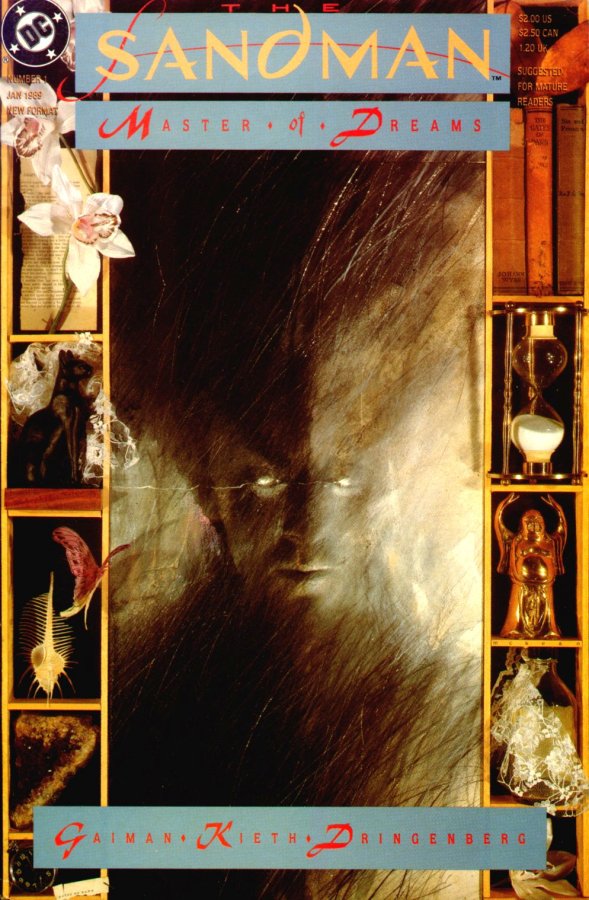
One feature of the school that I am glad now applies to me is the MILL, or comic book library and reading room (yeah, we know). It is an amazing room filled with extensive collections of golden-age franchises and a surprising depth of non-Japanese modern comics. I spent five hours of my Sunday reading the first volume of the complete collection of The Sandman. I don’t really want to go too much into it here, because I plan on giving a full review once I finish the omnibus. However, it does fit into the unintended theme of the post: religious speculative fiction.
2.
Every once in a while, I fall in love with the story of the creation of a work more than the merits of the work itself. That is why I was so happy that Ken Follett’s novel The Pillars of the Earth was so entertaining and well written. I really love the idea of a pulp spy novel writer publishing a 600+ page historical novel set in 12th Century England and having it take off. I understand those who might not consider it highbrow literature; it is extremely plot heavy and the occasional winks to the modern reader in conversations among the characters, but I found it thoroughly enjoyable and well worth my time. Follett does an incredible job of dramatizing the scale and glory of cathedrals. I found myself doubting the idea that a cathedral would be completed within the lifetime of any person, but that only underscores the sheer ambition of those that were constructed over centuries.
It also made me a little sad that we really have evolved as a global society beyond such works on that scale. Can you imagine a building project that employs hundreds of workers for centuries being started now? The Notre Dame in Paris took 300 years to complete. The new cathedral in Los Angeles was built in 8.
3.
Anathem by Neal Stephenson is probably the largest-scale work I have ever read. The size of it is intimidating; the final page count is 890. Stephenson not only creates his own universe within the pages of the books, but four parallel universes that touch it. Every page feels like it is the synthesis of hundreds of pages of philosophical and mathematic research read while the book was being written.
Stephenson is a little bit like the Eddie Izzard of the science fiction genre. Like Izzard, he uses the tropes and conventions of his form, but he makes it such an intellectual exercise that it feels like nothing you’ve ever read before, even if its about, you know, aliens. Many times I found myself unable to distinguish between real philosophical ideas and the fiction part of science fiction.
Like everything else, I am a little bit late to the party on this one, but if you feel like you can keep up with the ideas in the book, and you have the time to read an almost 900 page novel, I reccomend it.
I didn’t exactly hide the reputation of Reed College from my parents when I was doing college applications, per se. I just emphasized certain aspects of its reputation more than others. To be fair, Reed didn’t make it easy on me. The day that I called my parents to tell them that I had made my decision, the news broke that a Reed student had died of a heroin overdose. I knew that my parents had a lot of confidence in me to make good decisions, but I also knew better than to emphasize its eternal presence on the “Students Ignore God On A Regular Basis” list or its toleration of experimentation to my conservative Christian parents. Imagine my surprise, then, when my mother told me that all of her friends had already heard of Reed College through Christian writer Donald Miller’s book Blue Like Jazz: Nonreligious Thoughts on Christian Spirituality.
In theory, this should have been the perfect book for me. I grew up in the church, but unlike myriad other gays that grew up in the church, I don’t hate it, and I don’t hate Christians. I like most Christian people, and still consider the people in the church that I grew up in part of my family, even though I think very differently than I do now. It’s one of life’s little ironies that all of the Christian education that I went through as a child worked. I carry the Bible in my heart exactly like they wanted; I can no more divorce it from my psyche than change the color of my eyes. I am comfortable with that, my problems with Christianity rarely lay in the Bible. I left the church because once I left for school I was confronted with people that made lifestyle choices and thought in ways that the church had always said would lead to immorality, and found that I could not condemn them. Once I realized that I was learning more about universal love and acceptance in a dead secular academic environment than in church, I had to leave.

 Never fear, Thailand – Spiderman to the rescue! A young boy was saved from a third floor window ledge by a fireman dressed as the comic book superhero after the autistic lad refused to come down.

 Unfortunately, that connection was nonexistent between the soloist and the conductor during the Rhapsody. Horatio Gutierrez was the piano soloist, and he played clearly and with the seemingly effortless grace and fluidity that only comes with practice and mastery. Gutierrez, at least physically, is the complete opposite of Lindu. He is an enormous man, which made it all the more astonishing to me that he played with such ease. All of the rapid scalar and chordal passages were flawless and clear, but the piece was plagued by tempo problems. A few times the soloist got so much faster than the orchestra that the conductor actually had to turn to him and make a desperate, “There are other people playing, you know” face. Things finally got together enough that the famous Variation 18 was executed flawlessly. I am not the first person to say this, but it is truly amazing that by simply inverting a fraction of the original melody by Paganini, Rachmaninov creates a passage that seems as though it is his own creation. In other words, I could play a recording of that variation and say to someone, “That. That is what Rachmaninov sounds like.”