Get Used to It

We’re Here [HBO]. Three drag queens not named RuPaul take a Priscilla/Too Wong Foo tour through small towns across America to stage drag shows and use their power to validate and heal local queer scenes.

I loved gay culture, like so many of us did, before I loved my gay self. I loved the sense of humor and the aesthetic and the love for the forgotten and the neglected. I learned to love myself eventually, and only now am I truly understanding what it means to love and to gather close to the most defiant and challenging of us: the sissies and the faggots, the bullied and abused.

There’s so much power in the experience of learning to love yourself. That’s something that Queer Eye taps into so deeply. The danger in Queer Eye is that it muddies the line between who you are and what you buy (although much much less than its original incarnation) and also in the sheer amount of space it occupies in queer representation. Some queer people, especially young people discovering themselves, may not have more access to queer adults than their Netflix account, and I worry that the aspirational devotion the show has towards its stars makes their confidence seem unattainable to younger queers.

I considered ditching We’re Here a few minutes into its first episode. I though its hosts, Shangela, Eureka, and Bob the Drag Queen, were doing a tired and derivative imitation of Queer Eye. I’m so glad that I gave the show a second chance, because once I figured out what it was doing it totally won me over.

The show has more or less a fixed format. Bob, Shangela, and Eureka roll into a small town (ranging from about 10k people to about 50k, from Pennsylvania to New Mexico). They explore downtown shops, locals don’t know what to make of them. They pick three locals to collaborate with to put on a free drag show: one is always a straight, cis guy. Another is a queer person who is trying with all of their might to be themself despite adverse conditions, like a wildflower in a thunderstorm. The third is a little loose, but the thread that connects them is that they are people who have chosen to stay in their home communities despite deep wounds, and who are in need of a little healing through community.
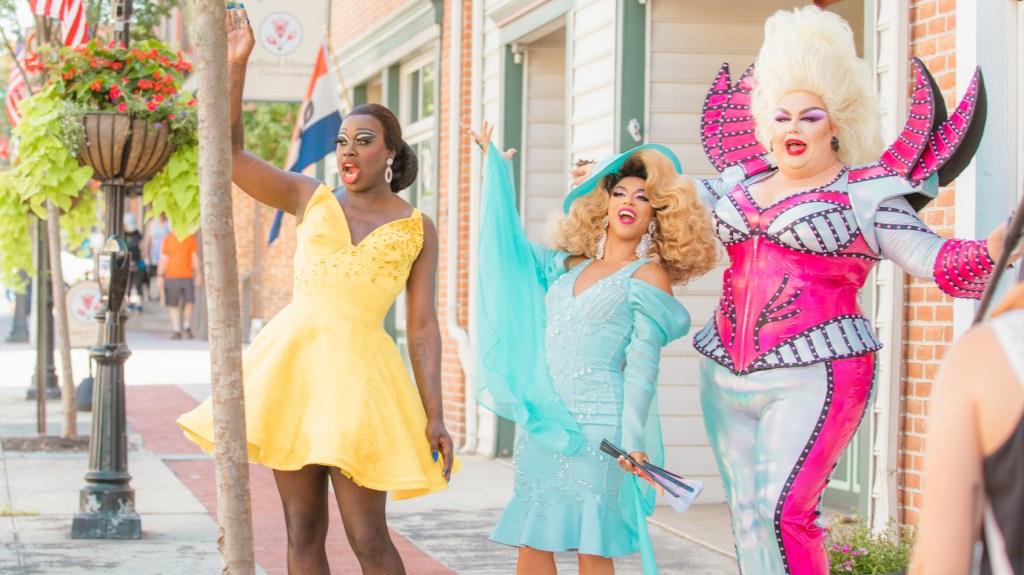
Bob the Drag Queen, Shangela and Eureka O’Hara/HBO’s We’re Here.

There is a little bit of “once in a lifetime experience”/“transformation” language—that’s what turned me off in the beginning—but the show is pretty straightforward about the fact that when the drag queens leave town, regular life will resume. “Your life is not going to change in one week” Shangela bluntly tells a young gay Latino man, José, in a Louisiana town. There’s a scene later in that episode where Shangela sits down with José’s mother so we can get the tearful scene where she tells him that she will always love him because he’s her son. What sets this show apart from the pack is the scene that comes afterward. “Moms always put on their best face for company,” Shangela says quietly. José’s face is guarded and ambivalent. He’s heard the love before. He’s also heard disappointment, disapproval, and scolding. It undercuts the drama of the moment, but it’s a thousand times more real than the staged scenes of reconciliation in Queer Eye, almost fraying in front of you at the edges of the frame.

This show would be so obnoxious and patronizing if it was about the big bad city queens showing small time yokels how it’s really done. What comes through so strongly is that, even though the locals are “crunchy,” according to an unusually shady Shangela in the episode in Twin Falls, Idaho, they have such respect for the people they are working with. The queers that stay in small towns are those who defy a whole host of voices—some loving, some hateful—that say that you are going to have a happier life if you don’t live it here. Queer people are delicate flowers. We flourish in environments where there is enough material abundance for beauty and grace to be valued, where self-expression is permitted, where difference is tolerated. Small town queer people are those flowers hanging on, fiercely, to life. The succulent rooted in sheer face of rock, the thistles growing on the side of the road, the tree that was uprooted by the storm but flowers anyway.

I was transfixed by the beauty of these people, the fierce way that they held on to their sense of themselves. A grandfather and a grandson, bonded so tight by love that there was no room for shame. Two gay men who have a beautiful friendship in which each is totally comfortable in the company of the other. The title carries a double meaning. It’s not just “we are now here” or “we’re here, we’re queer, get used to it,” it’s “look, we have always been here, right here, in your town. We’re your brother or cousin or granddaughter or boss or teacher.” The visiting drag queens are basically church planting. They are giving all of the local queer people a reason to gather together, a way for all of their allies to gather together by bringing this bubble of total queer acceptance and (almost) uncompromising queer aesthetic and letting everybody see each other and experience together what queer joy feels like. The shit that they stir up is the grit around which the pearl forms.

So in that way, it’s not like Queer Eye at all. It’s really the anti-Drag Race. (I think that Drag Race gets a lot of unfair hate. The critiques are totally valid, but they wouldn’t matter as much or sting when the show gets it wrong if there was a whole ecosystem of queer entertainment that was funded and promoted and critiqued and awarded like entertainment directed at straight audiences. That puts way more weight on Drag Race than it can support.) Drag Race is about gatekeeping, it’s about designating something as special, it’s about elevating regional talent into international spotlight. We’re Here is about recognizing that queer talent and beauty and joy is everywhere, and about the power of coming together and nurturing that in the places where you live.

This is for: queers who need a pick me up, people tired of LA/NY stories or having to pretend places like Houston, Chicago, or Atlanta are small towns because they are slightly smaller than those two cities, anyone really missing Pride this summer.

Not for: haters, cynics, the lactose intolerant.

Recommended. 🏳️‍🌈🏳️‍🌈🏳️‍🌈🏳️‍🌈/5

2020 Oscars

It was the Oscars tonight! I watched the full telecast for the first time in several years tonight, and thought it was a surprisingly inspiring and life-affirming broadcast. Here’s my picks of winners and losers this year.

Winners

Parasite. The winner that everybody is going to be talking about tomorrow is Parasite. The best case scenario is that this becomes an early episode in a process of the American film ecosystem becoming more curious about international films and less chauvinistic about Hollywood movies. There’s a lot to consider here: the politics of the movie, production nominations vs. acting nominations, the relationship of South Korean culture to US culture. I’m not informed enough to have an opinion on all that, what I do know is that the movie was very good and deserved every award it won tonight.

Olivia Coleman. She is glorious, and one of the sharpest, most witty people in entertainment right now. Her wit allows her to get away with saying things that push the envelope of taste with this regal dominance that is a joy to watch. There are few people who can take a stage like that and be so secure in their ownership of it that they can be playful. Every time she is on stage as “Olivia Colman,” it’s down to earth, warm, and with a hilarious angle that nobody else would take. This guy fucks.

Quality movies. One of the reasons that this Oscar year felt good was that there were relatively few victory lap/middlebrow consensus winners. There was a little more Ford vs. Ferrari and 1917 presence than I would like, but otherwise it seemed like all the winners were rewarded for outstanding work, rather than because of popularity

Corniness. Janelle Monaé opened the broadcast with “Come Alive” from The ArchAndroid. It’s not my favorite song, but the feel of the song is like this strange mixture of B-52’s/Violent Femmes novelty rock and Cab Calloway big band schmaltz. It (mostly) worked, and it was very corny. Also corny was Maya Rudolph and Kristin Wiig’s a capella songs-about-clothing melody that was both incredible and completely embarrassing. Very skit-from-your-theater-camp-counselor vibes.

Workers of the world. Julia Reichert is a documentarian who co-directed American Factory, which won Best Documentary. She has terminal cancer. In her speech, she recognized working people: ““Working people have it harder and harder these days — and we believe that things will get better when workers of the world unite.” I truly cannot imagine the emotions she must be experiencing, this wonderful validation and career highlight, in a time when she must be aware of every moment that she has left to live.

Frozen 2. I just loved everything about this performance. I love Idina Menzel (she was great in just a few minutes in Uncut Gems); I love when these kind of events can share the spotlight with performers that don’t always get this kind of reach and platform; I loved hearing the song in all of the different languages; I loved the haunting vocals (and very strange choice of staging) of the delightfully elfin Aurora; and I love the operatic power of many solo voices coming together and singing in harmony. Loved it.

The human quality of grace. Not everybody that won an award was able to accept it gracefully. That’s no knock on them, it’s a big event. Even Taika Waititi, who has a trickster energy and seems to be able to create a vaudevillian routine for every public appearance started to lose his hold on his composure when accepting his screenwriting award. But some others seemed to understand the power of the public platform that they were given, not feel rushed, and said what they felt like needed saying. It’s a wonderful human quality, grace. There is a physical sense of the word, graceful movements, graceful lines, etc. But the root of the word (Latin: “praising” “welcoming”) has to do with social interactions, the physical definition is the metaphor. It is being present in the moment and retaining your composure at the same time as you are aware of the different levels of context that are in operation. It’s like respect: if I am to be welcoming to you, I must not only choose to be welcoming, but be paying enough attention to you to understand how you will receive my gestures. The best speeches of the evening—Hildur Guðnadóttir for the Joker score, Carol Dysinger for Learning to Skate in a War Zone (If You’re a Girl), and Bong Joon Ho all evening—had this kind of grace.

Losers

Shia LeBeouf. Shia had a few years of psychotically bad behavior, but over the last few years has built up a portfolio of interesting performances. I have no insider knowledge, but my guess is that he is either incapable of making himself play nice with the media or he is still radioactive to publicists because his public image never really adjusted to where is is today. He presented a category with Zack Gottsagen, his costar of The Peanut Butter Falcon who has Down’s syndrome. Out of context, he had a moment where he seemed to get angry with and roll his eyes at Zack, but I believe was an expression of secondhand anxiety for Zack, who was struggling with stage fright. But for people who concluded that he was a dick and wrote him off in 2013, that seemed really dickish.

The Best Actor and the Best Actress. Both Joaquin Phoenix and Renée Zellweiger gave terrible acceptance speeches. Phoenix gave an emotional, rambling speech about human exploitation of nature and each other. You can’t talk about racism and animal rights and environmental rights in the same thought like that, you just can’t. There are ways to live in balance with nature while taking from nature what we need to survive. There is a range of opinions about whether there is a moral balance like that possible with animal protein and materials. There is no good, balanced way to exploit other human beings.

Zellweiger either winged it or thought that memorizing names would be enough because she read the entire production credits of Judy before getting to a personal message about rallying around “our heroes” with all of the coherence of Miss Teen South Carolina talking about maps in 2007.

Little Women. What a great movie. It should have been nominated for Best Director, it would have been a fine choice for Best Picture, and Florence Pugh was absolutely robbed by Laura Dern’s showy-performance-in-a-mediocre-movie for Best Supporting Actress. The only award it won was Best Costume, which was the only award it should not have won (all of the clothes in that movie were too clean).

Normal-sized women. There was an embarrassing amount of hollow “Girl Power” messaging that just underlined how shut out women were from directing and most of the technical categories. You don’t need any of that if people are getting jobs. That’s what people want, they just want their projects funded and to have a fair shot at getting hired.

Old men. There were moments of tension, where it seemed like the status quo of all-white and all-male categories cannot hold much longer. One guy who won an editing award thanked his wife for giving up her career to raise their kids, and it just clunked in the room. Chris Rock and Steve Martin had a couple of opening jokes, and they just seemed like dinosaurs. There’s enough momentum in the system that men who came up in it will be able to keep staying at the top, but the folks that are coming up now are—I am hopeful—bringing a different world with them, and there’s going to be a moment when that balance tips. This year felt like a step back, in terms of women and black nominees. But I don’t think the old boy’s world is coming back. These older, white artists have a challenge ahead of them, if they choose to engage with it. They have the opportunity to re-imagine a position in the industry that is not automatically on top. Some are going to choose to evolve, some are going to choose to hold onto the past with all of their strength.

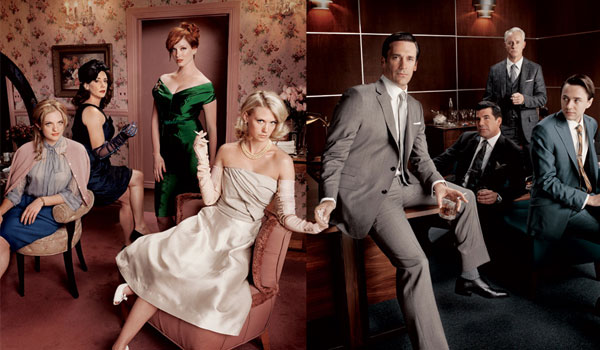
Mad Men & The Beatles


Readers who legitimately do not give a shit about Mad Men may still be interested in my comments on the Beatles album Revolver after the embedded YouTube video.
I have no interest whatsoever to blog seasons of television or do recaps or anything that needs to be timely or consistent, but I do want to say that I’m enjoying Mad Men so much this season; it may be my favorite season so far. I’m sure that almost everyone has decided at this point whether they’re into the show or not, so writing or talking about the show can feel a little circlejerky, but the show has changed so much over time that I feel like evangelizing the show all over again.
I feel like Mad Men‘s dramatic juice has always come from this combination of elements (and disregarding, for the moment, other concerns like marketing, costume design, cast etc.):

  1. The charisma and mystery and glamour of the character of Don Draper.
  2. The art and science of advertising, and
  3. The knowledge that the next decade, and the judgment of history, are going to hit this class of people like a bus.

Mad Men’s M.O. has generally been to foreground 1 & 2, while letting 3 work quietly in the background, visible only to the viewers. This formula has shifted over time. For one, Don Draper is just less mysterious. We may still be captivated by the way that he behaves and his responses to situations, but there’s no more puzzle to his history, and we’ve come a long way from watching him navigate between his wife and his piece on the side. For the last couple of seasons, even as the show stays anchored in the workplace, there is less emphasis on the advertising business. In the first season, it seemed like the show was going to establish a product-of-the-week format. This season, there have still been some high profile clients that contribute a C- or D-plot (Howard Johnson’s, Miracle Whip), but there’s less pontificating on the nature of advertising, fewer Draper pitches, fewer observations about what people want.
But where this season has been really shining is with that third element. Change has come to the foreground. Changes in music, in morés, style and class, there hasn’t been an episode this season where our characters haven’t been confronted by the culture moving to another place, or disrupted by a person that’s already there. One of my roommates is watching the show for the first time, and one huge contrast between the first season and the current season is the first season, both in both its style and its narrative, is about deeply controlled people. Their suits are fitted. Their lives, even as they are falling apart behind closed doors, are carefully compartmentalized. The most shocking moment of the pilot is Don Draper, who we’ve come to know in the context of his workplace, open his door and step into his role as father and husband. In comparison, this season is very messy. Characters are divorcing, shacking up; colors are loud, patterns clash; and the braintrust of Sterling Cooper Draper Pryce is increasingly buffeted by changes in mass taste and an increasingly politicized culture.
Some of the fun of this season is watching unexpected reactions to those changes–the same Roger Sterling who performed in blackface has seemingly skipped a generation and become an LSD-dropping nihilist, while the same Pete Campbell who was batted away from pursuing black-targeted accounts has begun to act out with all the propriety of a drunken salaryman at a karaoke bar–but none has been more interesting to watch than Don Draper. Because this is supposed to be the time where the culture catches up to Don Draper. In earlier seasons, Don is shown to be operating ten years ahead of his clients by producing ads that focus on the lives and desires of consumers rather than on products. At times, particularly in his preference for and interactions with strong, independent women, and his apparent dislike for the rules prescribed for men in gray suits, he has seemed like the audience-insertion character. Don’s pitches used to promise the future. But now we’re in the future, and it’s a new world of Beatles and beatniks, of civil rights and antiwar left, a world that Don is increasingly reluctant to embrace.


Last episode featured the Beatles song “Tomorrow Never Knows” in an extremely effective manner. This season has featured many “the 60’s are here” moments, but few have been as powerful as Ringo’s snare knocking on Don Draper’s door to introduce sounds that have become deeply integrated into contemporary pop culture’s DNA. And so I have found myself completely, and admittedly sheepishly, obsessed with Revolver.
It is because of the centrality of the Beatles catalogue to popular music that it has been hard for me to listen to their music as music, or listen to their albums like any other band. It was only a few months ago that I decided to try and listen to the albums through to get a sense of them as albums, instead of units containing some of the hits that I knew. I began with Sgt. Pepper’s, then slowly through  Rubber Soul  and Abbey Road. Somehow, I had not yet gotten to Revolver. I had heard from music people that Revolver was the best Beatles album, but I never appreciated the extent to which it–and Sgt. Pepper’s–are simply in a league of their own*. Rubber Soul is too indebted to their earlier pop rock sound, Abbey Road has a signal to noise ratio that’s too low, and Let It Be is moribund. In these two albums, they managed to do everything they do well right, and produce an astonishing amount of perfect songs on each. My the worst track on Revolver is either “Doctor Robert” or “Taxman,” and both of them are extraordinarily good songs.
*I’m going to break in with a couple of caveats here: One, a general disclaimer that I haven’t heard all of the albums yet. So I’ll admit the possibility that one of the other albums might just be that much better (though somehow I don’t think Magical Mystery Tour will be it). Two, it’s relevant that I really hate most of the early-Beatles, teen idol-y songs. I imagine that there is still some cohort that dislikes all of their albums after they went to India. But for me, almost all of those early albums are going to be disqualified.
Listening through Revolver also provided me with one of those cherished opportunities to check in with my own evolving tastes. I remember having a conversation with my piano teacher’s husband about whether we liked the Beatles by John Lennon or the Beatles by Paul McCartney better. I declared myself a McCartney man. My piano teacher told me to “give that time.” And that’s proven to be completely true. I can see where I was coming from; I played piano, and all of the best Beatles songs to play on the piano are Paul’s ballads (“Let It Be,””Yesterday”)**. Lennon’s songs tended to be more guitar-riff driven and  production-heavy.*** Scanning a tracklist of Revolver reveals that all of the songs that have been rocking my shit are Lennon songs.
**It took me time to discover that the best McCartney songs are the quasi-art songs: “She’s Leaving Home,” “Penny Lane” “The Long and Winding Road” etc. 
***Though, of course, those taxonomies can be deceptive. “Helter Skelter,” for example, is a McCartney song and is about as aggro as the Beatles get, while “Something” was written by George Harrison and is (with the exception of an extra-prominent guitar solo) almost a quintessential Paul song.
And now just a few thoughts on individual tracks:

  • “I’m Only Sleeping” and “Here, There and Everywhere” are weirdly mirror images of each other; the root of the chord progressions in their choruses are extremely similar, 1-2-3-4 (Here, There and Everywhere) and 1-2-3-2 (I’m Only Sleeping), yet I can’t stand HTE, and can’t get enough of IOS. IOS contains maybe my favorite use of sweet oohing harmonies, and the backtracked guitar solo is still just the greatest.
  • For all that the 90’s Britpop genre (Oasis, etc.) is pretty much defined by an indebtedness to the Beatles, “She Said, She Said” is maybe the only song in their catalog that I think could just be a 90’s song, if John Lennon didn’t have one of the most distinctive voices in rock. For that matter, the guitar intro could kick off a Pavement song. The drumming on this track is sublime; the only time that I have been completely impressed with Ringo Starr.
  • “For No One” is almost a perfect song, but the dotted rhythm at the end of “no sign of love behind the tears” is like jamming an icepick into my ears, I hate it that much.
  • “Tomorrow Never Knows” is still the greatest: epic tape loops and distortion; Lennon’s incantation-like delivery; anti-guitar solos; mystical nonsense that smells like profundity; a killer drum and bass ostinato; a maximalist masterpiece.

Waking Belle

20120120-221654.jpg

Saw the new Beauty and the Beast 3D rerelease tonight. I don’t have any special thoughts about the movie, as it has always been one of my favorites. I was a little too young to see it in theaters, however, and it did remind me that even now with high definition televisions and movie players the theater experience is something special.

It also made me think about Howard Ashman, the composer of Little Shop of Horrors, The Little Mermaid and Beauty and the Beast and a beautiful soul. His tragic young death of AIDS on the eve of Beauty’s release is covered in the excellent 2009 documentary, Waking Sleeping Beauty. We can never know what movies we’re missing if the dream team of Howard Ashman, Alan Menken, and the Disney Animation team were able to continue.