
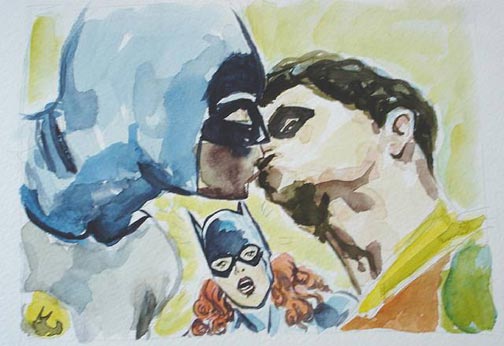
The Queer Crusader

Batman and Robin kissing, as realized by Mark Chamberlain.

This is an item from late April, but I think it’s so good that I’m going to throw it up now:

Prompted by writer Grant Morrison’s assertion that “Gayness is built into Batman. … Batman is very, very gay. There’s just no denying it. Obviously as a fictional character he’s intended to be heterosexual, but the basis of the whole concept is utterly gay.”; Comics Alliance writer Andrew Wheeler put together this barnburner of a post, giving context and explanation in defense of Morrison’s words.  There are pretty great tidbits in it:

When we talk about Batman’s gayness, we talk about presentation and perception. Writers as diverse as Bill Finger, Alan Grant, Devin Grayson and Frank Miller have all said that Batman is not gay; but they have all been asked the question. It’s not a question that generally gets asked about other heroes, but in the public imagination it’s one of the first questions asked about Batman. Psychologist Travis Langley, who co-wrote a book on the psychology of Batman, says it’s the question he was asked most often when he told people what he was working on.

and, after establishing Batman’s popularity among closeted gay men in the 1940’s:

We reject or deride the sexualization of Batman’s relationship with Robin precisely because of the worrying implications of eroticizing Robin, but that reading takes the roots of Batman’s gayness in the wrong direction. For gay readers in the 1940s, the introduction of Robin to Detective Comics did not sexualize Robin; it sexualized Batman. It created what Wertham called “a wish dream of two homosexuals living together,” a visible idealization of a same-sex relationship in an era when homosexuality had no mainstream recognition. The gayness of Batman was not just a joke about sidekicks, it was a scrap of identification for a starved gay audience. Robin established Batman as an early totem for a nascent and repressed gay subculture.

I think this is spot-on (though take a look at the original article’s comments to find plenty that disagree). A little over a year ago, in a post on Ta-Nehisi Coates’ blog, I made this comment:

I have nothing to contribute regarding In Memorium, however I do identify with l robert’s observation that “We each have a natural instinct to claim that love as “our own” in some way.”

Consider the great discrepancy between how heterosexual and homosexual relationships are modeled in the culture. Kids are exposed to normative models of heterosexual relationships constantly. Many are never exposed to homosexual relationships at all. Thus a young gay person’s understanding of themself goes hand in hand with an understanding that they are outside the mainstream.

That may seem like Queer 101, but it’s important to keep this in mind because I think it produces a (perhaps lifelong) hunger for representations of people like you in the relationships you want to be in. And because those themes have only been written about openly in Western culture in the past couple of hundred years, a lot of borrowing goes on.

Forgive the self-plagiarism, but I think the point stands. Please, read the Comics Alliance post.

postscript

in looking for a picture, I came across this:

also this Wikipedia page: Homosexuality in the Batman franchise.

The Cleveland Orchestra & the “Local Orchestra”

One of Portland artist Trixie Biltmore's impressions of Portland Opera's production of Hansel and Gretel. http://www.meencomics.com


Greg Sandow in the Wall Street Journal on Enrique Fernandez, the Cleveland Orchestra’s new “critic-in-residence”:

Despite his resounding title, Mr. Fernández is not a critic in the ordinary sense of the word. His blog, which you can visit by going to clevelandorchestramiami.com and clicking on “blog,” is an online magazine that runs feature pieces about the orchestra and its activities in Miami. In addition, Mr. Fernández invites concertgoers to post their own thoughts on the orchestra’s performances: “Online everybody’s a critic…. Comment on the concert you are about to experience. Review if you wish, if you must. Hey, it’s your ticket, rave on, pan on.”Mr. Fernández and the Cleveland Orchestra are clearly trying to come up with an institutional equivalent of the “online communities” that spring up around homemade blogs. This kind of blogging is still relatively new in the world of art, and to date the only institutions that seem to have embraced it wholeheartedly are museums (an especially good example is the Los Angeles County Museum of Art’s “Unframed,” which is at lacma.wordpress.com). Classical-music organizations, by contrast, seem ill at ease with the openness and interactivity of blogging, and even the best of their efforts, such as the St. Louis Symphony’s STL Symphony Blog (stlsymphony.org/blog), tend to be one-way operations that aren’t open to comments or email from readers.

As much as I usually disagree with Sandow, he’s absolutely right in questioning “new media” ventures that don’t engage in a thoughtful way with their audience. An orchestra blog without a personal perspective or engagement with commenters and other bloggers is nothing more than a glorified press release. It’s also true that only the biggest players in the game can afford–as in, “stop losing your audience” afford–to not participate (and it should be noted that the big players can get away with not directly engaging with their audience because there’s a cohort of bloggers who are willing to translate and comment upon press releases).

One of the best organizational efforts that I’ve come across trying to really understand a local audience and reach out a build a new audience is the Portland Opera’s Comic’s Night. From their press release (ok, sometimes this works):

In an effort to reach out to new audiences and new communities, Portland Opera is pleased to announce its first-ever Comic Artist Night @ the Opera on Monday, September 20.  Taking advantage of Portland’s wealth of comic talent, the Opera has invited 20 artists to attend a dress rehearsal and draw whatever inspires them about the production.  They’ll also receive a backstage tour prior to the show and front row seats during the show so that they can see every single operatic expression on stage.  The artists will share the results of the evening with their online communities and Portland Opera will share the artist’s work with our patrons at the theater as well as posting the work online at www.portlandopera.org.

I thought this was a fantastic venture, for a few reasons:

  1. It showed an understanding of the local audience. One of the most consistently frustrating things about regional classical music organizations is that there is often a distance between the organization and their city. Yet at the same time, we’re asked to support the local symphony, or opera house as a civic symbol and representation of our city. This was a real, genuine, smart play to one of Portland’s strengths.
  2. It attracted different press, therefore different readers. I actually read about Comics Night in comics blogs and the local alt-weekly (the same paper that will show classical listings on its music page, but would never promote a classical concert). That’s huge exposure to an audience–young, local, in to music–that classical organizations desperately want.
  3. It provided an entrance point for first-time operagoers. Opera is intimidating and weird. Many of the artists address that in their comics. Somebody whose curiosity is piqued by the comics will not be so discouraged by the newness of the experience.
  4. It solves the problem of promotional materials. On the internet, there’s an abundance of promotional materials that give some idea of what you’re getting yourself into if you want to see a live show. Curious about a standup comic? Check YouTube. What else has this artist done? Check the portfolio on their website. Band you’ve never heard of? You can be sure that any band getting started today has an online media presence before they play their first live show. At any point, these promotional materials can get picked up by other aggregators and go viral. Classical music doesn’t have that. This is partly a practical constraint; it would be impossible to have an opera trailer ready months before a performance, and orchestras have similar conditions. The comics produced by the local Portland artists, however, provide a subjective (in perspective) and objective (they are free to draw whatever they want) hook to draw in an audience. And this is mostly because…
  5. The comics produced were really cool. This is the most important part, and also the hardest to fake.

We now have a large population of people that grew up as the internet matured as a technology. The share of the population that grew up with internet access will only increase. This creates a new kind of media literacy, an intuitive sense that gets really excited by a group of artists invited to share their impressions of an opera preview, a sense that skips right by an astroturf-filled “blog” without even reading it.

More comics inspired by Hansel and Gretel can be seen in Portland Opera’s Facebook album.

The Cleveland Orchestra & the "Local Orchestra"

One of Portland artist Trixie Biltmore's impressions of Portland Opera's production of Hansel and Gretel. http://www.meencomics.com


Greg Sandow in the Wall Street Journal on Enrique Fernandez, the Cleveland Orchestra’s new “critic-in-residence”:

Despite his resounding title, Mr. Fernández is not a critic in the ordinary sense of the word. His blog, which you can visit by going to clevelandorchestramiami.com and clicking on “blog,” is an online magazine that runs feature pieces about the orchestra and its activities in Miami. In addition, Mr. Fernández invites concertgoers to post their own thoughts on the orchestra’s performances: “Online everybody’s a critic…. Comment on the concert you are about to experience. Review if you wish, if you must. Hey, it’s your ticket, rave on, pan on.”Mr. Fernández and the Cleveland Orchestra are clearly trying to come up with an institutional equivalent of the “online communities” that spring up around homemade blogs. This kind of blogging is still relatively new in the world of art, and to date the only institutions that seem to have embraced it wholeheartedly are museums (an especially good example is the Los Angeles County Museum of Art’s “Unframed,” which is at lacma.wordpress.com). Classical-music organizations, by contrast, seem ill at ease with the openness and interactivity of blogging, and even the best of their efforts, such as the St. Louis Symphony’s STL Symphony Blog (stlsymphony.org/blog), tend to be one-way operations that aren’t open to comments or email from readers.

As much as I usually disagree with Sandow, he’s absolutely right in questioning “new media” ventures that don’t engage in a thoughtful way with their audience. An orchestra blog without a personal perspective or engagement with commenters and other bloggers is nothing more than a glorified press release. It’s also true that only the biggest players in the game can afford–as in, “stop losing your audience” afford–to not participate (and it should be noted that the big players can get away with not directly engaging with their audience because there’s a cohort of bloggers who are willing to translate and comment upon press releases).
One of the best organizational efforts that I’ve come across trying to really understand a local audience and reach out a build a new audience is the Portland Opera’s Comic’s Night. From their press release (ok, sometimes this works):

In an effort to reach out to new audiences and new communities, Portland Opera is pleased to announce its first-ever Comic Artist Night @ the Opera on Monday, September 20.  Taking advantage of Portland’s wealth of comic talent, the Opera has invited 20 artists to attend a dress rehearsal and draw whatever inspires them about the production.  They’ll also receive a backstage tour prior to the show and front row seats during the show so that they can see every single operatic expression on stage.  The artists will share the results of the evening with their online communities and Portland Opera will share the artist’s work with our patrons at the theater as well as posting the work online at www.portlandopera.org.

I thought this was a fantastic venture, for a few reasons:

  1. It showed an understanding of the local audience. One of the most consistently frustrating things about regional classical music organizations is that there is often a distance between the organization and their city. Yet at the same time, we’re asked to support the local symphony, or opera house as a civic symbol and representation of our city. This was a real, genuine, smart play to one of Portland’s strengths.
  2. It attracted different press, therefore different readers. I actually read about Comics Night in comics blogs and the local alt-weekly (the same paper that will show classical listings on its music page, but would never promote a classical concert). That’s huge exposure to an audience–young, local, in to music–that classical organizations desperately want.
  3. It provided an entrance point for first-time operagoers. Opera is intimidating and weird. Many of the artists address that in their comics. Somebody whose curiosity is piqued by the comics will not be so discouraged by the newness of the experience.
  4. It solves the problem of promotional materials. On the internet, there’s an abundance of promotional materials that give some idea of what you’re getting yourself into if you want to see a live show. Curious about a standup comic? Check YouTube. What else has this artist done? Check the portfolio on their website. Band you’ve never heard of? You can be sure that any band getting started today has an online media presence before they play their first live show. At any point, these promotional materials can get picked up by other aggregators and go viral. Classical music doesn’t have that. This is partly a practical constraint; it would be impossible to have an opera trailer ready months before a performance, and orchestras have similar conditions. The comics produced by the local Portland artists, however, provide a subjective (in perspective) and objective (they are free to draw whatever they want) hook to draw in an audience. And this is mostly because…
  5. The comics produced were really cool. This is the most important part, and also the hardest to fake.

We now have a large population of people that grew up as the internet matured as a technology. The share of the population that grew up with internet access will only increase. This creates a new kind of media literacy, an intuitive sense that gets really excited by a group of artists invited to share their impressions of an opera preview, a sense that skips right by an astroturf-filled “blog” without even reading it.
More comics inspired by Hansel and Gretel can be seen in Portland Opera’s Facebook album.

The Cleveland Orchestra & the "Local Orchestra"

One of Portland artist Trixie Biltmore's impressions of Portland Opera's production of Hansel and Gretel. http://www.meencomics.com


Greg Sandow in the Wall Street Journal on Enrique Fernandez, the Cleveland Orchestra’s new “critic-in-residence”:

Despite his resounding title, Mr. Fernández is not a critic in the ordinary sense of the word. His blog, which you can visit by going to clevelandorchestramiami.com and clicking on “blog,” is an online magazine that runs feature pieces about the orchestra and its activities in Miami. In addition, Mr. Fernández invites concertgoers to post their own thoughts on the orchestra’s performances: “Online everybody’s a critic…. Comment on the concert you are about to experience. Review if you wish, if you must. Hey, it’s your ticket, rave on, pan on.”Mr. Fernández and the Cleveland Orchestra are clearly trying to come up with an institutional equivalent of the “online communities” that spring up around homemade blogs. This kind of blogging is still relatively new in the world of art, and to date the only institutions that seem to have embraced it wholeheartedly are museums (an especially good example is the Los Angeles County Museum of Art’s “Unframed,” which is at lacma.wordpress.com). Classical-music organizations, by contrast, seem ill at ease with the openness and interactivity of blogging, and even the best of their efforts, such as the St. Louis Symphony’s STL Symphony Blog (stlsymphony.org/blog), tend to be one-way operations that aren’t open to comments or email from readers.

As much as I usually disagree with Sandow, he’s absolutely right in questioning “new media” ventures that don’t engage in a thoughtful way with their audience. An orchestra blog without a personal perspective or engagement with commenters and other bloggers is nothing more than a glorified press release. It’s also true that only the biggest players in the game can afford–as in, “stop losing your audience” afford–to not participate (and it should be noted that the big players can get away with not directly engaging with their audience because there’s a cohort of bloggers who are willing to translate and comment upon press releases).
One of the best organizational efforts that I’ve come across trying to really understand a local audience and reach out a build a new audience is the Portland Opera’s Comic’s Night. From their press release (ok, sometimes this works):

In an effort to reach out to new audiences and new communities, Portland Opera is pleased to announce its first-ever Comic Artist Night @ the Opera on Monday, September 20.  Taking advantage of Portland’s wealth of comic talent, the Opera has invited 20 artists to attend a dress rehearsal and draw whatever inspires them about the production.  They’ll also receive a backstage tour prior to the show and front row seats during the show so that they can see every single operatic expression on stage.  The artists will share the results of the evening with their online communities and Portland Opera will share the artist’s work with our patrons at the theater as well as posting the work online at www.portlandopera.org.

I thought this was a fantastic venture, for a few reasons:

  1. It showed an understanding of the local audience. One of the most consistently frustrating things about regional classical music organizations is that there is often a distance between the organization and their city. Yet at the same time, we’re asked to support the local symphony, or opera house as a civic symbol and representation of our city. This was a real, genuine, smart play to one of Portland’s strengths.
  2. It attracted different press, therefore different readers. I actually read about Comics Night in comics blogs and the local alt-weekly (the same paper that will show classical listings on its music page, but would never promote a classical concert). That’s huge exposure to an audience–young, local, in to music–that classical organizations desperately want.
  3. It provided an entrance point for first-time operagoers. Opera is intimidating and weird. Many of the artists address that in their comics. Somebody whose curiosity is piqued by the comics will not be so discouraged by the newness of the experience.
  4. It solves the problem of promotional materials. On the internet, there’s an abundance of promotional materials that give some idea of what you’re getting yourself into if you want to see a live show. Curious about a standup comic? Check YouTube. What else has this artist done? Check the portfolio on their website. Band you’ve never heard of? You can be sure that any band getting started today has an online media presence before they play their first live show. At any point, these promotional materials can get picked up by other aggregators and go viral. Classical music doesn’t have that. This is partly a practical constraint; it would be impossible to have an opera trailer ready months before a performance, and orchestras have similar conditions. The comics produced by the local Portland artists, however, provide a subjective (in perspective) and objective (they are free to draw whatever they want) hook to draw in an audience. And this is mostly because…
  5. The comics produced were really cool. This is the most important part, and also the hardest to fake.

We now have a large population of people that grew up as the internet matured as a technology. The share of the population that grew up with internet access will only increase. This creates a new kind of media literacy, an intuitive sense that gets really excited by a group of artists invited to share their impressions of an opera preview, a sense that skips right by an astroturf-filled “blog” without even reading it.
More comics inspired by Hansel and Gretel can be seen in Portland Opera’s Facebook album.

It never rains…

This week has been awful. But at the end of it, I dropped my chemistry class, so maybe the rest of the semester will be less awful. Ironically, although I’ve been busy, I seem to have made it through a suprising amount of media works. There’s nothing that I particularly want to promote, or have the energy to write a full review of, so I’ll just give quick reviews here.

Jeff Lemire – The Complete Essex County

Essex County is a stark story expressed in stark style with stark technique. Interestingly, if I had to pick a single phrase to describe it, it would be “a Canadian 100 Years of Solitude comic book.” I don’t want to discuss the story for fear of spoiling it, but the graphic novel spends a lot of time showing what extended periods of lonlieness and solitude do to people emotionally and relating that to the geography and culture of rural Canada.

All of this is rendered in Lemire’s rough, monochromatic ink style, which perfectly illustrates the empty isolation in which most of his characters live. One powerful sequence shows the seasonal transitions on the farm, and we see that nothing changes, whether it is snow as far as the eye can see, corn rows as far as the eye can see, bare furrows…

Another aspect of the comic that I found interesting was the way in which it resembled Southern Gothic literature. This is not a perfect parallel; there is no Canadian analogue to the Civil War and race relations are much different there, yet as in Faulkner the rural isolation, long history, and buried secrets made me feel like I was missing something in every panel I read. I felt like because I am not from Essex County, I couldn’t really understand what was going on. Fortunately Lemire is humane and exposes those relationships (in a very exciting way, no less).

I wouldn’t say it’s perfect, but the story gives plenty to think about and some of the artwork is worth it on its own.

Ned Rorem – The Paris Diary

Ned Rorem was a young, beautiful, gay, American composer who ran around in Parisian expatriate and artistic circles in the mid-1950’s. In short, he was the person that I wish I could be at the time that I wish I could have been. I was surprised to find that he does not talk a whole lot about his work, but there are some personal insights into other composers of the time that I can’t imagine one could find anywhere else, and Rorem’s youthful, neurotic narration is entertaining and provoking in its own right.  I did find the untranslated use of French somewhat annoying (thanks, Babelfish!) and at times I felt like I was intruding into Rorem’s beautiful-people problems (“It’s much harder to maintain one’s reputation for being pretty than for being a talented composer”), but I’m just bitching so that this review doesn’t read as me drooling all over myself.

Arturo Perez-Reverte – The Club Dumas

As I was reading this, I was struck by how similar this book is to Matthew Pearl’s The Dante Club. Both involve clues embedded in the works of historical writers. Both involve brushes with the occult. But Dante is superior in every way to Dumas. It should be mentioned that Dumas was published a full decade before Pearl’s book, but in this case originality does not trump execution. Skip Dumas, read Dante.

Neal Stephenson – Quicksilver

This is my latest stop on my quest to read all of Stephenson’s works. Honestly, the book is just too long for me to feel comfortable reccomending it to anybody. It’s not that I don’t think it’s good (I do!), but at 900 pages (and don’t forget that it’s the first installment of a trilogy), I don’t want to be responsible for wasting anybody’s time. If you’ve liked anything by him before, you’ll probably like this.

The Big Sleep

It was weird watching this; I’ve seen so many neo-noir and parodies of the Bogart drawl, casual sexism and L.A. cool epitomized in this movie that I felt like I had seen it before. It seems to have scared me off of The Maltese Falcon, however. As one of the few people of my generation that has read quite a few of the classic pulp mystery novels, I can tell you that Bogart fits as Phillip Marlowe, but is completely wrong for Sam Spade.

The Exorcist

Meh. I was high and it wasn’t as scary.