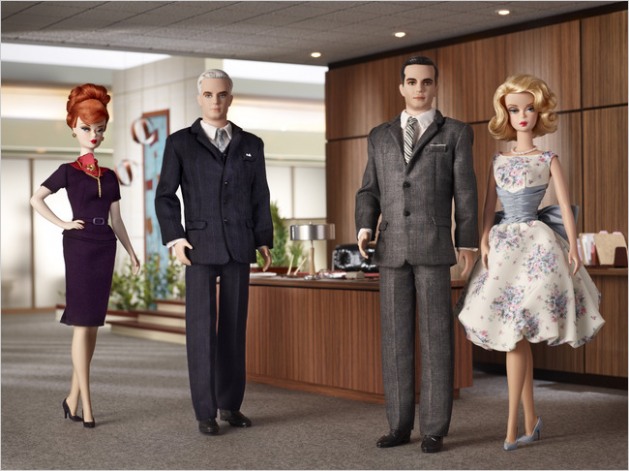
Parameters

Thursday

I spent my morning writing and reading and me-timing. I unplugged my headphones from my phone when I got to work, and when I next tried to plug them in, I realized that the headphone jack was fucked. I listen on my phone so much that it felt like a real loss of something. Everything has a workaround, and I had been thinking about ways to try and leave my ears open when I walk and I’m out in the world (if I have solitary time like that, it’s nearly impossible for me to resist listening to podcasts, and I worry that the chatty flow of interesting information, while amazing, also mitigates some of the imagination-stimulating properties of alone time). It still sucks to not have a choice. Between this and the damage to my car from a couple of weeks ago, I worry that I’m going to hit a period where it seems like Everything Is Breaking And I Have No Plans For Replacing Them.

Maybe this is why balance is overrated. Maybe this is why balance is overrated?

I ran some errands in the afternoon. For my hour with the fourth graders, we played this fairly fun, but chaotic and tiring (for me, that is. The kids seem to be into it.) game, so I was running low on energy. The next hour, however, perked me back up, because I was running a computer skills program. We are working on a project where we are creating a simple game using the kids visual programming language Scratch. I love teaching this program: it puts me in a room with the kids that are actually curious and enthusiastic about something that I share, and I love helping with their problems. I love their problems. Despite all the talk of digital natives, kids don’t know shit about computers, and its fun to teach them basic thing like how to save something or reopen old projects.

I was jonesing for spaghetti for some reason, so I stopped by the grocery store to get some missing ingredients. When I got home, my roommates were out or asleep, so I made my pasta. When it was finished, I offered some to Luke Skywalker, and we ate and watched the newest episode of Mad Men. 
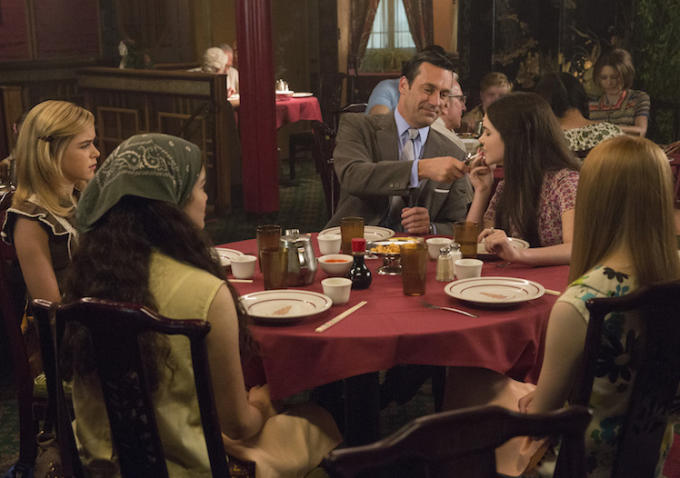
download

The first season is so fascinated by Don Draper, such a believer in his talents and his creative vision and insights that we become believers too. We have gotten in on the ground floor for this guy who is going to sell all the sugar water, elect all the presidents, define cool. Then the show never gave him that moment. At this point, most of the show is Don-Draper-knocked-off-his-game, not the cool Don that gave the show its early heat. Last season, I had to accept that the show had moved on, and decide to just take the show as it is. For that reason, the show hasn’t been super great (except for the generally excellent writing and acting), but hasn’t disappointed either. I kind of have a 5th season of LOST feeling about it: even if the last four episodes are fantastic, the last two seasons of the show have been so mediocre that I don’t think the show is ever going to deliver on the promise of its first season.

The light goes out, cycle completes. Dreams have been cinematic for the last few nights.

Friday

I woke up early on Friday morning to get to an all day training. I usually look forward to trainings, because I like breaks from routine. By the end of the day, I usually want to murder someone. I know this, and I still look forward to training days.

I stopped for muffin and coffee at the 7-Eleven, and say hi to the woman that owns it, who always seems to smile and remember me when I come into the store. She looks at me like a mother looks at her son. I imagine that she doesn’t like selling me cigarettes. Until this very moment, I hadn’t questioned that maybe that’s a projection, or that maybe I look at her like a son does to his mother.

I arrive at our location in Sellwood. We get trained on how to use an Epi-Pen. Awkward icebreakers are mercifully fewer than usual. Over time, I have become less game for icebreakers, and less generous with my sincerity. Withholding doesn’t feel great either, but I have a lot of suppressed irritation. Nobody is proud of their work, which encourages isolation, because nobody except your co-workers will understand exactly what you do to make do given what you have to work with.

I spend most of the time during the training writing in my journal. I do a little time travel, and start to write down—in as much detail as I had the discipline for—an interaction I had with an upset boy who’s parents are going through a rough divorce. It was a good exercise, and I try and write down his dialogue, which I very rarely try and capture. It made me think about how dull my memory is for the language of conversation, and how impatient I can get when I just try and get it down and not take the time to turn the words over in my head until they seem like they could plausibly come from the boy’s mouth.

We lunched at a Vietnamese fusion bistro, and I had excellent food and a very good sesame ball.

The second half of the day was even stupider than the first, though shorter. Thank the lord. The maintenance crew did a full vehicle audit while we were doing morning training, and a lot of concerning things were found. It’s good that they were found, but I am very not shocked (look at my face to see how shocked I am) that some stupid, dumb, easy, things were really bad, like the van that was almost completely out of oil. Its a weird, broken place right now and all I want to do is leave.

When I got home, I dozed before Hunter Thompson’s going away party. Before leaving, I played a bizarre game called Frog Fractions which is a very meta indie game that I enjoyed a lot. I probably wouldn’t have played it if it had been described to me ahead of time, but I’m very glad that I did.

It was a very nice and sweet going away. There were many people there, and I had a few nice moments where it felt like I was mingling and having a good time. I realized about an hour in that my batteries were running down fast, and I needed to flee, so I hopped a ride back home and spent the rest of the evening playing games and watching tv and relaxing.
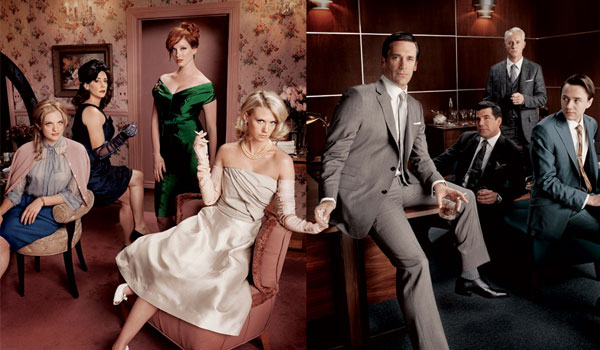
Mad Men & The Beatles


Readers who legitimately do not give a shit about Mad Men may still be interested in my comments on the Beatles album Revolver after the embedded YouTube video.
I have no interest whatsoever to blog seasons of television or do recaps or anything that needs to be timely or consistent, but I do want to say that I’m enjoying Mad Men so much this season; it may be my favorite season so far. I’m sure that almost everyone has decided at this point whether they’re into the show or not, so writing or talking about the show can feel a little circlejerky, but the show has changed so much over time that I feel like evangelizing the show all over again.
I feel like Mad Men‘s dramatic juice has always come from this combination of elements (and disregarding, for the moment, other concerns like marketing, costume design, cast etc.):

  1. The charisma and mystery and glamour of the character of Don Draper.
  2. The art and science of advertising, and
  3. The knowledge that the next decade, and the judgment of history, are going to hit this class of people like a bus.

Mad Men’s M.O. has generally been to foreground 1 & 2, while letting 3 work quietly in the background, visible only to the viewers. This formula has shifted over time. For one, Don Draper is just less mysterious. We may still be captivated by the way that he behaves and his responses to situations, but there’s no more puzzle to his history, and we’ve come a long way from watching him navigate between his wife and his piece on the side. For the last couple of seasons, even as the show stays anchored in the workplace, there is less emphasis on the advertising business. In the first season, it seemed like the show was going to establish a product-of-the-week format. This season, there have still been some high profile clients that contribute a C- or D-plot (Howard Johnson’s, Miracle Whip), but there’s less pontificating on the nature of advertising, fewer Draper pitches, fewer observations about what people want.
But where this season has been really shining is with that third element. Change has come to the foreground. Changes in music, in morés, style and class, there hasn’t been an episode this season where our characters haven’t been confronted by the culture moving to another place, or disrupted by a person that’s already there. One of my roommates is watching the show for the first time, and one huge contrast between the first season and the current season is the first season, both in both its style and its narrative, is about deeply controlled people. Their suits are fitted. Their lives, even as they are falling apart behind closed doors, are carefully compartmentalized. The most shocking moment of the pilot is Don Draper, who we’ve come to know in the context of his workplace, open his door and step into his role as father and husband. In comparison, this season is very messy. Characters are divorcing, shacking up; colors are loud, patterns clash; and the braintrust of Sterling Cooper Draper Pryce is increasingly buffeted by changes in mass taste and an increasingly politicized culture.
Some of the fun of this season is watching unexpected reactions to those changes–the same Roger Sterling who performed in blackface has seemingly skipped a generation and become an LSD-dropping nihilist, while the same Pete Campbell who was batted away from pursuing black-targeted accounts has begun to act out with all the propriety of a drunken salaryman at a karaoke bar–but none has been more interesting to watch than Don Draper. Because this is supposed to be the time where the culture catches up to Don Draper. In earlier seasons, Don is shown to be operating ten years ahead of his clients by producing ads that focus on the lives and desires of consumers rather than on products. At times, particularly in his preference for and interactions with strong, independent women, and his apparent dislike for the rules prescribed for men in gray suits, he has seemed like the audience-insertion character. Don’s pitches used to promise the future. But now we’re in the future, and it’s a new world of Beatles and beatniks, of civil rights and antiwar left, a world that Don is increasingly reluctant to embrace.


Last episode featured the Beatles song “Tomorrow Never Knows” in an extremely effective manner. This season has featured many “the 60’s are here” moments, but few have been as powerful as Ringo’s snare knocking on Don Draper’s door to introduce sounds that have become deeply integrated into contemporary pop culture’s DNA. And so I have found myself completely, and admittedly sheepishly, obsessed with Revolver.
It is because of the centrality of the Beatles catalogue to popular music that it has been hard for me to listen to their music as music, or listen to their albums like any other band. It was only a few months ago that I decided to try and listen to the albums through to get a sense of them as albums, instead of units containing some of the hits that I knew. I began with Sgt. Pepper’s, then slowly through  Rubber Soul  and Abbey Road. Somehow, I had not yet gotten to Revolver. I had heard from music people that Revolver was the best Beatles album, but I never appreciated the extent to which it–and Sgt. Pepper’s–are simply in a league of their own*. Rubber Soul is too indebted to their earlier pop rock sound, Abbey Road has a signal to noise ratio that’s too low, and Let It Be is moribund. In these two albums, they managed to do everything they do well right, and produce an astonishing amount of perfect songs on each. My the worst track on Revolver is either “Doctor Robert” or “Taxman,” and both of them are extraordinarily good songs.
*I’m going to break in with a couple of caveats here: One, a general disclaimer that I haven’t heard all of the albums yet. So I’ll admit the possibility that one of the other albums might just be that much better (though somehow I don’t think Magical Mystery Tour will be it). Two, it’s relevant that I really hate most of the early-Beatles, teen idol-y songs. I imagine that there is still some cohort that dislikes all of their albums after they went to India. But for me, almost all of those early albums are going to be disqualified.
Listening through Revolver also provided me with one of those cherished opportunities to check in with my own evolving tastes. I remember having a conversation with my piano teacher’s husband about whether we liked the Beatles by John Lennon or the Beatles by Paul McCartney better. I declared myself a McCartney man. My piano teacher told me to “give that time.” And that’s proven to be completely true. I can see where I was coming from; I played piano, and all of the best Beatles songs to play on the piano are Paul’s ballads (“Let It Be,””Yesterday”)**. Lennon’s songs tended to be more guitar-riff driven and  production-heavy.*** Scanning a tracklist of Revolver reveals that all of the songs that have been rocking my shit are Lennon songs.
**It took me time to discover that the best McCartney songs are the quasi-art songs: “She’s Leaving Home,” “Penny Lane” “The Long and Winding Road” etc. 
***Though, of course, those taxonomies can be deceptive. “Helter Skelter,” for example, is a McCartney song and is about as aggro as the Beatles get, while “Something” was written by George Harrison and is (with the exception of an extra-prominent guitar solo) almost a quintessential Paul song.
And now just a few thoughts on individual tracks:

  • “I’m Only Sleeping” and “Here, There and Everywhere” are weirdly mirror images of each other; the root of the chord progressions in their choruses are extremely similar, 1-2-3-4 (Here, There and Everywhere) and 1-2-3-2 (I’m Only Sleeping), yet I can’t stand HTE, and can’t get enough of IOS. IOS contains maybe my favorite use of sweet oohing harmonies, and the backtracked guitar solo is still just the greatest.
  • For all that the 90’s Britpop genre (Oasis, etc.) is pretty much defined by an indebtedness to the Beatles, “She Said, She Said” is maybe the only song in their catalog that I think could just be a 90’s song, if John Lennon didn’t have one of the most distinctive voices in rock. For that matter, the guitar intro could kick off a Pavement song. The drumming on this track is sublime; the only time that I have been completely impressed with Ringo Starr.
  • “For No One” is almost a perfect song, but the dotted rhythm at the end of “no sign of love behind the tears” is like jamming an icepick into my ears, I hate it that much.
  • “Tomorrow Never Knows” is still the greatest: epic tape loops and distortion; Lennon’s incantation-like delivery; anti-guitar solos; mystical nonsense that smells like profundity; a killer drum and bass ostinato; a maximalist masterpiece.

Mad Men & The Beatles

Readers who legitimately do not give a shit about Mad Men may still be interested in my comments on the Beatles album Revolver after the embedded YouTube video.

I have no interest whatsoever to blog seasons of television or do recaps or anything that needs to be timely or consistent, but I do want to say that I’m enjoying Mad Men so much this season; it may be my favorite season so far. I’m sure that almost everyone has decided at this point whether they’re into the show or not, so writing or talking about the show can feel a little circlejerky, but the show has changed so much over time that I feel like evangelizing the show all over again.

I feel like Mad Men‘s dramatic juice has always come from this combination of elements (and disregarding, for the moment, other concerns like marketing, costume design, cast etc.):

  1. The charisma and mystery and glamour of the character of Don Draper.
  2. The art and science of advertising, and
  3. The knowledge that the next decade, and the judgment of history, are going to hit this class of people like a bus.

Mad Men’s M.O. has generally been to foreground 1 & 2, while letting 3 work quietly in the background, visible only to the viewers. This formula has shifted over time. For one, Don Draper is just less mysterious. We may still be captivated by the way that he behaves and his responses to situations, but there’s no more puzzle to his history, and we’ve come a long way from watching him navigate between his wife and his piece on the side. For the last couple of seasons, even as the show stays anchored in the workplace, there is less emphasis on the advertising business. In the first season, it seemed like the show was going to establish a product-of-the-week format. This season, there have still been some high profile clients that contribute a C- or D-plot (Howard Johnson’s, Miracle Whip), but there’s less pontificating on the nature of advertising, fewer Draper pitches, fewer observations about what people want.

But where this season has been really shining is with that third element. Change has come to the foreground. Changes in music, in morés, style and class, there hasn’t been an episode this season where our characters haven’t been confronted by the culture moving to another place, or disrupted by a person that’s already there. One of my roommates is watching the show for the first time, and one huge contrast between the first season and the current season is the first season, both in both its style and its narrative, is about deeply controlled people. Their suits are fitted. Their lives, even as they are falling apart behind closed doors, are carefully compartmentalized. The most shocking moment of the pilot is Don Draper, who we’ve come to know in the context of his workplace, open his door and step into his role as father and husband. In comparison, this season is very messy. Characters are divorcing, shacking up; colors are loud, patterns clash; and the braintrust of Sterling Cooper Draper Pryce is increasingly buffeted by changes in mass taste and an increasingly politicized culture.

Some of the fun of this season is watching unexpected reactions to those changes–the same Roger Sterling who performed in blackface has seemingly skipped a generation and become an LSD-dropping nihilist, while the same Pete Campbell who was batted away from pursuing black-targeted accounts has begun to act out with all the propriety of a drunken salaryman at a karaoke bar–but none has been more interesting to watch than Don Draper. Because this is supposed to be the time where the culture catches up to Don Draper. In earlier seasons, Don is shown to be operating ten years ahead of his clients by producing ads that focus on the lives and desires of consumers rather than on products. At times, particularly in his preference for and interactions with strong, independent women, and his apparent dislike for the rules prescribed for men in gray suits, he has seemed like the audience-insertion character. Don’s pitches used to promise the future. But now we’re in the future, and it’s a new world of Beatles and beatniks, of civil rights and antiwar left, a world that Don is increasingly reluctant to embrace.

Last episode featured the Beatles song “Tomorrow Never Knows” in an extremely effective manner. This season has featured many “the 60’s are here” moments, but few have been as powerful as Ringo’s snare knocking on Don Draper’s door to introduce sounds that have become deeply integrated into contemporary pop culture’s DNA. And so I have found myself completely, and admittedly sheepishly, obsessed with Revolver.

It is because of the centrality of the Beatles catalogue to popular music that it has been hard for me to listen to their music as music, or listen to their albums like any other band. It was only a few months ago that I decided to try and listen to the albums through to get a sense of them as albums, instead of units containing some of the hits that I knew. I began with Sgt. Pepper’s, then slowly through  Rubber Soul  and Abbey Road. Somehow, I had not yet gotten to Revolver. I had heard from music people that Revolver was the best Beatles album, but I never appreciated the extent to which it–and Sgt. Pepper’s–are simply in a league of their own*. Rubber Soul is too indebted to their earlier pop rock sound, Abbey Road has a signal to noise ratio that’s too low, and Let It Be is moribund. In these two albums, they managed to do everything they do well right, and produce an astonishing amount of perfect songs on each. My the worst track on Revolver is either “Doctor Robert” or “Taxman,” and both of them are extraordinarily good songs.

*I’m going to break in with a couple of caveats here: One, a general disclaimer that I haven’t heard all of the albums yet. So I’ll admit the possibility that one of the other albums might just be that much better (though somehow I don’t think Magical Mystery Tour will be it). Two, it’s relevant that I really hate most of the early-Beatles, teen idol-y songs. I imagine that there is still some cohort that dislikes all of their albums after they went to India. But for me, almost all of those early albums are going to be disqualified.

Listening through Revolver also provided me with one of those cherished opportunities to check in with my own evolving tastes. I remember having a conversation with my piano teacher’s husband about whether we liked the Beatles by John Lennon or the Beatles by Paul McCartney better. I declared myself a McCartney man. My piano teacher told me to “give that time.” And that’s proven to be completely true. I can see where I was coming from; I played piano, and all of the best Beatles songs to play on the piano are Paul’s ballads (“Let It Be,””Yesterday”)**. Lennon’s songs tended to be more guitar-riff driven and  production-heavy.*** Scanning a tracklist of Revolver reveals that all of the songs that have been rocking my shit are Lennon songs.

**It took me time to discover that the best McCartney songs are the quasi-art songs: “She’s Leaving Home,” “Penny Lane” “The Long and Winding Road” etc. 

***Though, of course, those taxonomies can be deceptive. “Helter Skelter,” for example, is a McCartney song and is about as aggro as the Beatles get, while “Something” was written by George Harrison and is (with the exception of an extra-prominent guitar solo) almost a quintessential Paul song.

And now just a few thoughts on individual tracks:

  • “I’m Only Sleeping” and “Here, There and Everywhere” are weirdly mirror images of each other; the root of the chord progressions in their choruses are extremely similar, 1-2-3-4 (Here, There and Everywhere) and 1-2-3-2 (I’m Only Sleeping), yet I can’t stand HTE, and can’t get enough of IOS. IOS contains maybe my favorite use of sweet oohing harmonies, and the backtracked guitar solo is still just the greatest.
  • For all that the 90’s Britpop genre (Oasis, etc.) is pretty much defined by an indebtedness to the Beatles, “She Said, She Said” is maybe the only song in their catalog that I think could just be a 90’s song, if John Lennon didn’t have one of the most distinctive voices in rock. For that matter, the guitar intro could kick off a Pavement song. The drumming on this track is sublime; the only time that I have been completely impressed with Ringo Starr.
  • “For No One” is almost a perfect song, but the dotted rhythm at the end of “no sign of love behind the tears” is like jamming an icepick into my ears, I hate it that much.
  • “Tomorrow Never Knows” is still the greatest: epic tape loops and distortion; Lennon’s incantation-like delivery; anti-guitar solos; mystical nonsense that smells like profundity; a killer drum and bass ostinato; a maximalist masterpiece.

Daniel Mendelsohn on Mad Men

EDIT: I just realized that this is a super old article. My bad. 

Listen, I don’t expect everyone to like everything that I like. That would be boring. That being said, I am flabbergasted by how completely Daniel Mendelsohn, writing for the New York Review of Books (behind a paywall, unfortunately), misunderstands Mad Men‘s dramatic scheme and its appeal to fans:

I am dwelling on the deeper, almost irrational reasons for the series’s appeal—to which I shall return later, and to which I am not at all immune, having been a child in the 1960s—because after watching all fifty-two episodes of Mad Men, I find little else to justify it. We are currently living in a new golden age of television, a medium that has been liberated by cable broadcasting to explore both fantasy and reality with greater frankness and originality than ever before: as witness shows as different as the now-iconic crime dramas The Sopranos and The Wire, with their darkly glinting, almost Aeschylean moral textures; the philosophically provocative, unexpectedly moving sci-fi hit Battlestar Galactica, a kind of futuristic retelling of the Aeneid; and the perennially underappreciated small-town drama Friday Night Lights, which offers, among other things, the finest representation of middle-class marriage in popular culture of which I’m aware.

With these standouts (and there are many more), Mad Men shares virtually no significant qualities except its design. The writing is extremely weak, the plotting haphazard and often preposterous, the characterizations shallow and sometimes incoherent; its attitude toward the past is glib and its self-positioning in the present is unattractively smug; the acting is, almost without exception, bland and sometimes amateurish.

Boom. That’s a motherfuckin’ gauntlet.

There’s little sense in wasting energy refuting the critiques of someone who absolutely does not like the show. And Mendelsohn has some qualitative judgements with which I will never be able to find common ground (for example, where Mendelsohn believes, “The acting itself is remarkably vacant, for the most part—none more so than the performance of Jon Hamm as Don…you sometimes have the impression that Hamm was hired because he looks like the guy in the old Arrow Shirt ads: a foursquare, square-jawed fellow whose tormented interior we are constantly told about but never really feel.,” I’d say that Hamm is a tremendously skilled actor who manages to play basically two parts at once: the Don Draper that needs to be cool and composed at all times and the Dick Whitman who is never far below the surface, insecure and fearful.), others simply do not fit with my interpretation of the series. I’d like to respond to some of those:

The core appeal of the show: In what is probably his real thesis, Mendelsohn writes:

he people who watch Mad Men are, after all, adults—most of them between the ages of nineteen and forty-nine. This is to say that most of the people who are so addicted to the show are either younger adults, to whom its world represents, perhaps, an alluring historical fantasy of a time before the present era’s seemingly endless prohibitions against pleasures once taken for granted (casual sex, careless eating, excessive drinking, and incessant smoking); or younger baby boomers—people in their forties and early fifties who remember, barely, the show’s 1960s setting, attitudes, and look. For either audience, then, the show’s style is, essentially, symbolic: it represents fantasies, or memories, of significant potency.

Obviously I cannot comment on the appeal that the show has to the generation that are contemporaries of the children of the show’s main character. And I think that it is definitely true that Sally and Bobby Draper function, to some degree, as audience stand-ins (a point he expounds upon later in the essay). But he severely misunderstands the appeal to at least some of us on the younger end of the audience.

The main dramatic engine of Mad Men, for me, is that of watching a car crash in slow motion. The employees and families of Sterling Cooper are of a very specific class. They are separated from the average American of their time by a variety of factors: they are urban, wealthy, white, socially and politically connected, at the peak of their careers, and are in a prime position to influence the culture at large.

In short, this is the class of Americans that are going to be most affected by the societal changes that come in the late ’60’s and early ’70’s. The unique genius of the show is that the drivers of those changes, the feminists, gay rights activist, civil rights activists, are always just barely out of frame. In their present, the show’s characters deal with whatever crises arise, but we, with the extra perspective of history, know that any victory will be Pyrrhic and that any survivors will soon be plunged into more upheaval. Situations that Mendelsohn sees as facile winking–Don’s dismissive conversation with the black Sterling Cooper janitor, the gay Sal Romano’s storyline, Kinsey’s bohemian party–become dramatically supercharged because what we know what events those encounters foreshadow, and the show’s characters don’t.

Similarly, when Mendelsohn writes, “To my mind, the picture is too crude and the artist too pleased with himself. In Mad Men, everyone chain-smokes, every executive starts drinking before lunch, every man is a chauvinist pig, every male employee viciously competitive and jealous of his colleagues, every white person a reflexive racist (when not irritatingly patronizing).,” I think he’s watching a different show. There is a tremendous variation in the personal sensitivities of the characters in the show. There’s clearly a spectrum of misogyny, of racism, of classism. The fact that even the most openminded of characters on the show seem backwardly regressive to us shows how much societal norms have changed, not that people in the present are good and people in the past were bad. One of the tragedies of Don Draper is that, even as he sometimes appears to be ten years ahead of everybody around him, he never questions the societal norms that allow him to behave the way that he does and treat others the way that he does.

Verité and Mad Men’s style. As an incredible left-handed compliment, Mendelsohn writes, “With these [standout television shows of the last decade] (and there are many more), Mad Men shares virtually no significant qualities except its design.” And yet he takes exception to the direction of the show as well:

“The show’s directorial style is static, airless. Scenes tend to be boxed: actors will be arranged within a frame—sitting in a car, at a desk, on a bed—and then they recite their lines, and that’s that. Characters seldom enter (or leave) the frame while already engaged in some activity, already talking about something—a useful technique (much used in shows like the old Law & Order) which strongly gives the textured sense of the characters’ reality, that they exist outside of the script.”

It seems to show a tremendous lack of imagination to attack the show for having a house style that is substantially different from other shows on television. Mad Men is much slower paced than most shows on television. Its shots are carefully composed; it’s one of those shows in which almost every frame could work as a still image. And every aspect of the show is heavily stylized. When we like a television show, we describe the show as “having a voice.” When we dislike the show, we get pedantic ramblings like Mendelsohn’s.

Futhermore, one of the benefits of having such a controlled house style is that it heightens the drama in those places where the show chooses to break that style (off the top of my head, I’m thinking of Peggy’s delivery in season two, and Don’s notebook voiceover in season four). This is a feature, not a bug.

Elsewhere, Mendelsohn takes issue with the show trafficking in the same slick, sexualized, advertisement-like imagery that it ostensibly critiques, describing it as the show having its cake and eating it too. This is a valid criticism. There’s certainly a superficial appeal to the show that has everything to do with large breasts, retrosexual men, and amazing clothing. I, and perhaps here I speak as a young person, am fascinated by the slick style of the show and the advertisements within the show for another reason: the world that I live and grew up in is a world shaped by the advertising techniques that are still in their infancy in the world of the show. Season one, which featured Don’s work more than subsequent seasons, was often driven by conflict between two different paradigms of advertising. The kind of advertising that Don has made his name with are the same kinds of advertising that now permeate every aspect of our culture. Again there is a car crash element to this: we know how this story ends, and it is completely fascinating to see people making crucial decisions with now knowledge of the consequences of their actions.

Mad Men Season 4 Wrap-up

Sunday night’s “Tomorrowland” was the season finale of what has been a very good season of Mad Men. The first two seasons of the show were filled with twists and revelations as we encountered different aspects of Don Draper. In this season, we pretty much know who he is, and yet we’re still surprised by the things that he does (and there’s plenty of this in the finale). I want to talk about the things that really worked for me this season, and there will be spoilers:

Continue reading “Mad Men Season 4 Wrap-up”