Mad Men and Heroes

While I was on break last week, I had dinner with one of my former teachers and her husband, a graphics designer. They asked me what TV shows I keep up with, and I mentioned Mad Men. I had recommended it  to them before and I thought it would be a natural fit for an art teacher and a graphics designer.

To my surprise, they said that they couldn’t get into the show. I thought perhaps that they gave up after a couple episodes, but they said no, they watched the whole first season. I asked what they found elusive about the show, and they agreed that there was no likable character, no hero. At the end of the season, they couldn’t get behind any of the characters, or care about what happened to them.

At some level, I think our difference of opinion comes down to differences in taste. I would agree that there is no “hero,” but I think that is because almost every character is the protagonist of the scenes they are in. Clearly Don is the focus of the show, and by screen time alone must be considered our protagonist, but at no time  do Peggy, Joan, Betty, Pete, or even comedic characters like Roger or Ken lose independence to create a dramatic situation for Don to play against.

The more I thought about it, the more interesting I found the observation that there are no likable characters (whether that’s true or not). I’m pretty heavily invested in the series at this point, and at first I was surprised, because with very, very few exceptions (currently Dr. Rapist and Ugly Betty), I like every character. And that’s even more suprising. Don’s a bad philanderer (not that the activity is categorically wrong, but Don tends to have more destructive affairs than most), Roger is disgustingly sexist, everybody’s racist, most homophobic. Yet even with all of these very un-21st century attitudes, nobody is set apart as so bad that they’re a villain, or even an anti-hero.

I think that this is the thing that makes people so uncomfortable with race and, to a lesser extent, sexism and this show. We don’t get the psychological comfort of having a perfect Peter Fonda or Gregory Peck figure to stand in for us. We don’t even have a character that is so fundementally good that we can excuse their bad behavior. We just have people. People who are sometimes villains, sometimes heroes, and sometimes bad at both.

This is where my teacher and I diverge in opinion. Because of this impartiality, she can’t get into the show. I can’t get enough.

The History Boys

I’ve recently been rewatching one of my favorite movies, The History Boys, the 2006 film based on a play by Alan Benett. It’s one of my favorites, mostly because I like Very Intelligent People saying Very Intelligent things. In this respect the movie is like porn. If I’m being honest, I enjoy as much (or more) watching the smouldering sexual tension between Dakin and Irwin, and the unrequited love of Posner to Dakin. There will be spoilers, so click at your own risk.

Continue reading “The History Boys”

Mad Men opening credits sequence

Like most of the tv-blogging world, I’m catching up on last season’s Mad Men. I was always a fan of the show, but shit got busy around the middle of the second season, and I hadn’t had an opportunity to catch up until now. Or, to be more precise, I decided that I wanted to watch Season 3 with the rest of the world.
As I do this, I am reminded of what a true pleasure the titles sequence (created by Mark Gardner and Steve Fuller of Imaginary Forces) is. It perfectly captures the sexy cool of the show (and perhaps the era*) and features an abridged version of the song “A Beautiful Mine” by RJD2.
Titles:


I was excited to find the full version of the song used, but I was dissappointed to find that they exerpted all the cool parts and most of the rest is filler, or iterations of loops. Whatever, here it is:

*I’ll be the first person to praise the art direction and costumes, makeup and casting of the show, but part of me wonders (and I realize that this is paranoid) whether I’ll look back on this reconstruction of the ’60’s and see it as nothing but a product of our time. Like, the first time I saw Dirty Dancing, I didn’t even realize that it was supposed to be set in the ’60’s. It read like an ’80’s movie to me. Now, you’re right to say that Dirty Dancing didn’t take itself as seriously as Mad Men is, but still, it’s a thought that festers…

Julie/Julia

There was a really good article on cooking in the New York Times Magazine.

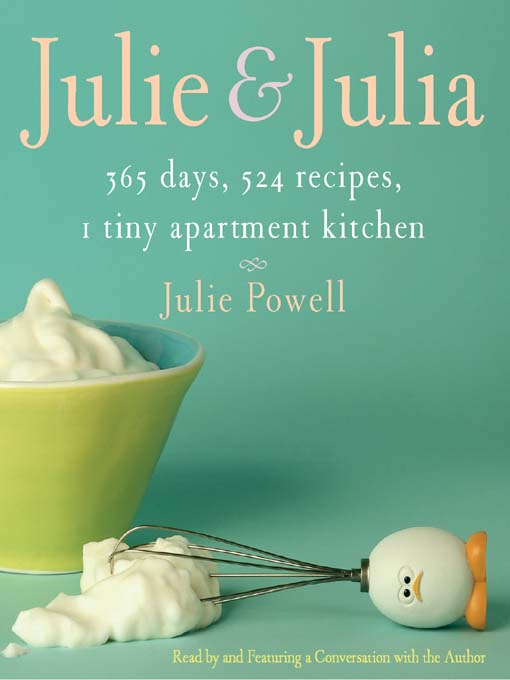
I link to it as a pretense so that I can discuss my mixed feelings on the new film Julie/Julia, dually based upon the lives of Julia Child and Julie Powell.

There are really three pieces of media at play here. There is the movie. Then there are the books that the movie is based on, My Life in France, by Julia Child and Alex Prud’homme (a ridiculous name, I might add), and Julie and Julia, by Julie Powell. When I heard the movie was coming out, I put the books on my list so that I could read them before the movie came out. Here’s what happened.

1. I read My Life in France…

…and discovered that Julia Child was indeed a wonderful and interesting person. Unfortunately, she had neither a wonderful nor interesting ghostwriter. Alex Prud’homme is her grandson, and one gets the feeling that he was chosen for the project for that reason, rather than his technical proficiency. As I was reading the book, I got the feeling that the story was struggling to break the surface; I could almost grasp what was hidden beneath the clunky writing. I found myself deciding to abandon the book almost every day that I would read it, only to give it “one more shot” the next day.

One saving grace is the many exerpts from letters between Julia and Paul Child, or between one of them and their many family friends. They were both prolific letter writers, and it is in those genuine sources that real personality comes through.**

2. I started Julie & Julia…

…and quickly discovered that with all the things I wanted to do with my time, reading prose by Julie Powell in the first person was not on the list. Although I know that there is no such thing as ethics on the internet, I really do feel bad offering an opinion about a book I didn’t finish.

But there’s a reason I didn’t finish it.

She is a little annoying, and after about 40 pages, there really wasn’t enough to hook me, nor was there any promise for unique insights, or really anything of value. I don’t know if I can recommend not reading it, but I certainly would not recommend it.

3. I found out that Julie and Julia was directed by Nora Ephron.

Which really just took all of my desire to see it away. I loved When Harry Met Sally but I honestly cannot think of another Ephron-related movie that I have enjoyed (and she didn’t even direct that one). And for all of you who believe that I hate her because she’s a woman (and I’m not just strawmanning, somebody actually told me that), one of the reasons that I hate her so much is because of her deeply shitty movie A League of Their Own. I believe that a female empowerment movie done badly is ultimately counterproductive.

So, I could not bring myself to actually see the movie.

Basically, at every step of this project, I have been underwhelmed. But I would like to hear from anyone that has seen it. Let me know what you think. And I would love to find someone to defend My Life in France.

**Surprisingly, (to me) almost everybody on Amazon.com disagrees with me about the quality of My Life in France. The vast majority of the reviews are 4 and 5 stars, and the only people who gave it 1 or 2 stars are complaining about Child’s Francophilia, her unapologetic carnivorous tendencies, or her political positions. Of the latter, I thought this gem, from Mr. BH, was precious:

I was disappointed that Ms. Child chose to insert political bias into the book and managed to insult many of her long-time fans. Why is that Liberals have to insert their biases into everything? The thing I found most offensive was her ridicule of American servicemen in Germany in the decade after the war. She looks down her considerable nose at a group of American servicemen she encounters in Germany in the early 1950s. They dared to reject the heavy German beers, showed little interest in learning the language, and declared the wives “conventional, incurious, and [most egregious of all] “conservative.” She points out that the men spoke with Southern accents, usually about sex and drink.

Here she was at this point in her 40s; and some of these same servicemen may have fought in the heinous war that was started by Germans, had family or friends who had been killed by Germans, and…heaven forbid….probably voted differently than she did.

UPDATE: My commenter has alerted me to my mistake with Nora Ephron/A League of Their Own. I realized that I was mistaking her for Penny Marshall, which is really unfair to Ephron because nobody should have to carry the sins of either Penny or Gary Marshall, although Ephron directed the Marshall-produced Bewitched.