
Downton Abbey and the Freight Train of Progress

From the Downton Pawnee tumblr.

Andrew Sullivan linked to a couple of different articles trying to explain the (unexpected?) popularity of Downton Abbey in the United States. For Newsweek, Simon Schama makes the case that the show is a snob-ridden piece of Hallmark-y tripe:

There are many things wrong with the Republic in 2012, but when historians come to write its chronicle they will notice that the country was gripped by the clammy delirium of nostalgia. Tea Partiers ache for what they imagine to have been a tricorny country, all innocent of the Monster Government. Politicians and radio ranters sell the credulous on an American paradise before “socialism,” in the wicked shape of Social Security and Medicare, ever came to be. And folks who might have better ways to pass their time have been falling like grouse to the gun before the mighty edifice of Downton Abbey. Deprived of a wallow in the dry-martini and bullet-bra world of Mad Men? Not to worry, Downton serves up a steaming, silvered tureen of snobbery. It’s a servile soap opera that an American public desperate for something, anything, to take its mind off the perplexities of the present seems only too happy to down in great, grateful gulps.

Irin Carmon posits that the show’s popularity resides in an idealization of the class system and a portrayal of noblesse oblige on the part of the “upstairs:”

“I actually think it’s a lot like ‘The West Wing,’” Steve Jacobs, a political communications strategist and a fan of the show, told me. “Lord Grantham is the platonic ideal of an English aristocrat, just like Jed Bartlet was the platonic ideal of an American president. The very fact that Grantham and Bartlet are so good and selfless is, to me, an indication that they’re not meant to be completely accurate depictions of their real-life counterparts.” Even if a democratically elected president differs in earned legitimacy from an earl, both involve a Great Man shaping history. As Max Read, a writer at Gawker, says of the analogy, “Both shows suffer from operating under ideas of politics/history that focus on the individual actor rather than the system. So the nobility and selflessness of Bartlet and the earl justify the systems in which they work … It’s a very classically conservative notion of history.”

Kathryn Hughes interprets the show as a reflection of British social anxieties, and places the show in a line of historical class dramas:

The show’s values of cohesion and cooperation promise to be challenged by the war’s fallout. But they remain Downton Abbey’s guiding ethos. There may be disruptions looming (socialism, feminism, the small matter of international carnage), but if the classes just pull together, total breakdown may be avoided. The creator and chief writer of this careful and approving dramatization of a social unity that depends, paradoxically, on social separation is Julian Fellowes, who was recently made a Life Peer—which means he becomes Lord Fellowes, although his son will not inherit the title—and sits on the Conservative side of the House of Lords. Fellowes is too canny an operator to say out loud that he wishes we could return to the good old days in which the story is set. But as season two approached its close in Britain, there was no getting around an increasing sense of the show’s nostalgic longing for an age of what we might call consensual paternalism. Which is all very well, of course, as long as you’re the one on the right side of the social divide, the side that decides whether it feels like being benign to those less favored than itself.

Obviously I cannot speak for all viewers of the show, and I am certain that there are plenty of them who watch it for the pure spectacle of costume drama, but none of these perspectives quite gets at why I like the show. I agree that the show generally positions the Earl of Grantham as a pure actor in an opressive system, and that the show draws some of its power from societal shifts that are happening right now, but I think it’s entirely too superficial to dismiss the show as nostalgia for a time past.

http://seg.sharethis.com/getSegment.php?purl=http%3A%2F%2Fmtthwkrl.wordpress.com%2Fwp-admin%2Fpost-new.php&jsref=&rnd=1326914289114Most period films have to deal with the moral conflict produced by societal differences between our time and the period depicted. Films can sidestep those questions, either by depicting characters as evil because their time was “evil” (think Braveheart: William Wallace is our enlightened, educated, modern hero, but 13th century Englishmen are mostly evil because they’re 13th century Englishmen), or by idealizing the past and not engaging with the question at all. But most honest films do deal with it one way or another, even if not successfully. And clearly Downton does idealize its main characters. But I think this is a deliberate strategy to highlight the brutality and suffocation of the system they operate in.

The Mad Men comparison is apt. A big difference, of course, is that Don Draper and most of the characters on the show are clearly portrayed as extremely flawed people even in the context of their time. This makes it a better show than Downton, however where they come together is in detailing the lives of a class of people who are going to be absolutely rocked by the social changes that will affect them in the coming years. Just like the social unrest of the late ’60s that invisibly permeates Mad Men, so does the period between wars permeate Downton. And that’s where the idealization of this group of people that inhabit the system becomes a real driver for pathos. Whether or not this class system has value (and personally, I do think the show could come down harder on the side of the “or not”), these people are going to have their lives completely upended, and all of the norms that they have internalized through their lives are going to be called into question. Even these people.

To be fair, Schama acknowledges this point:

In the current series, historical reality is supposed to bite at Downton in the form of the Great War. The abbey’s conversion into convalescent quarters did indeed happen in some of the statelies. But if Fellowes were really interested in the true drama attending the port and partridge classes—more accurately and brilliantly related in Evelyn Waugh’s Brideshead Revisited and Isabel Colegate’s wonderful The Shooting Party—the story on our TV would be quite different. Instead of being an occasional suffragette, Sibyl would have turned into a full-on militant, carving, while incarcerated in prison, a “V” for “votes” on her breast with a piece of broken glass. Lord Robert, whose income from land and rents would have collapsed with the long agricultural depression, would be unable to service his mortgage and, subject to the estate duties imposed to pay for old-age pensions, would have to sell the place to a wheat baron from Alberta. And Matthew would be one of the 750,000 dead.

and I do think he has a point. Fellowes class affiliations should be called into question. And there’s plenty of time for the show to go on too many seasons, postponing the painful social change until nobody cares any more. But for now, that spectre of change, visible only to us, hovers over the show and I cannot wait for that other shoe to drop.
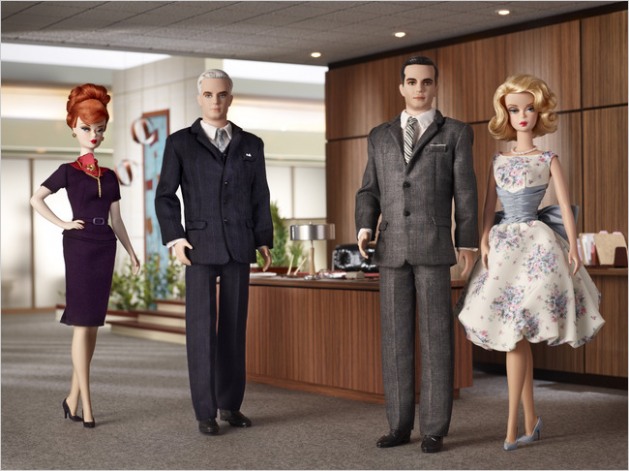
Daniel Mendelsohn on Mad Men

EDIT: I just realized that this is a super old article. My bad. 

Listen, I don’t expect everyone to like everything that I like. That would be boring. That being said, I am flabbergasted by how completely Daniel Mendelsohn, writing for the New York Review of Books (behind a paywall, unfortunately), misunderstands Mad Men‘s dramatic scheme and its appeal to fans:

I am dwelling on the deeper, almost irrational reasons for the series’s appeal—to which I shall return later, and to which I am not at all immune, having been a child in the 1960s—because after watching all fifty-two episodes of Mad Men, I find little else to justify it. We are currently living in a new golden age of television, a medium that has been liberated by cable broadcasting to explore both fantasy and reality with greater frankness and originality than ever before: as witness shows as different as the now-iconic crime dramas The Sopranos and The Wire, with their darkly glinting, almost Aeschylean moral textures; the philosophically provocative, unexpectedly moving sci-fi hit Battlestar Galactica, a kind of futuristic retelling of the Aeneid; and the perennially underappreciated small-town drama Friday Night Lights, which offers, among other things, the finest representation of middle-class marriage in popular culture of which I’m aware.

With these standouts (and there are many more), Mad Men shares virtually no significant qualities except its design. The writing is extremely weak, the plotting haphazard and often preposterous, the characterizations shallow and sometimes incoherent; its attitude toward the past is glib and its self-positioning in the present is unattractively smug; the acting is, almost without exception, bland and sometimes amateurish.

Boom. That’s a motherfuckin’ gauntlet.

There’s little sense in wasting energy refuting the critiques of someone who absolutely does not like the show. And Mendelsohn has some qualitative judgements with which I will never be able to find common ground (for example, where Mendelsohn believes, “The acting itself is remarkably vacant, for the most part—none more so than the performance of Jon Hamm as Don…you sometimes have the impression that Hamm was hired because he looks like the guy in the old Arrow Shirt ads: a foursquare, square-jawed fellow whose tormented interior we are constantly told about but never really feel.,” I’d say that Hamm is a tremendously skilled actor who manages to play basically two parts at once: the Don Draper that needs to be cool and composed at all times and the Dick Whitman who is never far below the surface, insecure and fearful.), others simply do not fit with my interpretation of the series. I’d like to respond to some of those:

The core appeal of the show: In what is probably his real thesis, Mendelsohn writes:

he people who watch Mad Men are, after all, adults—most of them between the ages of nineteen and forty-nine. This is to say that most of the people who are so addicted to the show are either younger adults, to whom its world represents, perhaps, an alluring historical fantasy of a time before the present era’s seemingly endless prohibitions against pleasures once taken for granted (casual sex, careless eating, excessive drinking, and incessant smoking); or younger baby boomers—people in their forties and early fifties who remember, barely, the show’s 1960s setting, attitudes, and look. For either audience, then, the show’s style is, essentially, symbolic: it represents fantasies, or memories, of significant potency.

Obviously I cannot comment on the appeal that the show has to the generation that are contemporaries of the children of the show’s main character. And I think that it is definitely true that Sally and Bobby Draper function, to some degree, as audience stand-ins (a point he expounds upon later in the essay). But he severely misunderstands the appeal to at least some of us on the younger end of the audience.

The main dramatic engine of Mad Men, for me, is that of watching a car crash in slow motion. The employees and families of Sterling Cooper are of a very specific class. They are separated from the average American of their time by a variety of factors: they are urban, wealthy, white, socially and politically connected, at the peak of their careers, and are in a prime position to influence the culture at large.

In short, this is the class of Americans that are going to be most affected by the societal changes that come in the late ’60’s and early ’70’s. The unique genius of the show is that the drivers of those changes, the feminists, gay rights activist, civil rights activists, are always just barely out of frame. In their present, the show’s characters deal with whatever crises arise, but we, with the extra perspective of history, know that any victory will be Pyrrhic and that any survivors will soon be plunged into more upheaval. Situations that Mendelsohn sees as facile winking–Don’s dismissive conversation with the black Sterling Cooper janitor, the gay Sal Romano’s storyline, Kinsey’s bohemian party–become dramatically supercharged because what we know what events those encounters foreshadow, and the show’s characters don’t.

Similarly, when Mendelsohn writes, “To my mind, the picture is too crude and the artist too pleased with himself. In Mad Men, everyone chain-smokes, every executive starts drinking before lunch, every man is a chauvinist pig, every male employee viciously competitive and jealous of his colleagues, every white person a reflexive racist (when not irritatingly patronizing).,” I think he’s watching a different show. There is a tremendous variation in the personal sensitivities of the characters in the show. There’s clearly a spectrum of misogyny, of racism, of classism. The fact that even the most openminded of characters on the show seem backwardly regressive to us shows how much societal norms have changed, not that people in the present are good and people in the past were bad. One of the tragedies of Don Draper is that, even as he sometimes appears to be ten years ahead of everybody around him, he never questions the societal norms that allow him to behave the way that he does and treat others the way that he does.

Verité and Mad Men’s style. As an incredible left-handed compliment, Mendelsohn writes, “With these [standout television shows of the last decade] (and there are many more), Mad Men shares virtually no significant qualities except its design.” And yet he takes exception to the direction of the show as well:

“The show’s directorial style is static, airless. Scenes tend to be boxed: actors will be arranged within a frame—sitting in a car, at a desk, on a bed—and then they recite their lines, and that’s that. Characters seldom enter (or leave) the frame while already engaged in some activity, already talking about something—a useful technique (much used in shows like the old Law & Order) which strongly gives the textured sense of the characters’ reality, that they exist outside of the script.”

It seems to show a tremendous lack of imagination to attack the show for having a house style that is substantially different from other shows on television. Mad Men is much slower paced than most shows on television. Its shots are carefully composed; it’s one of those shows in which almost every frame could work as a still image. And every aspect of the show is heavily stylized. When we like a television show, we describe the show as “having a voice.” When we dislike the show, we get pedantic ramblings like Mendelsohn’s.

Futhermore, one of the benefits of having such a controlled house style is that it heightens the drama in those places where the show chooses to break that style (off the top of my head, I’m thinking of Peggy’s delivery in season two, and Don’s notebook voiceover in season four). This is a feature, not a bug.

Elsewhere, Mendelsohn takes issue with the show trafficking in the same slick, sexualized, advertisement-like imagery that it ostensibly critiques, describing it as the show having its cake and eating it too. This is a valid criticism. There’s certainly a superficial appeal to the show that has everything to do with large breasts, retrosexual men, and amazing clothing. I, and perhaps here I speak as a young person, am fascinated by the slick style of the show and the advertisements within the show for another reason: the world that I live and grew up in is a world shaped by the advertising techniques that are still in their infancy in the world of the show. Season one, which featured Don’s work more than subsequent seasons, was often driven by conflict between two different paradigms of advertising. The kind of advertising that Don has made his name with are the same kinds of advertising that now permeate every aspect of our culture. Again there is a car crash element to this: we know how this story ends, and it is completely fascinating to see people making crucial decisions with now knowledge of the consequences of their actions.

Translating Lem

I was shocked to discover that Stanislaw Lem’s classic science fiction novel, Solaris has never before been translated directly from Polish to English:

The first ever direct translation into English of the Polish science fictionauthor Stanislaw Lem’s most famous novel, Solaris, has just been published, removing a raft of unnecessary changes and restoring the text much closer to its original state.

Telling of humanity’s encounter with an alien intelligence on the planet Solaris, the 1961 novel is a cult classic, exploring the ultimate futility of attempting to communicate with extra-terrestrial life. The only English edition to date is Joanna Kilmartin and Steve Cox’s 1970 version, which was translated from a French version which Lem himself described as poor.

Now Bill Johnston, a professor at Indiana University, has produced the first Polish-English translation of the novel. It has just been published as an audiobook download by Audible, narrated by Battlestar Galactica’s Alessandro Juliani, with an ebook to follow in six months’ time. Lem’s heirs are hoping to overcome legal issues to release it as a print edition as well.

The reason why I, and I imagine most, know of Solaris is through its 1972 movie adaptation of the same name. That film is regarded as a cinema classic, and it is astonishing to me that a book, both highly esteemed as a classic of mature science fiction and as the inspiration for another classic piece of art, managed to escape for so long (50 years!) without a proper English translation. The rest of the Guardian article makes clear that the mistakes in the translation are far from esoteric; in the game-of-telephone translation dialogue was reduced to narration, scientific points were reduced to gibberish, and a couple of passages came to mean the opposite of the corresponding passage in the Polish original.

Because I have a near-comic inability to keep myself from tying everything to classical music, I want to draw attention to a Bach organ prelude that appears several times in the 1972 Solaris. The prelude is Ich ruf zu dir, Herr Jesu Christ (I call to you, lord Jesus Christ); it appears in the opening credits, at the end of the film, and I believe once more in the course of the film. The video I’m embedding is actually a piano transcription by Ferruccio Busoni. Vladimir Horowitz is the pianist.

Rango

I thought that trailers for kid’s CG movies was something that I was completely immune to, but all of the trailers for Rango have completely charmed me. I love just about everything that Johnny Depp is in, but I don’t think he’s distinguished himself as a voice actor. Part of the fun of watching him is the different physicalities that he brings to every role*.

It also might be that it reminds me of a childhood standby, An American Tail: Fievel Goes West.

*though the only other voice acting movie I can think of is Corpse Bride.

Mad Men Season 4 Wrap-up

Sunday night’s “Tomorrowland” was the season finale of what has been a very good season of Mad Men. The first two seasons of the show were filled with twists and revelations as we encountered different aspects of Don Draper. In this season, we pretty much know who he is, and yet we’re still surprised by the things that he does (and there’s plenty of this in the finale). I want to talk about the things that really worked for me this season, and there will be spoilers:

Continue reading “Mad Men Season 4 Wrap-up”