
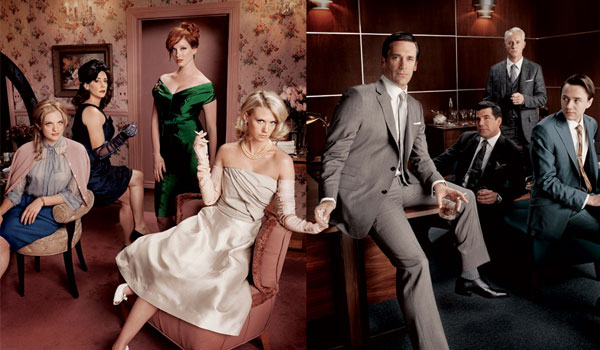
Readers who legitimately do not give a shit about Mad Men may still be interested in my comments on the Beatles album Revolver after the embedded YouTube video.
I have no interest whatsoever to blog seasons of television or do recaps or anything that needs to be timely or consistent, but I do want to say that I’m enjoying Mad Men so much this season; it may be my favorite season so far. I’m sure that almost everyone has decided at this point whether they’re into the show or not, so writing or talking about the show can feel a little circlejerky, but the show has changed so much over time that I feel like evangelizing the show all over again.
I feel like Mad Men‘s dramatic juice has always come from this combination of elements (and disregarding, for the moment, other concerns like marketing, costume design, cast etc.):
- The charisma and mystery and glamour of the character of Don Draper.
- The art and science of advertising, and
- The knowledge that the next decade, and the judgment of history, are going to hit this class of people like a bus.
Mad Men’s M.O. has generally been to foreground 1 & 2, while letting 3 work quietly in the background, visible only to the viewers. This formula has shifted over time. For one, Don Draper is just less mysterious. We may still be captivated by the way that he behaves and his responses to situations, but there’s no more puzzle to his history, and we’ve come a long way from watching him navigate between his wife and his piece on the side. For the last couple of seasons, even as the show stays anchored in the workplace, there is less emphasis on the advertising business. In the first season, it seemed like the show was going to establish a product-of-the-week format. This season, there have still been some high profile clients that contribute a C- or D-plot (Howard Johnson’s, Miracle Whip), but there’s less pontificating on the nature of advertising, fewer Draper pitches, fewer observations about what people want.
But where this season has been really shining is with that third element. Change has come to the foreground. Changes in music, in morés, style and class, there hasn’t been an episode this season where our characters haven’t been confronted by the culture moving to another place, or disrupted by a person that’s already there. One of my roommates is watching the show for the first time, and one huge contrast between the first season and the current season is the first season, both in both its style and its narrative, is about deeply controlled people. Their suits are fitted. Their lives, even as they are falling apart behind closed doors, are carefully compartmentalized. The most shocking moment of the pilot is Don Draper, who we’ve come to know in the context of his workplace, open his door and step into his role as father and husband. In comparison, this season is very messy. Characters are divorcing, shacking up; colors are loud, patterns clash; and the braintrust of Sterling Cooper Draper Pryce is increasingly buffeted by changes in mass taste and an increasingly politicized culture.
Some of the fun of this season is watching unexpected reactions to those changes–the same Roger Sterling who performed in blackface has seemingly skipped a generation and become an LSD-dropping nihilist, while the same Pete Campbell who was batted away from pursuing black-targeted accounts has begun to act out with all the propriety of a drunken salaryman at a karaoke bar–but none has been more interesting to watch than Don Draper. Because this is supposed to be the time where the culture catches up to Don Draper. In earlier seasons, Don is shown to be operating ten years ahead of his clients by producing ads that focus on the lives and desires of consumers rather than on products. At times, particularly in his preference for and interactions with strong, independent women, and his apparent dislike for the rules prescribed for men in gray suits, he has seemed like the audience-insertion character. Don’s pitches used to promise the future. But now we’re in the future, and it’s a new world of Beatles and beatniks, of civil rights and antiwar left, a world that Don is increasingly reluctant to embrace.
Last episode featured the Beatles song “Tomorrow Never Knows” in an extremely effective manner. This season has featured many “the 60’s are here” moments, but few have been as powerful as Ringo’s snare knocking on Don Draper’s door to introduce sounds that have become deeply integrated into contemporary pop culture’s DNA. And so I have found myself completely, and admittedly sheepishly, obsessed with Revolver.
It is because of the centrality of the Beatles catalogue to popular music that it has been hard for me to listen to their music as music, or listen to their albums like any other band. It was only a few months ago that I decided to try and listen to the albums through to get a sense of them as albums, instead of units containing some of the hits that I knew. I began with Sgt. Pepper’s, then slowly through Rubber Soul and Abbey Road. Somehow, I had not yet gotten to Revolver. I had heard from music people that Revolver was the best Beatles album, but I never appreciated the extent to which it–and Sgt. Pepper’s–are simply in a league of their own*. Rubber Soul is too indebted to their earlier pop rock sound, Abbey Road has a signal to noise ratio that’s too low, and Let It Be is moribund. In these two albums, they managed to do everything they do well right, and produce an astonishing amount of perfect songs on each. My the worst track on Revolver is either “Doctor Robert” or “Taxman,” and both of them are extraordinarily good songs.
*I’m going to break in with a couple of caveats here: One, a general disclaimer that I haven’t heard all of the albums yet. So I’ll admit the possibility that one of the other albums might just be that much better (though somehow I don’t think Magical Mystery Tour will be it). Two, it’s relevant that I really hate most of the early-Beatles, teen idol-y songs. I imagine that there is still some cohort that dislikes all of their albums after they went to India. But for me, almost all of those early albums are going to be disqualified.
Listening through Revolver also provided me with one of those cherished opportunities to check in with my own evolving tastes. I remember having a conversation with my piano teacher’s husband about whether we liked the Beatles by John Lennon or the Beatles by Paul McCartney better. I declared myself a McCartney man. My piano teacher told me to “give that time.” And that’s proven to be completely true. I can see where I was coming from; I played piano, and all of the best Beatles songs to play on the piano are Paul’s ballads (“Let It Be,””Yesterday”)**. Lennon’s songs tended to be more guitar-riff driven and production-heavy.*** Scanning a tracklist of Revolver reveals that all of the songs that have been rocking my shit are Lennon songs.
**It took me time to discover that the best McCartney songs are the quasi-art songs: “She’s Leaving Home,” “Penny Lane” “The Long and Winding Road” etc.
***Though, of course, those taxonomies can be deceptive. “Helter Skelter,” for example, is a McCartney song and is about as aggro as the Beatles get, while “Something” was written by George Harrison and is (with the exception of an extra-prominent guitar solo) almost a quintessential Paul song.
And now just a few thoughts on individual tracks:
- “I’m Only Sleeping” and “Here, There and Everywhere” are weirdly mirror images of each other; the root of the chord progressions in their choruses are extremely similar, 1-2-3-4 (Here, There and Everywhere) and 1-2-3-2 (I’m Only Sleeping), yet I can’t stand HTE, and can’t get enough of IOS. IOS contains maybe my favorite use of sweet oohing harmonies, and the backtracked guitar solo is still just the greatest.
- For all that the 90’s Britpop genre (Oasis, etc.) is pretty much defined by an indebtedness to the Beatles, “She Said, She Said” is maybe the only song in their catalog that I think could just be a 90’s song, if John Lennon didn’t have one of the most distinctive voices in rock. For that matter, the guitar intro could kick off a Pavement song. The drumming on this track is sublime; the only time that I have been completely impressed with Ringo Starr.
- “For No One” is almost a perfect song, but the dotted rhythm at the end of “no sign of love behind the tears” is like jamming an icepick into my ears, I hate it that much.
- “Tomorrow Never Knows” is still the greatest: epic tape loops and distortion; Lennon’s incantation-like delivery; anti-guitar solos; mystical nonsense that smells like profundity; a killer drum and bass ostinato; a maximalist masterpiece.
 hammer & jack