I never get tired of the highbrow/lowbrow debate. There’s a long article in the Chronicle of Higher Educationon (according to the writer, Michael Clune) a reluctance for humanities scholars to engage in critical evaluation (as opposed to interpretation).
This eschewal of hierarchy appears eminently progressive. Who am I to say that one book is better than another? Why should I tell you what you should read? Everyone’s taste is equal. No one’s judgment is any better or worse than anyone else’s. […] The abdication of professional judgment throws all questions of value into the marketplace. The free market is where consumers, whose preferences are all accorded equal status, exercise their cultural choices.
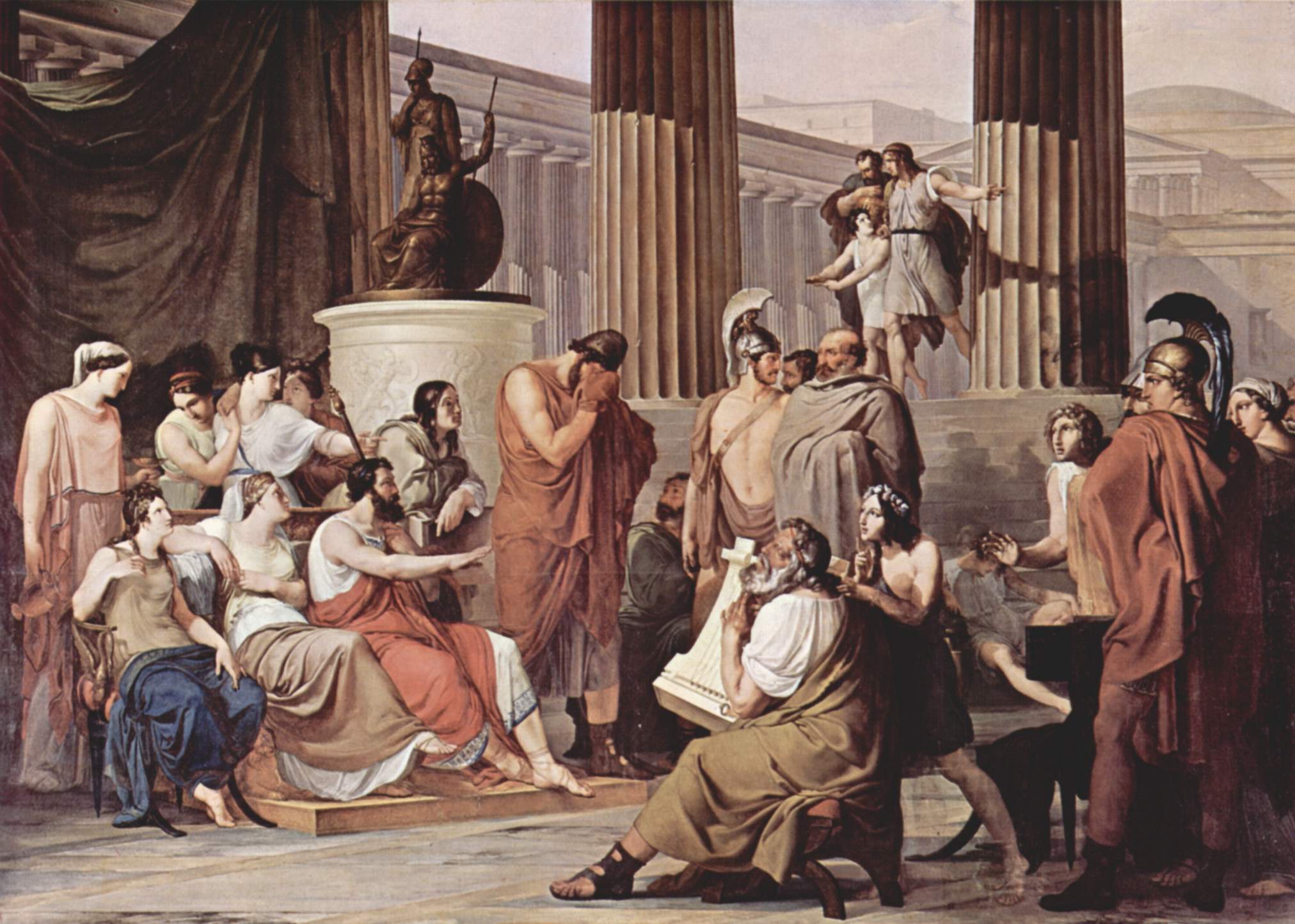
Ulysses at the court of Alcinous by Francesco Hayez. In other words, poetry in the literal marketplace.
Is making a hierarchical ranking the same thing as making an aesthetic judgement? Clune performs this little misdirection throughout the essay. Ranking things in lists seems like an insane way to engage with any art form to me. Art criticism must start with what’s on the page or on the canvas, but it’s no longer tenable to ignore the other axes of power and cultural capital that lead to one thing being considered a masterpiece and another forgotten. Clune tries to head off this argument: “Criticizing the limits of equality doesn’t mean ignoring the pathologies of expertise. Many expert judgments of the past bear the ugly marks of racism and sexism. Probably many of our own judgments will seem similarly distorted in the future.” Clune seems unwilling to entertain the idea that the cultural hierarchy he’s defending is simply a mirror of social hierarchy.
The deadliest trap in art is the circular logic trap that comes about when “Is this the best?” leads to “To whom?” which is then answered by “Us!” The exclusivity of the connoisseur becomes evidence the greatness of the work, and the greatness of the work becomes evidence of the enlightened nature of the connoisseur. This is something I am very passionate about: I think that the whole world of art and literature and culture opens up when you get away from that question.
I do think Clune is coming from a good place, he writes sentimentally about a vivid reading experience he had as a teenager, exploring the Japanese poet Bashō. This is a great example of the questions that go unexplored when you’re just looking at hierarchy: why is Bashō a part of your poetry canon, when he would not have been if you were reading poetry at Oxford 100 years ago? How does a poem move in and out of “greatness?”
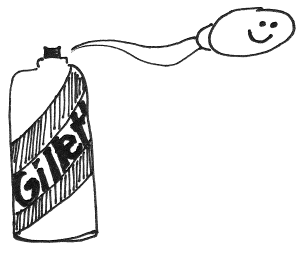
Last week Gillette released an advertisement called The Best Men Can Be (25m+ views) which in 90 seconds presents this masculinity pageant: toxic masculinity has been perpetrated by men forever, now the #MeToo movement has shed light on it, now nothing will be the same, we’re not afraid of it because men can be better, here’s a couple of clips of men already being better.
This morning, I read this plainspoken line in Heather Havrilesky’s new book of essays, What If This Were Enough: “We are living in a time of extreme delusion, disorientation, and dishonesty.” There’s a fever going on right now and the dead-end racist, sexist bluster that is destroying our governmental infrastructure by pushing out government workers, the two documentaries about the fraud and waste of the Fyre Festival (resplendant in its stupid fucking novelty spelling), and Tony Blair grinning like a naughty schoolboy as he struggles to defend himself against the characterization of Davos as “a family reunion for the people who broke the modern world” all seem to be in dialogue with each other.
We’re also trapped in this this slow motion racist gaslighting sparked by a group of white boys from a Catholic school harassing a man they assumed had no power. When the public gave that man power through their attention, their parents circled to protect them and used every connection they had to take it back. A friendly CNN interviewer and the President helped them do it.
Last year, the Canadian government asked the Pope for an apology to the Inuit and Métis peoples for the role the church played in operating genocidal boarding schools and orphanages for Native children. A spokesman for the Pope responded: “After carefully considering the request and extensive dialogue with the bishops of Canada, he felt that he could not personally respond.”
Nick Sandmann, the boy from Covington, when asked if he felt like apologizing for his actions, said “I wish we could’ve walked away and avoided the whole thing, but I can’t say that I’m sorry for listening to (Phillips) and standing there.” In his written statement, he wrote, “I am a faithful Christian and practicing Catholic, and I always try to live up to the ideals my faith teaches me”.
Here’s what connects these phenomena: We are living through a time where the mechanism by which privilege perpetuates itself—by controlling the story and by controlling what context gets incorporated into the story—is becoming more and more nakedly visible as the divide between those who are benefitting from current political, cultural and economic conditions and those who must change those conditions in order to have a thriving future is becoming wider. Privilege is the power to say “you didn’t see what you saw. And if you did it wasn’t that bad. And if it is that bad, you should see what this other person did. And if you still have a problem with that, Jesus said ‘Let he who is without sin cast the first stone.'”
It’s bullshit.
Here’s why the Gillette advertisement is bullshit, too:
Gillette’s shaving products do not play a significant role in gender-based violence or economic inequality. They did not, for example, run a PSA about not using single-use plastic items.
The advertisement perpetuates a fantasy alternate history where toxic masculinity was a thing that nobody knew was wrong, then #MeToo happened and men realized it was wrong and changed the world. You can’t simplify the narrative like that without performing the same erasure that toxic masculinity needs to perpetuate itself.
Gillette continues to sell rectangular razors to men in tough blue and gray boxes and oval razors to women in pretty pink and green boxes.
Gillette apparently believes that you solve toxic masculinity by being tough and intervening in fights and shouting positive affirmations at your daughter in the mirror*, as opposed to, say, looking at pay inequalities and family leave policies in their company and supply chain.
You cannot credit with–or protest–Gillette changing the culture of masculinity without imputing authority over masculinity to Gillette. Both sides reinforce the desired message, which is that buying Gillette is being a man.
*Which was very cute, I’m not a monster.
Pointing all of this out pedantic, because we all have a baseline expectation that power and bullshit go together. The government is so clogged with bullshit it cannot perform even the most basic functions. The church is so full of shit that people stopped going then discovered what a better social adaptation that is. Institutions that used to police bullshit like universities and newspapers now support themselves by distributing the bullshit (plus, we know that they only ever policed bullshit for white dominant culture, so even calling them the bullshit police is itself a kind of bullshit). Brands are bullshit, but they also seem to kind of work and are kind of accountable to the public sometimes so we give them feedback with love or scorn because that sometimes works and nothing else seems to work.
Gillette has total control over its workplace. It has control over its products, its marketing. It has a lot of influence over the city and state in which it has offices. It did not choose to make change in those spheres in which it has a lot of power. Instead, Gillette is trying to change the way you think about masculinity, which is a power that you have to give it.
So gender progressives have to pretend that liking an advertisement means supporting women and gender troglodytes have to pretend that their honor was sullied by a razor blades and queer folks have to pretend that a company that differentiates its products by gender are going to teach men to protect nonbinary kids and on and on and on…
I think all of that pretending has a cost. I think every time that we do it we erode, just a little bit, our ability to see what else could be possible, what real change would look like. Resisting, though, is not cute and feels useless. In my own real life, where I have total control over me, someone asked what I thought of the Gillette ad and I just shrugged and didn’t say anything.
I went for a walk through a historic graveyard. Most of the people seemed to be dead before the 1940’s, although there were some random 00’s scattered amongst the pioneers. The graveyard in my hometown is beautiful, though it has a little bit of a sterile, David Hockney quality, all flat lawns and sunlight and palm trees. The dead find their rest and, like the living, are rarely bothered by the weather.
The Oregon graveyard is scarred by the weather. Grave markers sink quietly into the uneven ground, while more ostentatious markers are overtaken by moss.
The most interesting feature of the cemetery were large rococo stelae in the shape of trunks, complete with gnarled bark and forest creatures. It reminded me of the pioneer identity that must have been so important to previous generations of Oregonians–I am the worst kind of outsider, a Californian–, an identity that I don’t really see in the culture here, except in museums and school names. I was struck by its tackiness and its idiosyncrasy: I didn’t imagine that the person who could afford to be buried in the city and have a person-height memorial was the coonskin hat wearing type, and at the same time, it’s hard to imagine anything like it anyplace else.
My mind wandered to the tension between the local and the universal. I’m one of those high culture types. I believe, sincerely, that great culture can come from anywhere and be an asset to the world. Japanese film. Tequila. Gumbo. Whatever. One of the things that eats at me, though, is that it is exactly my type of person that is the most threatening to folk cultures, to local variation, to art forms not yet recognized as such.
There seems to be a life cycle: a culture forms as a response to change. That culture challenges baseline assumptions of existing cultural forms. Those existing forms have already achieved legitimacy, so culture defenders (again, I think of myself as one of them) form ranks to protect them. The new form hangs on. The new form becomes popular because of its newness. The new form becomes old, but has built up a body of practitioners and ideas about itself. The culture defenders recognize the wealth of culture that has built up, and incorporate it into existing patterns of cultural presentation/prestige. This hybrid form becomes part of the world culture.
For that life cycle to complete itself requires that I have a shadow twin. Somebody that believes the local/new/yet-unrecognized culture is legitimate in and of itself. That rejects the influence of the wider culture as intrusion. One of the things that most difficult for me to accept is that perhaps the perfect outcome is that we both be in balance, that neither one achieves dominance over the other. Too much high culture, and the idiosyncrasies of the local culture become ironed out, homogenized. Too much of the local culture, and it dies with its last practitioner, or never evolves in complexity in response to the mixture of other cultures.
Portland is going through a bit of a high culture moment. Its aspirations, in its restaurants, art scene, music culture, is to be a “world class” city. But where does that leave the pioneers? Are they present with us, in mason jars of bourbon drinks, in the fresh local produce and heritage breeds featured in its restaurants, in the genderfuckery and tolerance for experiment in its art scene? Or are they dormant, preserved in the cold earth, waiting to take their place as grandparents of the future city?
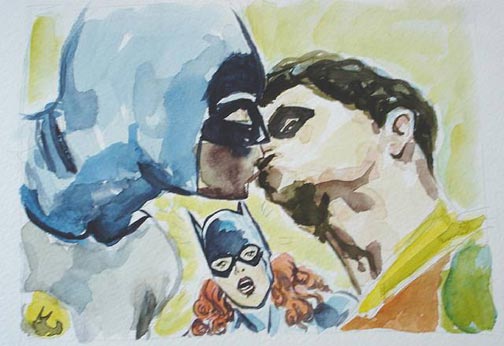
Batman and Robin kissing, as realized by Mark Chamberlain.
This is an item from late April, but I think it’s so good that I’m going to throw it up now:
Prompted by writer Grant Morrison’s assertion that “Gayness is built into Batman. … Batman is very, very gay. There’s just no denying it. Obviously as a fictional character he’s intended to be heterosexual, but the basis of the whole concept is utterly gay.”; Comics Alliance writer Andrew Wheeler put together this barnburner of a post, giving context and explanation in defense of Morrison’s words. There are pretty great tidbits in it:
When we talk about Batman’s gayness, we talk about presentation and perception. Writers as diverse as Bill Finger, Alan Grant, Devin Grayson and Frank Miller have all said that Batman is not gay; but they have all been asked the question. It’s not a question that generally gets asked about other heroes, but in the public imagination it’s one of the first questions asked about Batman. Psychologist Travis Langley, who co-wrote a book on the psychology of Batman, says it’s the question he was asked most often when he told people what he was working on.
and, after establishing Batman’s popularity among closeted gay men in the 1940’s:
We reject or deride the sexualization of Batman’s relationship with Robin precisely because of the worrying implications of eroticizing Robin, but that reading takes the roots of Batman’s gayness in the wrong direction. For gay readers in the 1940s, the introduction of Robin to Detective Comics did not sexualize Robin; it sexualized Batman. It created what Wertham called “a wish dream of two homosexuals living together,” a visible idealization of a same-sex relationship in an era when homosexuality had no mainstream recognition. The gayness of Batman was not just a joke about sidekicks, it was a scrap of identification for a starved gay audience. Robin established Batman as an early totem for a nascent and repressed gay subculture.
I think this is spot-on (though take a look at the original article’s comments to find plenty that disagree). A little over a year ago, in a post on Ta-Nehisi Coates’ blog, I made this comment:
I have nothing to contribute regarding In Memorium, however I do identify with l robert’s observation that “We each have a natural instinct to claim that love as “our own” in some way.”
Consider the great discrepancy between how heterosexual and homosexual relationships are modeled in the culture. Kids are exposed to normative models of heterosexual relationships constantly. Many are never exposed to homosexual relationships at all. Thus a young gay person’s understanding of themself goes hand in hand with an understanding that they are outside the mainstream.
That may seem like Queer 101, but it’s important to keep this in mind because I think it produces a (perhaps lifelong) hunger for representations of people like you in the relationships you want to be in. And because those themes have only been written about openly in Western culture in the past couple of hundred years, a lot of borrowing goes on.
Forgive the self-plagiarism, but I think the point stands. Please, read the Comics Alliance post.


 hammer & jack