Now, I’m as nostalgic for old crappy shit as anybody else, but this article from the Telegraph that breathlessly reports on the coming resurgence of cassette tapes is among the top ten most wrong things that have ever been egregiously false. The article charges that: “Demand for blank audio cassettes has soared as music fans return to the analogue sound of the C60 and C90 tape for listening to tracks, nostalgi[c] for the richer sound of cassette tapes.” Obviously whoever wrote that has never listened to a cassette tape. Analogue ≠ Crappy. Then there is some more bullshit about people looking for high quality blank tapes, and an interview with the editor of Hi-Fi World magazine. If you follow the link, the magazine looks a little bullshit, and I cannot imagine someone who considers himself an expert on high quality audio to go near a cassette tape. Finally, it wraps up with some saccharine, nostalgia bullshit about how mixtapes were the best! and that iPods suck. They might, but not for those reasons, and certainly not compared to cassettes. That’s some bullshit.
On Monday night, I had the privilege of scoring free tickets to the Oregon Symphony. I had been wanting to go that weekend, mostly to hear Rachmaninov’s sublime Rhapsody on a Theme by Paganini, and when the offer came up, I jumped at it.
Interior of the Arlene Schnitzer Concert Hall
It was my first time at the beautiful Arlene Schnitzer Concert Hall, an Art Deco monstrosity (and I use that term with the utmost affection) that reminded me strongly of the theater that I will always associate with orchestral music, the Alex Theater in Glendale, CA (home of the Los Angeles Chamber Orchestra). I had orchestra level seats, and the view of the ceiling was breathtaking.
The program started off with Mozart’s Symphony No. 36. The orchestra was tight and had a great sound (although from my seat, it would have been impossible for me not to hear the full sound of the orchestra) and although in general I can never find anything to differentiate one Mozart orchestral piece from another, it did give me time to observe the style of the guest conductor, Hannu Lintu of Finland.
Lintu is a virtual caricature of a conductor, tall and thin with the body type that tuxedos with tails are made for. I don’t know how useful he was for keeping the beat , but he was certainly entertaining, and clear enough in his gestures that only the blind wouldn’t pick up on the effects that he was trying to achieve. He jumped about, throwing his hands in the air when he wanted a big statement, shaking like an overcaffinated David Byrne when he wanted clear stacatto notes. In the Mozart, the orchestra was hanging on his every gesture, and you could almost see the connection between the orchestra and the conductor.
Unfortunately, that connection was nonexistent between the soloist and the conductor during the Rhapsody. Horatio Gutierrez was the piano soloist, and he played clearly and with the seemingly effortless grace and fluidity that only comes with practice and mastery. Gutierrez, at least physically, is the complete opposite of Lindu. He is an enormous man, which made it all the more astonishing to me that he played with such ease. All of the rapid scalar and chordal passages were flawless and clear, but the piece was plagued by tempo problems. A few times the soloist got so much faster than the orchestra that the conductor actually had to turn to him and make a desperate, “There are other people playing, you know” face. Things finally got together enough that the famous Variation 18 was executed flawlessly. I am not the first person to say this, but it is truly amazing that by simply inverting a fraction of the original melody by Paganini, Rachmaninov creates a passage that seems as though it is his own creation. In other words, I could play a recording of that variation and say to someone, “That. That is what Rachmaninov sounds like.”
Hannu Lintu
On the other hand, even after seeing it live, I could not tell you what Magnus Lindberg’s Feria sounds like. The conductor prefaced the piece in heavily accented English, “You see, we have a deal tonight. You listen to 13 minutes of modern Finnish music and then we play for you the Bolero.” Feria is a Spanish word meaning (obviously) an open air fair or carnival. All I can say is I don’t know what kind of carnivals Lindberg has been to, but by the sound of the music, it would be the scariest carnival ever. This type of modern composition always provokes in me an intense feeling of inferiority. I really don’t posses the knowledge or the experience to tell whether it is any good or not. There were parts that were flashy; the composer made full use of an expanded percussion section to make broad dramatic gestures. But I really don’t know what I thought of it. Tangentially, it did provide one of the most entertaining moments of the concert. At one point, the score called for a muted tuba. I got a kick out of seeing the tuba player pull out an enormous mute. It was about the size and rough shape of a motorcycle gasoline tank.
Finally, in the words of the conductor (and I really wish I could convey his accent and slightly sarcastic cadence), the Bolero. It takes balls to write an orchestral piece (in C no less!) that has an unchanging rhythm and one melody. And even though we have heard the melody played over and over by the time we get to it, the full orchestra playing fortissimo at the end is genuinely thrilling. On the other hand, it does feel a little like brainwashing by the final notes.
I was hoping for a little better Rachmaninov, especially considering that it was the third night, but the Oregon Symphony has a standing deal on student tickets, and I look forward to returning many times to the Schnitz.
So, for the last couple of weeks I have been without a computer, and therefore constant internet access. Obviously, I cannot do a regular post today, because I don’t really have anything interesting from my two days of browsing, but I thought I would write about what I discovered about myself during a seemingly simple change in routine. It is also my explanation of why I am giving up Twitter. Continue reading “Best Week Ever, or at least a different one”→
This week has been so meh, I have ‘meh’rly been able to keep up with things. I spent all of Sunday working on a odiously difficult counterpoint assignment, which is in its way a blessing because I never have to do it again. This is going to end up being one of the more emo MWE… ever. This week I have spent a lot of time being depressed about the state of culture in America and the world, and anxious about finding my place in it. This is not so bad really. It’s a nice break from being depressed about being fat and alone.
1. The Angela Merkel Barbie
2. “We’re All Gonna Die – 100 Meters of Existence”
This is a really interesting photo project. It is a 100 meter long image made up of portraits taken from the same point on a bridge over 20 days. The effect it creates is kind of eerie. The sterile white background, as well as the people all walking toward the camera does seem to suggest something sinister. It’s probably fair to say that the title of the project is a little pretentious, but taken with the image, it does not seem out of place.
3. Karl Paulnack
This speech by Karl Paulnack, a lecturer at the Boston Conservatory, sums up a lot about what I have been feeling lately about the value of music in my life and in the world. I have lately begun to wrestle with the idea that I have no cognitive tools available to me to evaluate art’s value. I think that I have been trained to see value in things as a function of their usefulness. Things that can be quantized, things that can be measured, things that can be broken down into discrete components, these are the things that have value in our society.
I think that this is most easily seen in the greatest intersection of art and commerce ever: the movie industry. There is no question that some movies are driven by their star power (I’m thinking Pirates of the Caribbean). But think how lame it is when studios try and sell movies with clearly nothing going for them except their lead actors. Same thing with “soul” or “heart.” I recently saw Rachel Getting Married, a movie with drama and pain, and yet was completely grounded in a human goodness that was completely genuine. On the other end, you get a movie like The Reader, a movie that replaces genuine emotion and human conflict with emotional pandering through the Holocaust and uncomfortable sexuality.
What I’m trying to say is that there is no way while making a movie to say, “Let’s make this 20% more soulful,” let alone “20% more scary” or “%20 more thrilling.” By the time you are thinking in those terms, reducing the masterpiece to a widget, you have already lost. I think it’s telling that the most consistently successful studio in Hollywood right now is Pixar. Pixar has never had a movie gross less than $460 million dollars. Their average gross is $500 million dollars. Half a billion dollars. And yet the Pixar philosophy is simple: provide the artists with tools, and let them make something that they are satisfied with. I understand that this model will not work everywhere, and that different markets are completely, well, different. I will even give you that Pixar is an outlier. And yet I think that people can see what is genuine, and people can recognize quality. 4. Or maybe not.
This is a super interesting article that came out about this time last year in the Washington Post magazine. Their team asked Joshua Bell, the virtuoso violinist, to play at the entrance to a Metro station to see if anybody would recognize a musician of his caliber.
In the three-quarters of an hour that Joshua Bell played, seven people stopped what they were doing to hang around and take in the performance, at least for a minute. Twenty-seven gave money, most of them on the run — for a total of $32 and change. That leaves the 1,070 people who hurried by, oblivious, many only three feet away, few even turning to look.
No, Mr. Slatkin, there was never a crowd, not even for a second.
It was all videotaped by a hidden camera. You can play the recording once or 15 times, and it never gets any easier to watch. Try speeding it up, and it becomes one of those herky-jerky World War I-era silent newsreels. The people scurry by in comical little hops and starts, cups of coffee in their hands, cellphones at their ears, ID tags slapping at their bellies, a grim danse macabre to indifference, inertia and the dingy, gray rush of modernity.
Even at this accelerated pace, though, the fiddler’s movements remain fluid and graceful; he seems so apart from his audience — unseen, unheard, otherworldly — that you find yourself thinking that he’s not really there. A ghost.
Only then do you see it: He is the one who is real. They are the ghosts.
Well worth reading.
5. Walter Martin & Paloma Muñoz
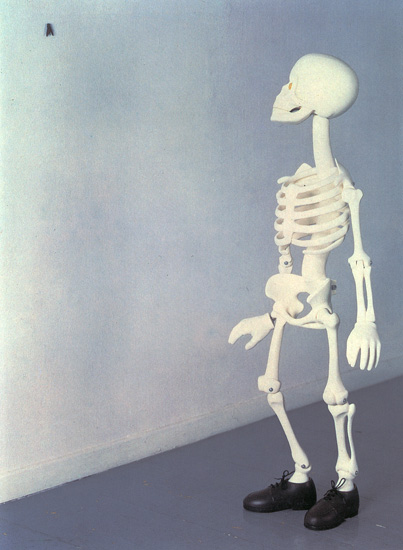
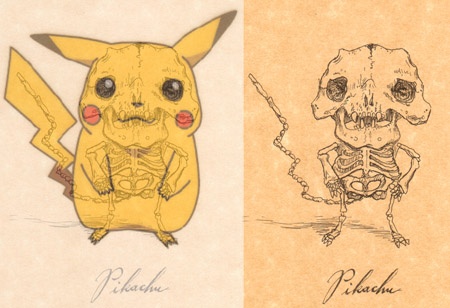
Martin and Muñoz create occasionally whimsical, occasionally disturbing artworks, such as this: It’ll take you like three seconds to click the link, some of the stuff there is really cool. I found it via Street Anatomy, a very cool anatomy themed blog with things like this: 6. Right America Feeling Wronged
This is a documentary by Alexandra Pelosi that aired on HBO showing footage of McCain/Palin supporters during the rallies. I found some of it a little scary, some of it a little familiar (see my earlier post about Alan Keyes), but I mostly felt a little overwhelmed that these people live in the same country that I do. All five parts are up on Youtube, worth it if you have a spare 40 minutes.
This week has been so meh, I have ‘meh’rly been able to keep up with things. I spent all of Sunday working on a odiously difficult counterpoint assignment, which is in its way a blessing because I never have to do it again. This is going to end up being one of the more emo MWE… ever. This week I have spent a lot of time being depressed about the state of culture in America and the world, and anxious about finding my place in it. This is not so bad really. It’s a nice break from being depressed about being fat and alone.
This is a really interesting photo project. It is a 100 meter long image made up of portraits taken from the same point on a bridge over 20 days. The effect it creates is kind of eerie. The sterile white background, as well as the people all walking toward the camera does seem to suggest something sinister. It’s probably fair to say that the title of the project is a little pretentious, but taken with the image, it does not seem out of place.
This speech by Karl Paulnack, a lecturer at the Boston Conservatory, sums up a lot about what I have been feeling lately about the value of music in my life and in the world. I have lately begun to wrestle with the idea that I have no cognitive tools available to me to evaluate art’s value. I think that I have been trained to see value in things as a function of their usefulness. Things that can be quantized, things that can be measured, things that can be broken down into discrete components, these are the things that have value in our society.
I think that this is most easily seen in the greatest intersection of art and commerce ever: the movie industry. There is no question that some movies are driven by their star power (I’m thinking Pirates of the Caribbean). But think how lame it is when studios try and sell movies with clearly nothing going for them except their lead actors. Same thing with “soul” or “heart.” I recently saw Rachel Getting Married, a movie with drama and pain, and yet was completely grounded in a human goodness that was completely genuine. On the other end, you get a movie like The Reader, a movie that replaces genuine emotion and human conflict with emotional pandering through the Holocaust and uncomfortable sexuality.
What I’m trying to say is that there is no way while making a movie to say, “Let’s make this 20% more soulful,” let alone “20% more scary” or “%20 more thrilling.” By the time you are thinking in those terms, reducing the masterpiece to a widget, you have already lost. I think it’s telling that the most consistently successful studio in Hollywood right now is Pixar. Pixar has never had a movie gross less than $460 million dollars. Their average gross is $500 million dollars. Half a billion dollars. And yet the Pixar philosophy is simple: provide the artists with tools, and let them make something that they are satisfied with. I understand that this model will not work everywhere, and that different markets are completely, well, different. I will even give you that Pixar is an outlier. And yet I think that people can see what is genuine, and people can recognize quality.
This is a super interesting article that came out about this time last year in the Washington Post magazine. Their team asked Joshua Bell, the virtuoso violinist, to play at the entrance to a Metro station to see if anybody would recognize a musician of his caliber.
In the three-quarters of an hour that Joshua Bell played, seven people stopped what they were doing to hang around and take in the performance, at least for a minute. Twenty-seven gave money, most of them on the run — for a total of $32 and change. That leaves the 1,070 people who hurried by, oblivious, many only three feet away, few even turning to look.
No, Mr. Slatkin, there was never a crowd, not even for a second.
It was all videotaped by a hidden camera. You can play the recording once or 15 times, and it never gets any easier to watch. Try speeding it up, and it becomes one of those herky-jerky World War I-era silent newsreels. The people scurry by in comical little hops and starts, cups of coffee in their hands, cellphones at their ears, ID tags slapping at their bellies, a grim danse macabre to indifference, inertia and the dingy, gray rush of modernity.
Even at this accelerated pace, though, the fiddler’s movements remain fluid and graceful; he seems so apart from his audience — unseen, unheard, otherworldly — that you find yourself thinking that he’s not really there. A ghost.
Only then do you see it: He is the one who is real. They are the ghosts.
Martin and Muñoz create occasionally whimsical, occasionally disturbing artworks, such as this:
It’ll take you like three seconds to click the link, some of the stuff there is really cool. I found it via Street Anatomy, a very cool anatomy themed blog with things like this:
6. Right America Feeling Wronged
This is a documentary by Alexandra Pelosi that aired on HBO showing footage of McCain/Palin supporters during the rallies. I found some of it a little scary, some of it a little familiar (see my earlier post about Alan Keyes), but I mostly felt a little overwhelmed that these people live in the same country that I do. All five parts are up on Youtube, worth it if you have a spare 40 minutes.



 Unfortunately, that connection was nonexistent between the soloist and the conductor during the Rhapsody. Horatio Gutierrez was the piano soloist, and he played clearly and with the seemingly effortless grace and fluidity that only comes with practice and mastery. Gutierrez, at least physically, is the complete opposite of Lindu. He is an enormous man, which made it all the more astonishing to me that he played with such ease. All of the rapid scalar and chordal passages were flawless and clear, but the piece was plagued by tempo problems. A few times the soloist got so much faster than the orchestra that the conductor actually had to turn to him and make a desperate, “There are other people playing, you know” face. Things finally got together enough that the famous Variation 18 was executed flawlessly. I am not the first person to say this, but it is truly amazing that by simply inverting a fraction of the original melody by Paganini, Rachmaninov creates a passage that seems as though it is his own creation. In other words, I could play a recording of that variation and say to someone, “That. That is what Rachmaninov sounds like.”