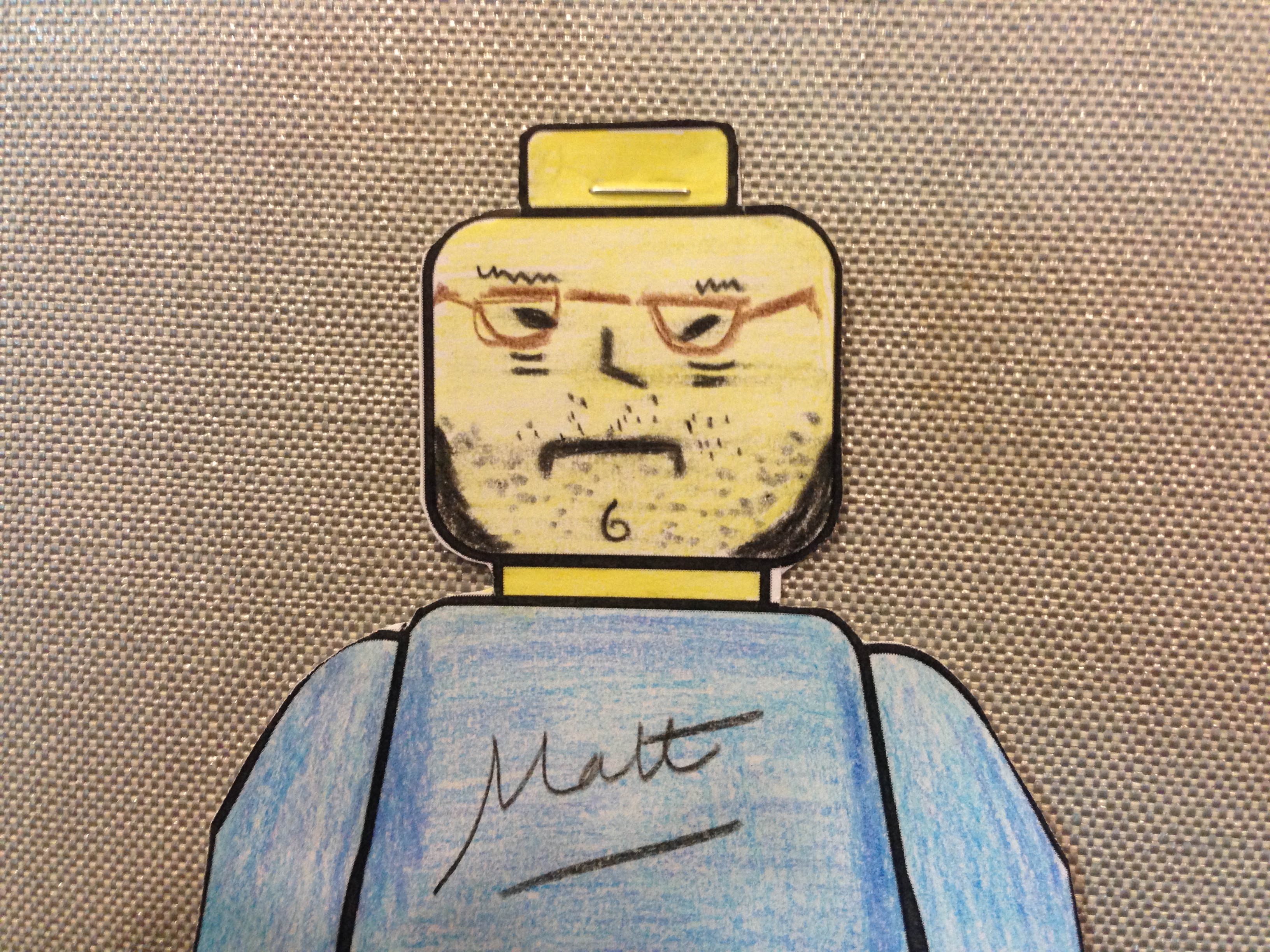
A drawing I made of myself at work for a LEGO math program I’m going to be running.
Tonight I feel like I can finally exhale and start going back to normal again. My lovely sister and lovely cousin have been visiting for the last couple of weeks, and today was the last day for my last visitor and I finally feel free from questions like, “Am I selfish for wanting to take a nap right now?” and “Are they having fun?” and “Should we go out to eat again tonight?” It was a good visit, I was happy to have them, but now I can pick up the pieces, get myself back in order, and recover from what feels like three months worth of eating out and going out for entertainment. I’m not going to fill in the gap, but there are two really nice memories that I want to preserve and treasure:
A game of chess
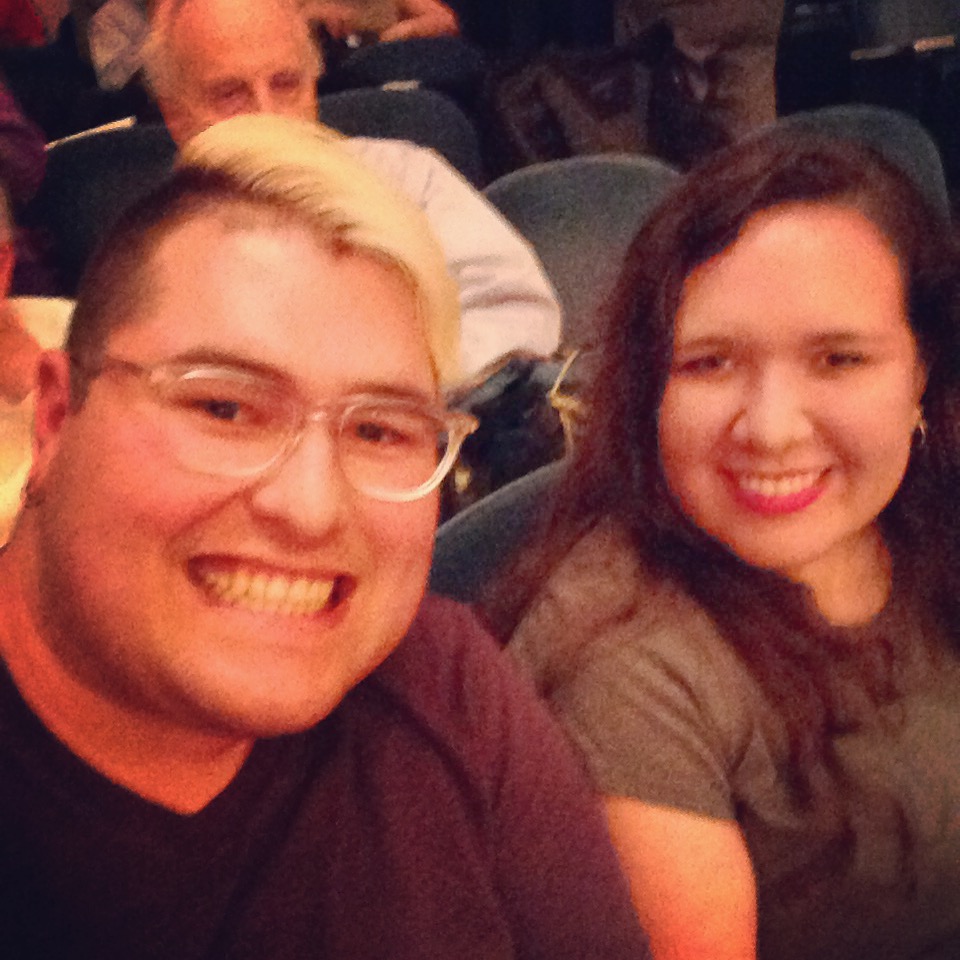
Me and my seeester at a great Oregon Symphony concert last weekend.
I had a lot of fun with my sister: talking, visiting, going to see music, drinking. The most fun thing we did all visit though was to go to a NW coffee house that has chess sets available. We played one game fairly quickly, being quiet ourselves because there was a very Nancy Meyers-ish first date going on next to us between a hilarious woman with a young kid and a freaked out, very chill guy. The second game, I asked for her coaching, and we played a wonderful, nearly three hour long game that was neck-and-neck the whole way. I take very little credit for my victory, but she’s such a private person that I don’t usually get a window into her actual cognitive processes very often.
Queer Portland
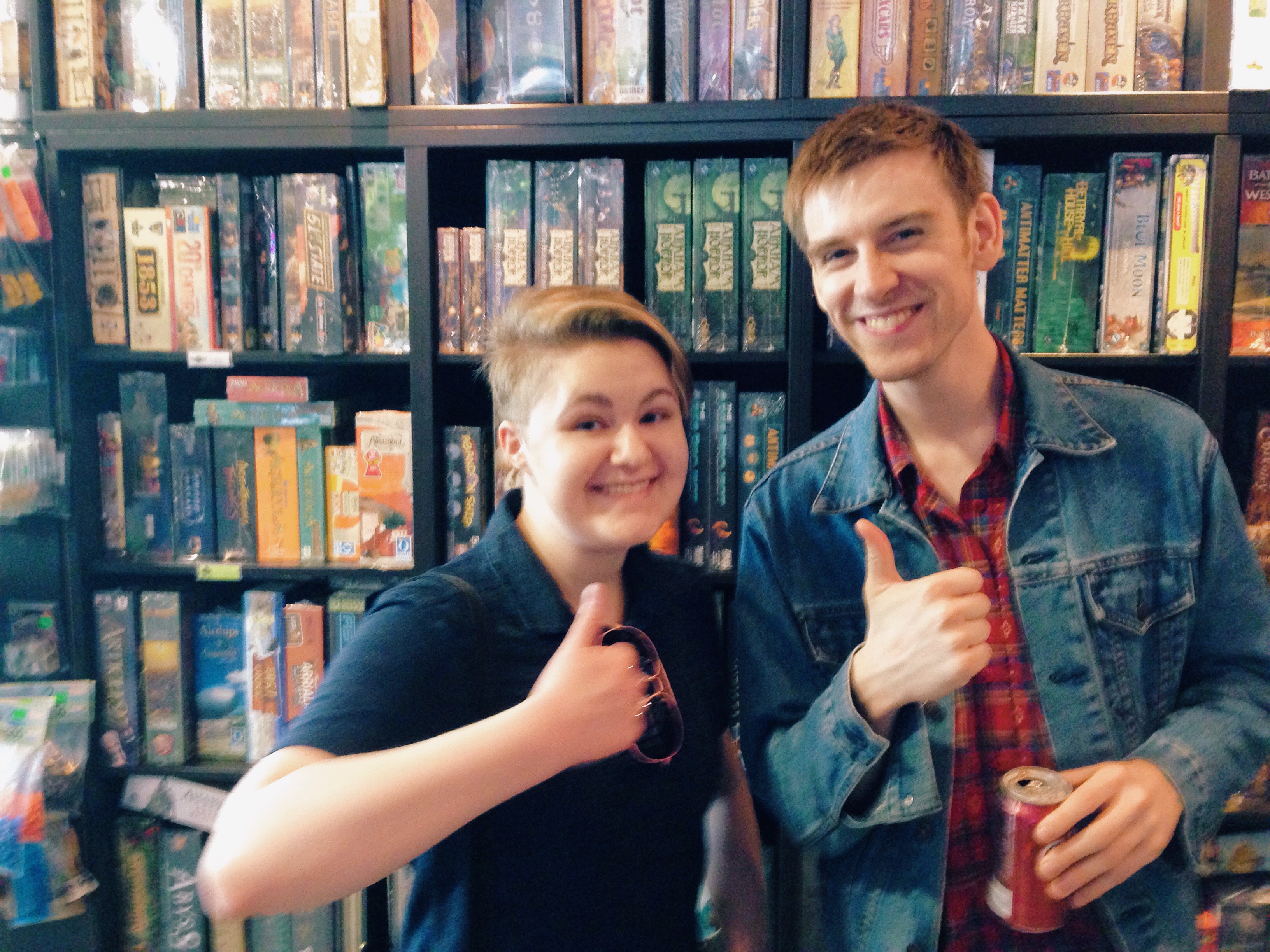
Cousin Remy with Jesus Christ
My second outstanding memory was split over two days spending it out and about with my cousin Remy and Jesus Christ. The first night, we ended up going to CC’s on a night when it was weirdly busy, and having a couple of those small town/gay circles are small moments of serendipity that made me seem cooler/more of a regular than I really am. The second day we spent walking up and down Mississippi after a perfect dim sum breakfast.
Wed-ness-day
I woke up and made my cousin breakfast. I got a chance to talk to Luke Skywalker for a little bit, we’ve both been busy. She gave me a little bit of shit for feeling like I hadn’t had my “quality time” with her, but then we had a classic conversation over IM later in the day so I’m calling that even. Made it in to work on timeish, sleptwalked through my day– the less said the better– and made it home to veg out and try and get back to normalcy. I had a whole bunch of things I wanted to talk about but I don’t even care anymore and I’m eager to try again tomorrow.
My grandmother was a great lover of talking about her illnesses. I found it very boring, so I’ll shut up now.
So, I guess I should be careful about shutting the door on a day before it’s finished. After yesterday’s perfunctory update, my sister chatted me which turned into an hour-and-a-half conversation about motivation, personal growth, what it means to finish things and finish things well, and explore some of the personal revelation/resolution territory that I’ve been in for the past week. We discussed Carol Dweck’s Mindset, which has been my jam over the last six months. It was strange to see her come at some of the same problems that I worried about as a student. I don’t think I’m that much further along in untangling my own human contradictions than she is, but it was interesting to hear her articulate ideas that I’ve had before but now think of as dead ends. For example, I no longer think about my own “motivation” or “laziness,” and tend to see my good and bad habits and desired and undesired behaviors as a product of feedback that feels good or other conditions. That’s really wordy: basically, I’ve stopped beating myself up about being lazy when there is another obvious explanation, like fear or lack of feedback, or lack of self-confidence.
One of my goals for the new year was to work on the relationship I have with my brother and sister, and I am so happy that we are all talking right now.
I slept in and was a little late getting in to work in the morning. Our work phone has been down for three weeks—it’s so embarrassing that there seems to be no person in the whole organization with the combination of competence and authority to get a simple thing resolved—and I was so demoralized to be at work. It’s been a rough winter after a rough summer, and I have so little confidence in my workplace right now I’m starting to make myself crazy with how much I want a new job. As I was setting up the room for the day, I called my mom. I started to talk about where my head has been with trying to give myself room to dream of new possibilities (I know that’s all very vague, but I’m not yet ready to write even semipublicly about it yet). It ended up being a very raw and open conversation about some of the things that had happened to me as a teenager that made me a much more fearful person than the fearless child I had been. I got very emotional when she said to me that she thought that I deserved to go after what I wanted, to chase after dreams.
I got very excited about Portland’s first Dumpling Week. I’m still waiting to see if it’s going to be affordable, the only reason I could try Burger Week burgers is that prices were set at $5. One of the commenters on the Facebook announcement remarked on the fact that there were no restaurants east of 82nd on the list. [For out of towners, the area of Portland east of 82nd Avenue is where most of the recent Asian immigration has moved to.] At first, I resisted that critique, because its clearly an effort to support a fine dining scene, and it just doesn’t bother me that restaurants in a certain cost range, fanciness, and food aesthetic were selected to participate. At the same time, I thought about how the cruelty of this kind of appropriation is that the white majority sees a subcultural product/object/tradition/design, copies its most superficial aspects in a game of cultural telephone, then siphons away the profits from that subculture. But then I was thinking that a) the idea that any one culture could own a food form like the dumpling is ludicrous. b) the dumplings are just not the same. I understand wanting to identify with the romanticized family restaurant that’s making grandma’s dumplings and nobody cares and the big bad white haute cuisine restaurant across the river makes the same thing and everybody goes apeshit. But that’s not reality. The reality is that those restaurants have completely different ways of communicating about food, sourcing ingredients, presentation, restaurant design, and pretending like all that stuff isn’t important or meaningful is silly. Nevertheless, I’ve been thinking about it all day and don’t feel like I have an “answer.”
Speaking of race and culture, I was hit with two very interesting pieces that dealt with race and classical music in a way that made my soul hurt a little bit. The first was an essay on Wagner and anti-Semitism. I’ve never liked Wagner, there’s plenty of other composers to listen to, I find most of his aesthetic very creepy, and there’s something about his arrogance at claiming that all people must love his music that makes me resist it. Anyway, the choice that the essay tries to force is: either you believe that abstract music, just sound, has the ability to convey a spiritual message, in which case Wagner’s music itself, even that without words, is anti-semitic and abhorrent. Or, as much as we talk about why we love the music, music is incapable of carrying that kind of message and to speak of it as though it is is deceptive/cultish. Read it, if any of that sounds interesting. The second was a Jezebel post about a black woman that had a racist interaction with an older white patron at the Met during a production of Aida. The interaction, whatever. Racist, and shameful that she got no support from the ushers, but racist individuals can be rude anywhere. The part that broke my heart was that she is so completely right about the racist casting conventions of major opera houses. They are decades behind film and TV, neither of which are particularly good at imagination and casting or representation. The other thing that upset me is that if that happened to me, I would never go back.
Work was fine. I lost steam throughout the day, and by the end of the day I was completely burnt out from feeling sick. I got home and downloaded a bunch of new music to listen to, but mostly just dozed. Hopefully tomorrow isn’t too bad.
I went for a walk through a historic graveyard. Most of the people seemed to be dead before the 1940’s, although there were some random 00’s scattered amongst the pioneers. The graveyard in my hometown is beautiful, though it has a little bit of a sterile, David Hockney quality, all flat lawns and sunlight and palm trees. The dead find their rest and, like the living, are rarely bothered by the weather.
The Oregon graveyard is scarred by the weather. Grave markers sink quietly into the uneven ground, while more ostentatious markers are overtaken by moss.
The most interesting feature of the cemetery were large rococo stelae in the shape of trunks, complete with gnarled bark and forest creatures. It reminded me of the pioneer identity that must have been so important to previous generations of Oregonians–I am the worst kind of outsider, a Californian–, an identity that I don’t really see in the culture here, except in museums and school names. I was struck by its tackiness and its idiosyncrasy: I didn’t imagine that the person who could afford to be buried in the city and have a person-height memorial was the coonskin hat wearing type, and at the same time, it’s hard to imagine anything like it anyplace else.
My mind wandered to the tension between the local and the universal. I’m one of those high culture types. I believe, sincerely, that great culture can come from anywhere and be an asset to the world. Japanese film. Tequila. Gumbo. Whatever. One of the things that eats at me, though, is that it is exactly my type of person that is the most threatening to folk cultures, to local variation, to art forms not yet recognized as such.
There seems to be a life cycle: a culture forms as a response to change. That culture challenges baseline assumptions of existing cultural forms. Those existing forms have already achieved legitimacy, so culture defenders (again, I think of myself as one of them) form ranks to protect them. The new form hangs on. The new form becomes popular because of its newness. The new form becomes old, but has built up a body of practitioners and ideas about itself. The culture defenders recognize the wealth of culture that has built up, and incorporate it into existing patterns of cultural presentation/prestige. This hybrid form becomes part of the world culture.
For that life cycle to complete itself requires that I have a shadow twin. Somebody that believes the local/new/yet-unrecognized culture is legitimate in and of itself. That rejects the influence of the wider culture as intrusion. One of the things that most difficult for me to accept is that perhaps the perfect outcome is that we both be in balance, that neither one achieves dominance over the other. Too much high culture, and the idiosyncrasies of the local culture become ironed out, homogenized. Too much of the local culture, and it dies with its last practitioner, or never evolves in complexity in response to the mixture of other cultures.
Portland is going through a bit of a high culture moment. Its aspirations, in its restaurants, art scene, music culture, is to be a “world class” city. But where does that leave the pioneers? Are they present with us, in mason jars of bourbon drinks, in the fresh local produce and heritage breeds featured in its restaurants, in the genderfuckery and tolerance for experiment in its art scene? Or are they dormant, preserved in the cold earth, waiting to take their place as grandparents of the future city?
Big reading month for me. Here’s the good, the bad, and the ugly, with some commentary. I get apathetic about rewriting what is easily Googleable, so no plot summaries. Unreservèd recommendations are marked with a star.
The Little Way of Ruthie Leming – Rod Dreher
A truly unique project. Dreher’s book rarely strays beyond the borders of the small Louisiana hamlet in which he was raised and his sister lived, but it manages to be at once a small book about the complex relationships between siblings and a large book, a synecdoche of America’s relationship to the rest of the world. Dreher made me stop often to consider the way that the dynamics and attitudes he describes have played out in my own life. It was also consistently frustrating to me, as some of the insights that Dreher captures are so right, and others betray the same lack of flexible thinking and imagination that he sees as missing in his sister and father. Go forth and read this book.
Right on the border between sci-fi and fantasy. If you look at a plot summary and think you might be interested, you’ll probably like it. If it sounds like it’s not for you, you’re probably right.
Bill Carter’s 1994 account of the Carson-Leno-Letterman Tonight Show saga, The Late Shift has become one of the canonical pieces of television writing and reportage. I haven’t read it, but I thought I would have more interest in this second book, because I remember the media nuttiness surrounding Conan O’Brien at NBC. Reading the book, I became aware of two things. First, I just care less about everybody involved in this story than I thought. Second, disciplined academic writing has spoiled me for easy narratives, characterizations, and explainations. After yet another TV executive’s negotiating style explained by their hardscrabble Brooklyn roots, I said fuck it and dropped the book.
We The Animals – Justin Torres
One of the most intriguing debuts I’ve read. I hated this book when I finished it. I thought the ending was so cheap, so out of keeping with the rest of the novel. It was like watching somebody construct something amazing, then seeing them turn on the project and burn it down. Once I calmed down from that initial emotional reaction, I was able to consider that, no, it’s not the same thing as burning it down. The first three-quarters of the book are still great. Torres’ prose (prose poetry?) shows either stylistic precocity or stylistic vapidity. This is one of the few books these days that I wish would have a better constructed plot. The structure of the book is very loose, either a novel, novella, short story cycle, fictional memoir, or vignettes, depending on how you feel about it. I personally think its a fantastically successful short story cycle, and a poor novel. I eagerly await either Torres’ first volume of poetry or his third novel.
I was excited to read this book because Soehnlien’s The World of Normal Boys, which I read a couple of years ago, is a true masterwork. While not breaking from the model established by Edmund White’s A Boy’s Own Story, Soehnlein’s specificity of character and setting elevates it above the many realization and coming out stories that are staples of gay lit. You Can Say You Knew Me When, about a self-destructive 30something gay in San Francisco discovering himself and shit, is not nearly as good. It was fine. If you’re like me, and will read any half-decent piece of trash if there are gay people in it, go ahead and pick it up. Otherwise, there’s only about three pieces of real interest. 1. The main character’s encounter with a rough-around-the-edges 19 year-old perfectly captures the appeal of rough trade. 2. The description of pre-90’s tech bubble craziness has come back around and become relevant again in this day of billion dollar aquisitions. 3. The main character’s father is compassionately portrayed, and is interesting and plausible as a person who had a bohemian youth and became more conservative in later life.
Reading this book is like listening to the filthy gay uncle you never had hold court. So there are bound to be great stories here (my favorite involved a one eyed, alcoholic, lesbian stripper named Zorro) and some sections that put you to sleep.
Absurd book written by a gay club promoter that proves that endless fucking in New York is not, in itself, engaging absent any other point of interest.
Far From The Tree – Andrew Solomon
To me, Andrew Solomon’s project, which you can learn about in compressed form in this TED talk, boils down to this: what does the “normal” parent-child relationship look like when defined as the opposite of its variants? To that end, Solomon looks at situations where children best thrive by developing identity through peer relationships and opposed to familial relationships (deafness, dwarfism, homosexuality); where emotional relationships cannot be reciprocated (autism, multiple disabilities); where meaning of the child to the world shouts down meaning of the child to its parents (prodigies, criminals). The miracle of this book is that Solomon manages to balance on the knife’s edge between detachment and compassion towards his subjects, and has created one of the few recent pieces of writing that I might call wise. His prose has a razor sharpness to his conservatism of meaning and precision of language, and the through-line of his logic is consistent, and strong. He presents factual information straightforwardly, both communicating the best of what we know about these conditions while acknowledging that the science is in its infancy. At the same time, he is respectful of his subjects and their constructed identities, while refraining from adopting their communities’ jargon unless it edifies. This is not an easy read. The prose is dense, and because it is so carefully written it reads slow. And in focusing on this cohort of families, a major secondary theme that runs through the book are the profound bioethical questions that are going to come, with fury and anger and disruption and casualties, to our world.
American in Paris memoir. I was expecting a little more. Tone was a little too Erma Bombeck/Sedarisy, his insights about the differences in American and French national culture were interesting, but a little too few and far between.
Not only has this memoir been a breakout hit in the last two years, but Strayed is a hometown hero here in Portland. I thought the book was pretty good, mostly because Strayed has a distinctive voice, and is good company. After finishing the book, I began to explore some of her Dear Sugarcolumns, and I can see how this book would be of interest for those who are interested in how she cultivated her unique, and uniquely precious, moral sense. While I am mostly positive about the book, the material in it is half nature writing about the settings Strayed encountered on the Pacific Coast Trail, and half grief memoir about the loss of Strayed’s mother, and I thought both suffered for the attention given to the other. I found myself contradictorily wishing Strayed had given more time to the aftermath of the grief process, and more closely described her process of leveling out, while at the same time wanting her to take a little more time with the wildnerness locales she passed through rather than just talking about her condition on the trail.
Another straight teen romance in the vein of John Green’s Looking forAlaska. My pet theory about books like this is that it is an unintended consequence of the discovery of the gay YA market. Every one of Park’s (male protagonist) character notes—his love for new wave and punk, distance from authoritarian father, picked on at school—seem swiped from an Alex Sanchez or David Levithan book from ten years ago. Straight is the new gay.
Like one of my other favorite living writers, David Mitchell, Saunders is a profoundly moral writer that never moralizes. Though a couple of stories in this collection did not affect me profoundly, those that did kept me both at complete physiological attention to discover where the plot would go, and with a incessant lump in my throat as Saunders captures just how cruel we can be to each other, and how improbably kind.
A better than average book that made a worse than average movie. Heim, with subtlety and empathy, explores the complicated role that sexual abuse plays in the formation of one gay man’s identity. Very dangerous subject to tackle.
Big reading month for me. Here’s the good, the bad, and the ugly, with some commentary. I get apathetic about rewriting what is easily Googleable, so no plot summaries. Unreservèd recommendations are marked with a star.
A truly unique project. Dreher’s book rarely strays beyond the borders of the small Louisiana hamlet in which he was raised and his sister lived, but it manages to be at once a small book about the complex relationships between siblings and a large book, a synecdoche of America’s relationship to the rest of the world. Dreher made me stop often to consider the way that the dynamics and attitudes he describes have played out in my own life. It was also consistently frustrating to me, as some of the insights that Dreher captures are so right, and others betray the same lack of flexible thinking and imagination that he sees as missing in his sister and father. Go forth and read this book.
Right on the border between sci-fi and fantasy. If you look at a plot summary and think you might be interested, you’ll probably like it. If it sounds like it’s not for you, you’re probably right.
Bill Carter’s 1994 account of the Carson-Leno-Letterman Tonight Show saga, The Late Shift has become one of the canonical pieces of television writing and reportage. I haven’t read it, but I thought I would have more interest in this second book, because I remember the media nuttiness surrounding Conan O’Brien at NBC. Reading the book, I became aware of two things. First, I just care less about everybody involved in this story than I thought. Second, disciplined academic writing has spoiled me for easy narratives, characterizations, and explainations. After yet another TV executive’s negotiating style explained by their hardscrabble Brooklyn roots, I said fuck it and dropped the book.
One of the most intriguing debuts I’ve read. I hated this book when I finished it. I thought the ending was so cheap, so out of keeping with the rest of the novel. It was like watching somebody construct something amazing, then seeing them turn on the project and burn it down. Once I calmed down from that initial emotional reaction, I was able to consider that, no, it’s not the same thing as burning it down. The first three-quarters of the book are still great. Torres’ prose (prose poetry?) shows either stylistic precocity or stylistic vapidity. This is one of the few books these days that I wish would have a better constructed plot. The structure of the book is very loose, either a novel, novella, short story cycle, fictional memoir, or vignettes, depending on how you feel about it. I personally think its a fantastically successful short story cycle, and a poor novel. I eagerly await either Torres’ first volume of poetry or his third novel.
I was excited to read this book because Soehnlien’s The World of Normal Boys, which I read a couple of years ago, is a true masterwork. While not breaking from the model established by Edmund White’s A Boy’s Own Story, Soehnlein’s specificity of character and setting elevates it above the many realization and coming out stories that are staples of gay lit. You Can Say You Knew Me When, about a self-destructive 30something gay in San Francisco discovering himself and shit, is not nearly as good. It was fine. If you’re like me, and will read any half-decent piece of trash if there are gay people in it, go ahead and pick it up. Otherwise, there’s only about three pieces of real interest. 1. The main character’s encounter with a rough-around-the-edges 19 year-old perfectly captures the appeal of rough trade. 2. The description of pre-90’s tech bubble craziness has come back around and become relevant again in this day of billion dollar aquisitions. 3. The main character’s father is compassionately portrayed, and is interesting and plausible as a person who had a bohemian youth and became more conservative in later life.
Reading this book is like listening to the filthy gay uncle you never had hold court. So there are bound to be great stories here (my favorite involved a one eyed, alcoholic, lesbian stripper named Zorro) and some sections that put you to sleep.
Absurd book written by a gay club promoter that proves that endless fucking in New York is not, in itself, engaging absent any other point of interest.
To me, Andrew Solomon’s project, which you can learn about in compressed form in this TED talk, boils down to this: what does the “normal” parent-child relationship look like when defined as the opposite of its variants? To that end, Solomon looks at situations where children best thrive by developing identity through peer relationships and opposed to familial relationships (deafness, dwarfism, homosexuality); where emotional relationships cannot be reciprocated (autism, multiple disabilities); where meaning of the child to the world shouts down meaning of the child to its parents (prodigies, criminals). The miracle of this book is that Solomon manages to balance on the knife’s edge between detachment and compassion towards his subjects, and has created one of the few recent pieces of writing that I might call wise. His prose has a razor sharpness to his conservatism of meaning and precision of language, and the through-line of his logic is consistent, and strong. He presents factual information straightforwardly, both communicating the best of what we know about these conditions while acknowledging that the science is in its infancy. At the same time, he is respectful of his subjects and their constructed identities, while refraining from adopting their communities’ jargon unless it edifies. This is not an easy read. The prose is dense, and because it is so carefully written it reads slow. And in focusing on this cohort of families, a major secondary theme that runs through the book are the profound bioethical questions that are going to come, with fury and anger and disruption and casualties, to our world.
American in Paris memoir. I was expecting a little more. Tone was a little too Erma Bombeck/Sedarisy, his insights about the differences in American and French national culture were interesting, but a little too few and far between.
Not only has this memoir been a breakout hit in the last two years, but Strayed is a hometown hero here in Portland. I thought the book was pretty good, mostly because Strayed has a distinctive voice, and is good company. After finishing the book, I began to explore some of her Dear Sugarcolumns, and I can see how this book would be of interest for those who are interested in how she cultivated her unique, and uniquely precious, moral sense. While I am mostly positive about the book, the material in it is half nature writing about the settings Strayed encountered on the Pacific Coast Trail, and half grief memoir about the loss of Strayed’s mother, and I thought both suffered for the attention given to the other. I found myself contradictorily wishing Strayed had given more time to the aftermath of the grief process, and more closely described her process of leveling out, while at the same time wanting her to take a little more time with the wildnerness locales she passed through rather than just talking about her condition on the trail.
Another straight teen romance in the vein of John Green’s Looking forAlaska. My pet theory about books like this is that it is an unintended consequence of the discovery of the gay YA market. Every one of Park’s (male protagonist) character notes—his love for new wave and punk, distance from authoritarian father, picked on at school—seem swiped from an Alex Sanchez or David Levithan book from ten years ago. Straight is the new gay.
Like one of my other favorite living writers, David Mitchell, Saunders is a profoundly moral writer that never moralizes. Though a couple of stories in this collection did not affect me profoundly, those that did kept me both at complete physiological attention to discover where the plot would go, and with a incessant lump in my throat as Saunders captures just how cruel we can be to each other, and how improbably kind.
A better than average book that made a worse than average movie. Heim, with subtlety and empathy, explores the complicated role that sexual abuse plays in the formation of one gay man’s identity. Very dangerous subject to tackle.



 hammer & jack