
My 1,300 Page Weekend

I always feel bad when I don’t update regularly, like I am letting down the four people that read this blog. Today, I have my reviews of a couple of books that I have read this past weekend and half-week. As the good people at This American Life would say, a book report in three acts:

1.

I am incredibly privileged to attend Reed College. As a prospective student looking at different schools, I tended to pay way too much attention to features of the school that just don’t apply to me. For example, I still brag about Reed’s science programs, even though I really don’t want to complete the science requirement and resent the department for siphoning off music funds.

One feature of the school that I am glad now applies to me is the MILL, or comic book library and reading room (yeah, we know). It is an amazing room filled with extensive collections of golden-age franchises and a surprising depth of non-Japanese modern comics. I spent five hours of my Sunday reading the first volume of the complete collection of The Sandman. I don’t really want to go too much into it here, because I plan on giving a full review once I finish the omnibus. However, it does fit into the unintended theme of the post: religious speculative fiction.
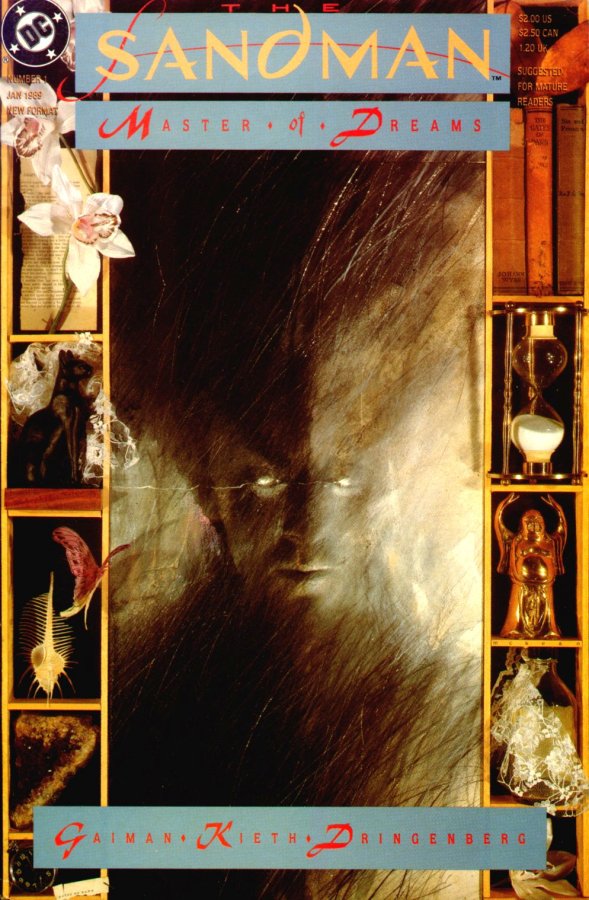
sandman_no1_modern_agecomiccover

2.

Every once in a while, I fall in love with the story of the creation of a work more than the merits of the work itself. That is why I was so happy that Ken Follett’s novel The Pillars of the Earth was so entertaining and well written. I really love the idea of a pulp spy novel writer publishing a 600+ page historical novel set in 12th Century England and having it take off. I understand those who might not consider it highbrow literature; it is extremely plot heavy and the occasional winks to the modern reader in conversations among the characters, but I found it thoroughly enjoyable and well worth my time. Follett does an incredible job of dramatizing the scale and glory of cathedrals. I found myself doubting the idea that a cathedral would be completed within the lifetime of any person, but that only underscores the sheer ambition of those that were constructed over centuries.

It also made me a little sad that we really have evolved as a global society beyond such works on that scale. Can you imagine a building project that employs hundreds of workers for centuries being started now? The Notre Dame in Paris took 300 years to complete. The new cathedral in Los Angeles was built in 8.

3.

Anathem by Neal Stephenson is probably the largest-scale work I have ever read. The size of it is intimidating; the final page count is 890. Stephenson not only creates his own universe within the pages of the books, but four parallel universes that touch it. Every page feels like it is the synthesis of hundreds of pages of philosophical and mathematic research read while the book was being written.

Stephenson is a little bit like the Eddie Izzard of the science fiction genre. Like Izzard, he uses the tropes and conventions of his form, but he makes it such an intellectual exercise that it feels like nothing you’ve ever read before, even if its about, you know, aliens. Many times I found myself unable to distinguish between real philosophical ideas and the fiction part of science fiction.

Like everything else, I am a little bit late to the party on this one, but if you feel like you can keep up with the ideas in the book, and you have the time to read an almost 900 page novel, I reccomend it.

Book Review – Blue Like Jazz

I didn’t exactly hide the reputation of Reed College from my parents when I was doing college applications, per se. I just emphasized certain aspects of its reputation more than others. To be fair, Reed didn’t make it easy on me. The day that I called my parents to tell them that I had made my decision, the news broke that a Reed student had died of a heroin overdose. I knew that my parents had a lot of confidence in me to make good decisions, but I also knew better than to emphasize its eternal presence on the “Students Ignore God On A Regular Basis” list or its toleration of experimentation to my conservative Christian parents. Imagine my surprise, then, when my mother told me that all of her friends had already heard of Reed College through Christian writer Donald Miller’s book Blue Like Jazz: Nonreligious Thoughts on Christian Spirituality.


In theory, this should have been the perfect book for me. I grew up in the church, but unlike myriad other gays that grew up in the church, I don’t hate it, and I don’t hate Christians. I like most Christian people, and still consider the people in the church that I grew up in part of my family, even though I think very differently than I do now. It’s one of life’s little ironies that all of the Christian education that I went through as a child worked. I carry the Bible in my heart exactly like they wanted; I can no more divorce it from my psyche than change the color of my eyes. I am comfortable with that, my problems with Christianity rarely lay in the Bible. I left the church because once I left for school I was confronted with people that made lifestyle choices and thought in ways that the church had always said would lead to immorality, and found that I could not condemn them. Once I realized that I was learning more about universal love and acceptance in a dead secular academic environment than in church, I had to leave.

Continue reading “Book Review – Blue Like Jazz”

Best Week Ever, or at least a different one

So, for the last couple of weeks I have been without a computer, and therefore constant internet access. Obviously, I cannot do a regular post today, because I don’t really have anything interesting from my two days of browsing, but I thought I would write about what I discovered about myself during a seemingly simple change in routine. It is also my explanation of why I am giving up Twitter.  Continue reading “Best Week Ever, or at least a different one”

Where did all the Russians go?

The review that I wrote yesterday reminded me about another book that I recently finished, The Mission Song, by John LeCarré. By chance, I finished the book a couple of days after watching the perplexingly mediocre new Bond installment, Quantum of Solace.

I was really intrigued by the new directions that these two franchises have taken with this new century. Le Carré was the prototypical Cold War spy novelist. James Bond was the over-the-top secret agent obsessed with his nemesis, S.P.E.C.T.R.E. And yet the Cold War is over. Teenagers today were barely alive during the fall of the Wall, and it will be many years yet before people will begin to read Cold War novels as historical fiction. Where then do writers go when they have built their entire careers on books that are factually and fashionably out of favor?

Continue reading “Where did all the Russians go?”

Book Review: The Appeal

As I was browsing books at a Hudson News in the Portland, Oregon airport terminal, I smiled to myself because it was the first time that I had ever bought an “airport book” to read while traveling in an actual airport. Don’t get me wrong, I have read many such books. They are fairly short, easily digestible, and have brisk enough pacing that every cover editor feels the obligation to bandy around the workhorse clichè “page-turner.” There was a particularly fruitful stretch when I was between the ages of 11 to 14 where I must have read upwards of 600 of them; Robin Cook and Michael Crichton (may he rest in peace, that’s a different post altogether) scientific thrillers, Tom Clancy military thrillers, Ian Fleming and Clive Cussler action-adventure novels. Then there were the mysteries. I read all of the current writers, Janet Evanovitch, J.A. Jance, Patricia Cornwell, Lilian Jackson Braun, Carolyn Hart. I read all of the old series: Nero Wolfe, Hercule Poirot, Sam Spade, Philip Marlowe. Then I discovered the magic of British mysteries: G.K. Chesterson, Agatha Christie, P.D. James…

I just drifted completely off track. The point I want to make is that I have read more than a few legal thrillers in my day. I have even read more than a few written by John Grisham. Continue reading “Book Review: The Appeal”